


By Suresh Unnithan, editor@apnnews.com
In West Bengal’s 2026 Assembly elections, held in two phases on April 23 and 29, voters turned out in record numbers — nearly 92% — demonstrating their continued faith in the democratic process. Yet, beneath the high participation lies a troubling disconnect. While ordinary citizens grapple with pressing livelihood issues, the political contest between the ruling Trinamool Congress (TMC) and the principal opposition BJP often appears centred on retaining or capturing power, with massive resources deployed in the process.
Ground Realities Facing the People
Young people in the state are desperately seeking stable jobs. Many educated youth register for unemployment allowances, reflecting challenges in gainful employment despite official figures showing a relatively moderate overall unemployment rate. Farmers require reliable and timely supply of fertilisers along with remunerative Minimum Support Prices (MSP) to sustain their livelihoods. Women, especially in rural and low-income households, depend on consistent access to subsidised LPG cylinders for clean cooking, as price fluctuations or supply disruptions add to household burdens. These are not peripheral concerns but central to the daily struggles of millions.
Economic Indicators Paint a Sobering Picture
West Bengal’s economic status underscores the urgency of addressing these issues. The state’s per capita income stands at approximately ₹1,71,184 (for 2025-26), which is nearly 20% below the national average. This places Bengal lower in the ranking among Indian states, trailing behind several others in economic well-being. Literacy rates remain respectable at around 76-77%, slightly above the national average, but this human capital is not translating into adequate opportunities, particularly for the youth.
The state’s Gross State Domestic Product (GSDP) has grown, with projections around ₹20-21 lakh crore, yet structural challenges persist. High levels of disguised unemployment in agriculture and limited industrial expansion mean that growth does not sufficiently translate into broad-based prosperity. Most concerning is the fiscal health: the state carries a substantial debt burden, estimated at around 38% of GSDP. Annual market borrowings run into tens of thousands of crores, with significant portions of the budget allocated to interest payments and debt servicing. This leaves fewer resources for productive investments in jobs, infrastructure, agriculture, and social services.
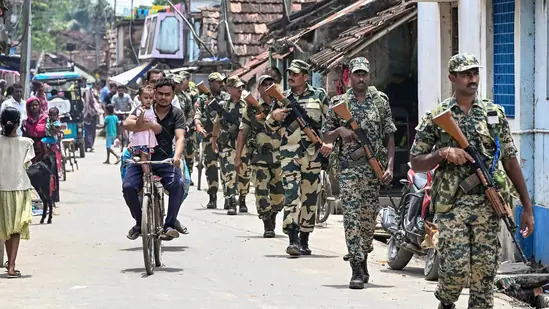
In this context, the heavy deployment of over two lakh central paramilitary forces during the elections — with around 70,000 remaining post-polling — raises important questions. While authorities cite the need to ensure free and fair polling amid past tensions, one must ask whether a democratic exercise in a state not facing any external conflict or widespread emergency truly requires such an occupation-like security arrangement. Schools functioning as temporary bases and streets under heavy security presence divert attention and resources from governance priorities.
The Self-Interest in Power Politics
This contrast highlights a deeper issue: the priorities of political leaders. Those in power focus on retaining control of the state machinery, while those outside seek to capture it. Both major parties invest enormous energy, cadre mobilisation, and financial resources in the electoral battle. Campaigns involve promises tailored to immediate voter concerns, yet the underlying drive often seems to be the perks and influence that come with office.
Elected representatives and ministers benefit from salaries, allowances, housing, travel facilities, medical benefits, and pensions — all funded by public money. The state assembly and government apparatus involve significant expenditure on maintaining offices, staff, security, and privileges for those in power. Meanwhile, per capita spending on ordinary citizens — in areas like health, education, skill development, and direct welfare — faces constraints due to the high debt servicing and fiscal pressures. When a large chunk of resources goes towards sustaining the political and administrative class, and towards managing intense political contests, the capacity to address youth unemployment, farmer distress, or women’s basic needs gets compromised.
Incidents like reported tampering in some booths leading to repolls, post-poll dharnas at strongrooms, and clashes in various districts further illustrate how the process becomes a high-stakes turf war rather than a smooth exercise in public accountability. The Election Commission’s interventions become necessary precisely because trust between parties and in the system remains low.
The public, caught in the middle, continues to fund this entire ecosystem through taxes and by bearing the opportunity costs of diverted governance focus. They provide the votes, bear the economic hardships, and hope for better outcomes. Yet, after every election cycle, the fundamental challenges — creating quality jobs, supporting sustainable agriculture, ensuring reliable public services, and reducing the debt burden for future generations — persist with varying degrees of attention.
Political leaders on all sides project themselves as servants of the people. However, when power becomes an end in itself, and parties prioritise cadre loyalty, organisational strength, and personal or group influence over long-term state development, it reflects a certain self-interest. The massive security arrangements, the spectacle of allegations and counter-allegations, and the continuation of high-stakes politics even as debt mounts and per capita incomes lag, point to a system where the interests of the rulers often take precedence over rapid improvement in the condition of the ruled.
Time for Greater Public Awareness
The impressive voter turnout is strength of Indian democracy. But sustained progress requires citizens to look beyond election-time promises and evaluate performance on measurable outcomes: reduction in youth unemployment and migration, better farm incomes, improved industrial investment, fiscal prudence, and efficient delivery of services like LPG and healthcare.
When the public recognises how resources are allocated — substantial spending on maintaining the political class and managing power contests versus the pressing needs of jobless youth, struggling farmers, and households managing daily expenses — pressure for change can build. Leaders who treat the state as a prize to be won or retained, while the public bears the costs in the form of slower economic mobility and rising liabilities, risk losing credibility over time.
Bengal 2026 serves as a reminder. Democracy functions through elections, but its success depends on whether those elected prioritise public welfare over perpetuating their hold on power and associated privileges. The coming years will test whether the new government — whatever its composition — focuses on alleviating the real burdens of the people or continues the familiar cycle of power politics at the expense of genuine development.
The people of Bengal deserve governance that matches their participation and aspirations. Reducing the debt burden, creating opportunities that utilise the state’s literacy and human potential, and ensuring fiscal discipline so that more resources reach citizens rather than servicing past obligations or political machinery — these are the benchmarks that matter. Until political incentives align more closely with these goals, the gap between public needs and political priorities will remain a defining feature of the state’s reality.
Jai Hind. An aware and engaged citizenry remains the best check on self-serving politics.
*The author is veteran journalist of over four decades plus standing