


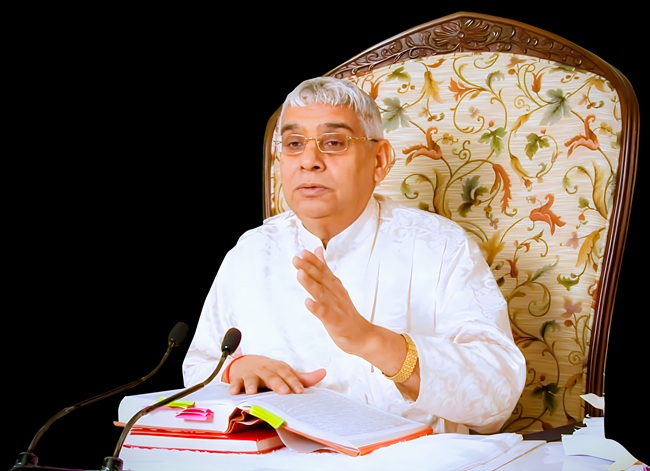
The first episode of Sant Rampal Ji’s scriptural debate examines the origins of Brahma, Vishnu and Mahesh, the identity of the Bhagavad Gita’s speaker, the claimed loss of a fifth Vedic section, and Biblical and Quranic accounts of creation.
The question, seemingly simple, reaches into some of the oldest explanations of creation. The familiar Hindu cosmological framework associates Brahma with creation, Vishnu with preservation and Mahesh with destruction. But in the first live episode of Sant Rampal Ji’s scriptural debate on October 3, 2026, that framework was placed under scrutiny. The programme argued that Brahma, Vishnu and Mahesh perform defined functions within the universe but are not the Supreme Creators of all existence. At the heart of the presentation was another claim: that the Vedic corpus originally comprised five sections, including a fifth section called Sukshma Ved, which was subsequently removed. The programme further argued that the Bhagavad Gita contains the voice of Kaal Brahm speaking through Krishna, rather than
Krishna speaking as the Supreme Being.
The case was built from passages in the Vedas, Puranas and Gita, alongside references to the Bible and Quran. Printed editions and translations were displayed as evidence.
A Public Case Built on Scripture
Sant Rampal Ji presented the episode as a public scriptural case, inviting viewers to judge the evidence. The sources named included Sukshma Ved, the four Vedas, the 18 Puranas, the Bhagavad Gita, Ramayana, Mahabharata and Bhagavata Purana. He also announced a ₹50 lakh challenge to anyone able to demonstrate an error in his presentation through scriptural evidence.
Rather than independently translating every Sanskrit verse, the programme examined existing
translations from recognised publications and interpreters. Where Sant Rampal Ji believed a translation altered a verse’s meaning, he offered an alternative based on his understanding of Sukshma Ved. The episode therefore made translation and interpretation themselves part of the debate.
The Claimed Missing Fifth Veda
According to the programme, the original Vedic corpus consisted of five sections: Rig, Yajur, Sama, Atharva and Sukshma. Sukshma Ved was not presented as a separately available manuscript, but as the fifth section of an original body of Vedic knowledge. The programme claimed that it contained complete knowledge of the Supreme Being, creation and liberation, and that Jyoti Niranjan, identified in the presentation as Kaal Brahm, removed or destroyed it.
The remaining four sections, according to the programme, were passed down as incomplete knowledge and later organised by Ved Vyas into the Rig, Yajur, Sama and Atharva Vedas known today. This claim forms a foundation for the programme’s wider argument that the existing Vedic corpus contains genuine knowledge but not the entirety of the original spiritual knowledge.
The Gita and the Question of Complete KnowledgeThe programme cites Bhagavad Gita, Chapter 4, Verse 34, which instructs a seeker to approach a realised teacher, ask questions and receive deeper knowledge. Sant Rampal Ji interprets this as evidence that the Gita does not itself contain complete spiritual knowledge: if it did, he argues, there would be no need to direct the seeker to a Tattvadarshi saint.
Yajur Veda, Chapter 40, Verse 10 is similarly presented as directing the seeker towards a wise or realised person for correct spiritual understanding. Together, these references are used to argue that the available Vedas and Gita contain true knowledge but not the complete method of knowing and attaining the Supreme Being. The programme further invokes the traditional description of the Gita as the essence of the Vedas, reasoning that if the four available Vedas are incomplete, their summary would likewise be incomplete.
A clip of Premanand Maharaj, stating that the Vedas have no human author and emerged from the breath of God, is used to support their divine origin and the view that Ved Vyas organised existing knowledge rather than authored it. The programme does not present the statement as an endorsement of its theory of the missing fifth Veda or Kaal Brahm. Similarly, statements attributed to the four Shankaracharyas are used to establish the relationship between the Vedas, Upanishads, Gita and Puranas, but not as endorsements of all the programme’s
wider conclusions.
Who Spoke the Bhagavad Gita?
The episode then addresses the identity of the Gita’s speaker. Sant Rampal Ji argues that the Gita was not spoken by Krishna in the conventional understanding, but by Kaal Brahm through Krishna’s body. Chapter 4, Verse 34 is used to discuss the completeness of spiritual knowledge, while Chapter 7, Verse 24 is central to the argument about the speaker. The programme interprets the verse as describing the speaker’s highest nature as unmanifest, while Krishna appears in the narrative as a visible, embodied figure. Its reasoning is therefore that the unmanifest Kaal Brahm spoke through Krishna rather than Krishna speaking as the Supreme Being in his own identity.
The programme explicitly acknowledges that no single verse literally states that Kaal Brahm entered Krishna’s body. Rather, that conclusion is developed by combining its interpretation of Chapter 7, Verse 24 with the wider theological framework. Chapter 2, Verse 53 is also cited in discussing the steadiness of a true yogi after moving beyond contradictory knowledge, but not as evidence identifying the Gita’s
speaker.
Scriptural Authority Over Religious Practice
The programme next turns to religious practice, citing Gita Chapter 16, Verses 23 and 24.
Verse 23 is presented as stating that a person who abandons scriptural instruction and acts according to personal desire attains neither spiritual perfection, happiness nor the supreme goal. Verse 24 is interpreted as establishing scripture as the authority for determining what should and should not be done. The programme therefore argues that rituals, mantras, worship methods and other practices should be tested against scripture rather than accepted merely because they are traditional, popular or widely followed.
It identifies the Vedas and Gita as primary authorities for spiritual practice, while treating the Puranas and Upanishads as useful for understanding deities and their positions, provided their instructions on practice agree with the Vedas and Gita. The episode also notes that Verse 23 specifically refers to spiritual perfection, happiness and the supreme goal, while extending that principle to the broader promises of peace, prosperity and liberation.
The Question of Brahma’s Origin
The central question is examined through the Devi Bhagavata Purana and Shiva Purana.
In the Devi Bhagavata Purana edition shown, Narada asks Brahma about the origin of the universe. Brahma calls the question extremely difficult and directs him to Vishnu. Brahma then describes emerging from a lotus while the universe was covered by water. Unable to see the sun, moon, earth, mountains or trees, he does not know how the lotus itself appeared. He searches for its source for a thousand years but fails to find its beginning or end. After being instructed to perform penance, he is told to create, yet remains uncertain about what he is supposed to create.
The programme interprets this as evidence that Brahma neither knows the universe’s origin nor fully understands his own. The same account describes Brahma encountering Vishnu reclining on Sheshnag. After Yoga Nidra departs, Vishnu awakens, and Brahma, Vishnu and Rudra appear before Adya Shakti, who assigns them creation, preservation and destruction. The programme interprets this as showing the three deities functioning within an existing cosmic order under a higher power. The Vidyeshvara Samhita of the Shiva Purana is then cited as presenting Vishnu as Brahma’s father, with Brahma emerging from the lotus at Vishnu’s navel. The programme uses the passage to argue that Brahma cannot be the first or Supreme Source of creation.
Creation of Beings and Creation of World
The episode resolves the apparent contradiction between Brahma being instructed to create and the claim that he is not the Supreme Creator by distinguishing between creation of beings and creation of the universe itself. It associates Brahma with rajoguna, Vishnu with sattvaguna and Shiva with tamoguna, referring to the Markandeya Purana. An analogy comparing these qualities to the smell of spices spreading from a kitchen illustrates the proposed mechanism of influence. Taken together, the programme argues that Brahma, Vishnu and Shiva perform assigned cosmic functions, while the creation of all universes belongs to a Supreme Being beyond them.
Rig Veda, Bible and Quran
The episode examines eight Rig Veda editions, focusing on Mandala 9, Sukta 54, Mantra 3; Sukta 86, Mantra 27; and Sukta 82, Mantra 1. Some translations are presented as describing a Supreme Being above all universes or as the all-producing source of creation. Other editions describe Soma as a substance passing through a filter or being mixed with milk. Sant Rampal Ji
argues that certain translations obscure references to the Supreme Being. The programme maintains that the original Vedic knowledge is correct but that some translations have
altered its intended meaning. It nevertheless acknowledges that establishing the accuracy of any translation would require independent examination of the original Sanskrit, grammar and established commentaries.
The presentation then turns to Genesis, citing the six-day creation account, the creation of humanity in God’s image, Genesis 3:22 and the multiple figures appearing in Genesis 18 and 19. It interprets these passages as suggesting a recognisable divine form and multiple supernatural powers, which it identifies with Brahma, Vishnu and Mahesh under a higher Brahm. The programme acknowledges that this identification is its own interpretation and is not stated directly in the Biblical text.
The Quran is examined through Surah Al-Furqan, Verses 52, 58 and 59. The programme interprets terms translated in some editions as “great” or “most aware” as references to Kabir or Kabiran, whom it identifies as the Supreme Being. Verse 59 is presented as describing creation of the heavens and earth in six days followed by the Supreme Being’s presence upon the throne, while Verse 58 is interpreted as directing seekers towards spiritually informed persons for deeper knowledge.
The Evidence Trail
The episode also discusses The Story of God with Morgan Freeman as a comparison of how scholars and thinkers approach the origins of the universe and nature of God. Sant Rampal Ji argues that some answers presented there are insufficiently grounded in scripture and offers his interpretation as an alternative. The documentary functions as a starting point for returning to the scriptural argument, rather than independent evidence for the programme’s claims.
By its conclusion, the episode has assembled a connected case: the Vedas originally had five sections; Sukshma Ved was the missing fifth section; the Vedas are divinely originated; the available scriptures do not contain complete spiritual knowledge; Kaal Brahm is interpreted as the unmanifest speaker of the Gita through Krishna; spiritual practices must conform to scripture; Brahma has an origin and is therefore not the Supreme Creator; selected Rig Veda translations point to a Supreme Being beyond the universe; and Biblical and Quranic passages are interpreted as supporting the same broader framework.
The programme promises a fuller account of creation in subsequent episodes.
For viewers, therefore, the debate is no longer merely whether Brahma created the universe. The deeper question is whether the scriptural passages presented actually support the conclusions drawn from them—a question that ultimately requires examination of the original verses, translations, context and competing interpretations. At the heart of the debate remains the question with which the episode began:
Who created Brahma—and what do the scriptures themselves say about the Supreme Creator?