


By Our Correspondent
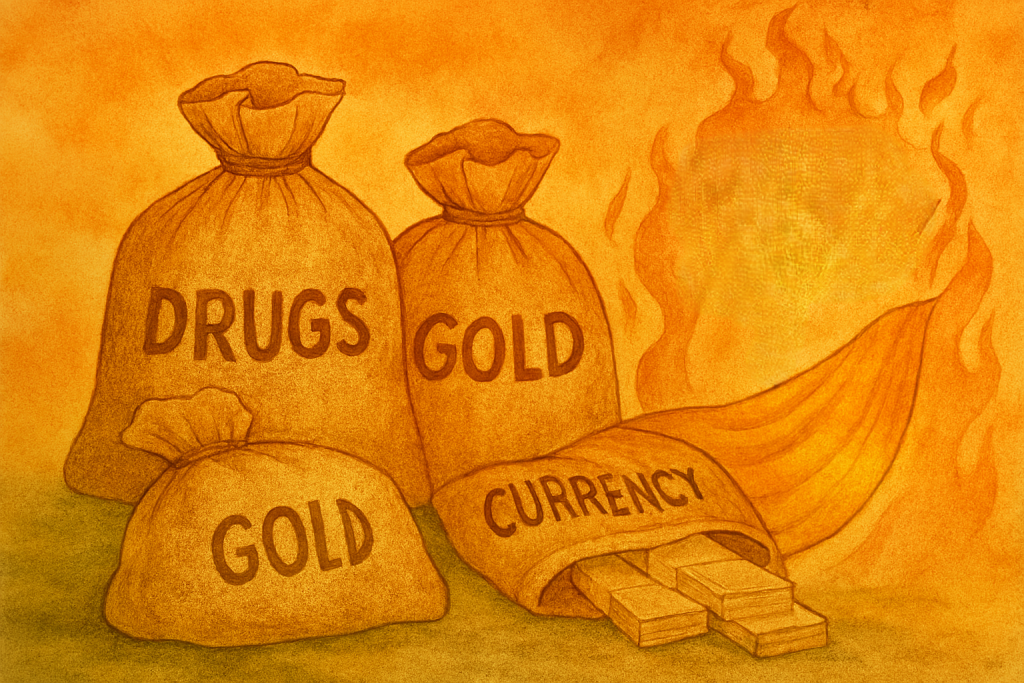
Kolkata: In the labyrinth of India’s security challenges, terrorism draws its sustenance not from ideology alone but from a triad of shadowy financial streams: illicit drug trafficking, gold smuggling, and black money circuits. These arteries pump billions into the coffers of outfits like Lashkar-e-Taiba (LeT) and Jaish-e-Mohammed (JeM), enabling everything from border infiltrations to urban bombings—and, as starkly demonstrated by the devastating car blast near Delhi’s iconic Red Fort on November 10, 2025, which killed at least eight people and injured over 20, the insidious activation of sleeper cells embedded in the heart of the capital. This brazen attack, investigated as a terror strike by “anti-national forces” with arrests already made in Kashmir, highlights how dormant operatives of Islamic terror modules, sustained by these illicit funds, can strike with lethal precision amid Diwali festivities. Afghan heroin and methamphetamine from the Golden Crescent, smuggled gold bars melted into untraceable wealth, and hawala-transferred black money—generated from crimes like drug sales and tax evasion—form a resilient ecosystem that launders terror funds with impunity. To decapitate the terror threat, India must cauterize these sources: choking drug routes, sealing gold inflows, and dismantling black money networks through rigorous anti-money laundering (AML) enforcement. Yet, as Financial Action Task Force (FATF) evaluations reveal, progress falters—rated “partially effective” in countering terror financing—often derailed by political compulsions that shield probes, dilute convictions, and prioritize alliances over accountability. Critics, including Amnesty International, decry how authorities weaponize these very laws against dissenters while high-profile cases languish amid interference.
This nexus came into sharp relief in September 2021 at Gujarat’s Mundra Port, where the Directorate of Revenue Intelligence (DRI) unearthed 2,988 kg of heroin disguised as talc stones, valued at ₹21,000 crore ($2.7 billion)—one of the world’s largest seizures. Shipped from Afghanistan via Iran’s Bandar Abbas and imported by Andhra Pradesh’s Aashi Trading Company, it exposed a syndicate blending narcotics with terror finance. Owners M. Sudhakar and G. Durga Purna Vaishali, arrested for a paltry ₹10-12 lakh commission, highlighted local enablers in a chain funding groups like LeT. Investigations by the National Investigation Agency (NIA) later linked the proceeds directly to LeT’s operations, with the agency opposing bail for accused in 2025 Supreme Court hearings, arguing the funds supported terror activities. By August 2023, 27 arrests had been made, including Afghan and Uzbek nationals, underscoring the international web. Mundra’s woes persisted: From 2020-2024, five seizures there—among eight in Gujarat—netted drugs worth ₹11,311 crore, including cocaine and tramadol, often linked to Afghan-Iranian networks. In May 2022 alone, 52 kg of cocaine was seized, leading to three arrests and a criminal complaint. A massive 3,004 kg heroin haul in another operation resulted in eight arrests, including four Afghans, one Uzbek, and three Indians, revealing sophisticated concealment in container linings. In 2024, an accused’s escape from custody during an Amritsar-to-Kutch transfer exposed procedural vulnerabilities, allowing the fugitive to evade a multi-agency manhunt.
Offshore busts amplified the threat, painting a picture of maritime smuggling as a terror lifeline. February 2024 saw 3,300 kg of narcotics (3,089 kg charas, 158 kg methamphetamine, and 25 kg morphine) seized near Porbandar, worth ₹1,300-2,000 crore, with Pakistani nationals implicating cross-border terror ties to LeT via Karachi routes. April 2025 brought 300 kg of methamphetamine (₹1,800 crore) dumped in the Arabian Sea near the International Maritime Boundary Line, tied to Pakistani smugglers whose vessel fled after jettisoning cargo to evade the Gujarat Anti-Terrorist Squad (ATS) and Indian Coast Guard. Another February bust nabbed 2,500 kg of hashish off Gujarat, detaining five Iranians; intelligence traced origins to Afghan poppy fields, potentially en route to Sri Lanka but with Indian terror cells as pit stops for diversion. These hauls, per UNODC, generate $500 million yearly for terror, laundered via hawala into black money pools—funds that buy weapons, train recruits, and sustain sleeper cells in Jammu & Kashmir and the Northeast.
Gold smuggling, equally insidious and intertwined with narco-routes, has ballooned to a ₹50,000-crore annual racket since 2020, exploiting price surges to ₹80,000 per 10 grams amid global volatility and festival demands. Over 3,005 cases in FY 2024/25 yielded 2.6 metric tons seized, but convictions remain abysmal—just 16 from 5,689 arrests—allowing kingpins to operate with impunity. DRI’s 2025 tally: 321 kg across 65 cases (₹406 crore), with Mumbai as a hotspot for melting and recasting. In October, “Operation Bullion Blaze” dismantled a syndicate, confiscating 11.88 kg and arresting 11 operatives running clandestine furnaces that converted raw smuggled gold into bars for hawala resale. Just last week, a major ring in Mumbai was busted, seizing ₹15 crore in assets and arresting 11, including the mastermind, who transformed imported contraband into jewelry-grade metal. Earlier, in March, 14.2 kg concealed on a passenger’s body at an airport netted ₹12.56 crore, with additional assets worth ₹4.73 crore frozen. In September, four arrests in West Bengal recovered ₹6 crore in gold bars destined for Delhi via overland routes. Diversified paths—Dubai body-carriers swallowing capsules (as in actress Ranya Rao’s April 2025 arrest for 14.2 kg from Dubai, part of a hawala racket), African transits via Kenya, Indo-Myanmar drone drops, and even LAC treks from China smuggling 1,000 kg (₹800 crore) over two years involving Tibetan middlemen—convert gold into black money for terror procurement. Overseas echoes include Ghana’s April 2025 arrest of three Indians in a $270,000 gold scheme, exposing a Kumasi-based network funneling funds back to India.
This trinity—drugs, gold, black money—doesn’t just fund overt attacks; it sustains sleeper cells, the dormant vipers of India’s terror landscape. In Kashmir, Hizbul Mujahideen operatives embedded as traders use gold hawala to procure arms, blending into Srinagar’s jewelry markets. Northeast insurgents, per NIA probes, leverage Manipur’s drug trade—methamphetamine from Myanmar golden triangles—to bankroll ethnic clashes, with sleeper modules posing as porters along smuggling trails. The 2021 Mundra heroin, explicitly tied to LeT by NIA, allegedly reached urban sleeper cells in Delhi and Mumbai via hawala, financing reconnaissance for blasts. FATF’s 2025 update highlights how migrant smuggling networks, often overlapping with narco-gold routes, enable terror financing, with Indian cases showing terrorists exploiting porous borders for dual-purpose consignments. In Punjab, Khalistani revivalists have revived opium-gold pipelines, using Sikh diaspora remittance fronts to launder funds for radicalization. These cells, numbering in hundreds per intelligence estimates, thrive on the anonymity of smuggling: a gold bar funds a safe house; a kilo of heroin buys encrypted comms. Without draining these streams, decapitating high-value targets like JeM commanders remains a whack-a-mole game.
Countering this fails not for lack of tools—AI scanners, drone patrols, and NCB-DRI fusion centers abound—but due to glaring security lapses that have spiked smuggling volumes 30% since 2020. At ports like Mundra, operated by private entities, scrutiny over “lax oversight” persists: the 2021 bust revealed un-scanned containers lingering days, a lapse repeated in 2022’s cocaine seizure where insider tip-offs allegedly delayed alerts. Mid-tier airports, from Lucknow to Kochi, have emerged as “smuggling sweet spots,” with a July 2024 security breach allowing 29 gold couriers to slip through undetected, exploiting understaffed scanners and corrupt handlers. Broader indictments point to fractured intelligence—IB and RAW silos, poor NCB-DRI sync—and under-resourced Coast Guard patrols covering 7,500 km of coastline, where 70% of maritime drugs enter. Political meddling exacerbates: The 2020 Kerala gold scandal, seizing 30 kg in diplomatic baggage linked to CM Pinarayi Vijayan’s office, saw probes allegedly scuttled by LDF appeals and Union ties. In Manipur, drug probes implicating Deputy CM kin were reportedly pressured amid ethnic polls. Bengaluru’s 2025 gold racket targeted politically connected figures, with leads buried post-elections. Home Minister Amit Shah’s “drug-free India” vows clash with reality: overburdened courts (backlog of 4 crore cases), witness intimidation, and electoral compulsions that prioritize crony shields over convictions. FATF slams India’s “failures in STR reporting,” rating supervision “partially effective” as hawala evades digital trails.
As 2025 Diwali’s glow masks alleyway deals, the cycle endures. Mundra’s talc stones and Mumbai’s furnace embers aren’t anomalies—they’re symptoms of veins pulsing unchecked. Until intelligence fuses, ports harden, and politics bows to probes, these lifelines will nourish terror’s roots, one smuggled gram at a time. Draining them demands not rhetoric, but resolve.