


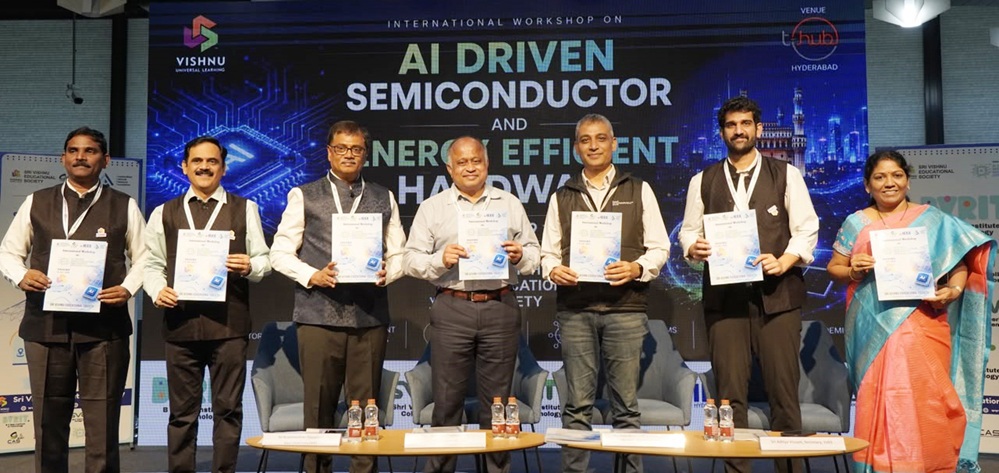
Hyderabad : A two-day International Workshop on Artificial Intelligence Driven Semiconductor and Energy Efficient Hardware was successfully organized on 7–8 July 2026 at T-Hub, Hyderabad; by the Sri Vishnu Educational Society (SVES), with active contribution from Penn State University, USA. SVES comprising Vishnu Institute of Technology (VIT), Shri Vishnu Engineering College for Women (SVECW), BVRIT Hyderabad College of Engineering for Women (BVRITH), and B V Raju Institute of Technology (BVRIT) technically cosponsored by Anusandhan National Research Foundation (ANRF), IEEE CAS Chapter Hyderabad section.
The workshop brought together more than 350 eminent academicians, researchers, industry leaders, policymakers and students from across India and abroad to deliberate on the rapidly evolving landscape of Artificial Intelligence, Very Large-Scale Integration, semiconductor technologies, advanced packaging, photonics, edge computing and intelligent power electronics and hardware systems.
The workshop commenced with an inspiring inaugural session, during which Mr. Aditya Vissam, Secretary, Sri Vishnu Educational Society (SVES), addressed the gathering. He highlighted the visionary initiatives undertaken by SVES in transforming its educational institutions to meet the demands of the Artificial Intelligence era. Elaborating on the revolutionary measures introduced across SVES institutions, he emphasized the integration of AI into teaching, learning, research, innovation, and skill development to prepare students for emerging technologies and future careers. He also underscored India’s growing opportunities in semiconductor manufacturing, chip design, advanced packaging, and AI-driven technologies, stressing the need for engineering graduates to acquire industry-relevant competencies. Motivating the participants, he encouraged students to actively engage with the eminent speakers, make the most of the learning opportunities offered by the workshop, and equip themselves to contribute meaningfully to India’s vision of becoming a global semiconductor powerhouse. His inspiring address set an enthusiastic tone for the two-day workshop and was warmly appreciated by the participants.
The inaugural session was followed by an address by Mr Ravichandran Rajagopal, Vice chairman of SVES. An inspiring keynote address by Prof. Madhavan Swami Nathan of Penn State University, USA, who highlighted the future of 3D Heterogeneous Integration and its transformative role in next-generation semiconductor systems. Technical sessions throughout the first day featured and distinguished experts including Mrs. Nupur Shah, Mr. Navin Bishnoi of Marvell Technology, Prof. Sharath Sriram of RMIT University, Mr. Ravikanth Reddy of NXP, Dr. Charan Gurumurthy of Tata Electronics, Dr. Bhagwati Prasad of IISc Bangalore, Dr. Suraj Rengarajan of Applied Materials India, Dr. Nikita Ambasana of SimYog Technology, and Mr. Sharat Babu Kotamraju of AMD. Their presentations covered AI-enabled network transformation, semiconductor innovation, bio sensing, edge computing, memory technologies, advanced packaging, semiconductor testing, and Physical AI.
A major highlight of the first day was an engaging panel discussion on “Education, Research, and Innovation Ecosystem for VLSI & Semiconductors” where experts from leading universities and industries deliberated on strengthening India’s semiconductor ecosystem through collaborative research, industry-academia partnerships, and skill development. Another thought-provoking panel focused on Edge AI in Semiconductors, addressing FPGA acceleration, chip validation, processor architectures, and future semiconductor design paradigms.
The second day featured advanced technical sessions by national and internationally acclaimed speakers including Prof. Rohit Sharma (IIT Ropar), Dr. Manish Kumar Hooda (India Semiconductor Mission), Prof. Christos Argyropoulos (Penn State University, USA), Dr. Yutaka Uematsu (Hitachi, Japan), Mr. Paul Ilanghovan (Kaynes Semicon), Dr. Sai Rama Krishna Malladi (IIT Hyderabad), and Dr. Harsha Sanjeev (CMTI, Bangalore). The deliberations focused on signal and thermal co-design, startup ecosystems, graphene-based terahertz photonics, advanced semiconductor devices, MEMS technologies, and photonics characterization.
The workshop also featured an insightful panel discussion on “From Silicon to Systems: Power-Aware AI Computing through Algorithm and Hardware Co-Optimization” emphasizing sustainable AI hardware development and next-generation computing architectures.
The concluding technical sessions included lectures on VLSI design for neural networks, energy-efficient FPGA accelerators, advanced packaging for SiC and GaN technologies, AI-enabled metrology tools, power electronics for AI infrastructure, and advanced glass substrate metallization delivered by Prof. Asral of UNIMAP, Malaysia, Dr. Akshay of IIT Bhubaneswar, Prof. Satya Savithri, Director R & D, JNTUH, Mr. Vijay of IVP Semiconductors, Mr. Parikshit Sengupta of Horiba India, Prof. Pradeep Dixit, IIT Bombay.
The speakers were honoured by Mr. K. Sai Sumanth, Joint Secretary, SVES. These sessions provided participants with valuable insights into emerging research directions and industrial practices shaping the future semiconductor ecosystem.
The workshop served as an excellent platform for knowledge exchange between academia, industry, and research organizations, inspiring students and faculty to pursue innovation in semiconductor technologies and AI-enabled hardware systems. The event concluded with a Vote of Thanks by Dr. Sanjay Dubey, Principal BVRIT and SVES Team, expressing gratitude to all the distinguished speakers, panellists, organizers, participants, and supporting institutions for making the workshop a grand success.