


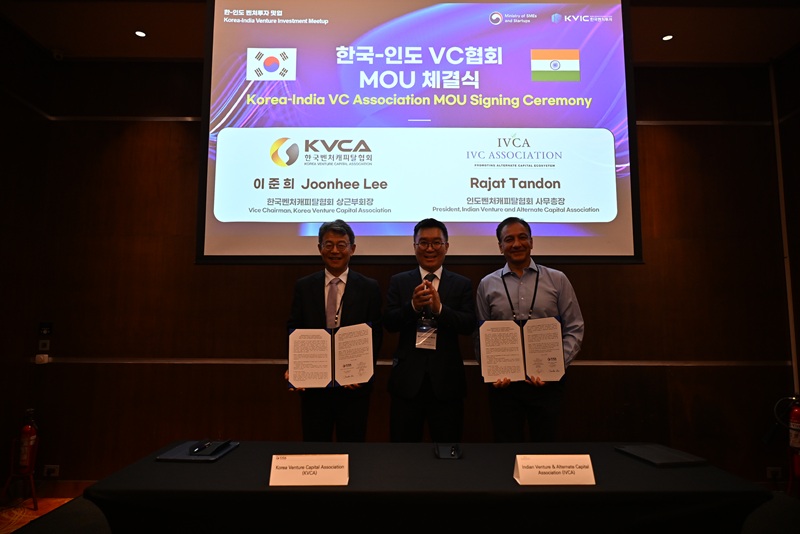
Bengaluru : The Indian Venture and Alternate Capital Association (IVCA) and the Korea Venture Capital Association (KVCA) have signed a Memorandum of Understanding (MoU) to strengthen collaboration between the venture capital, private equity and alternative investment ecosystems of India and South Korea.
The MoU was signed by Rajat Tandon, President, IVCA, and Joonhee Lee, Vice Chairman, KVCA, in the presence of representatives from the Ministry of SMEs and Startups (MSS), Korea Venture Investment Corporation (KVIC), venture capital firms and ecosystem stakeholders from both countries.
The partnership is aimed at fostering stronger engagement between investors, entrepreneurs and institutions in India and South Korea through cross-border investment opportunities, knowledge exchange, market access support, industry dialogue, research initiatives and ecosystem development activities.
India and South Korea share a longstanding economic relationship, with bilateral merchandise trade approaching USD 27 billion and both countries working towards a USD 50 billion trade target by 2030. As both economies increasingly focus on innovation-led growth, the partnership seeks to strengthen linkages between the venture capital and alternative investment communities of the two countries.
India today hosts one of the world’s most dynamic private capital markets, having attracted approximately USD 303 billion in private equity and venture capital investments across more than 6,000 transactions over the last five years, with exits worth nearly USD 143 billion during the same period. Korean investors have also played a meaningful role in India’s growth journey, creating a strong foundation for deeper engagement between the two ecosystems.
Under the MoU, IVCA and KVCA will work together to:
● Facilitate cross-border investment and networking opportunities;
● Support market access and ecosystem engagement for members;
● Promote knowledge sharing through workshops, seminars and industry dialogues;
● Explore collaborative research and publications;
● Encourage exchange of best practices and policy dialogue between the two ecosystems.
The partnership is expected to serve as a platform for fostering stronger connections between investors, startups, institutions and industry stakeholders, while supporting the continued growth of innovation and entrepreneurship in both countries.