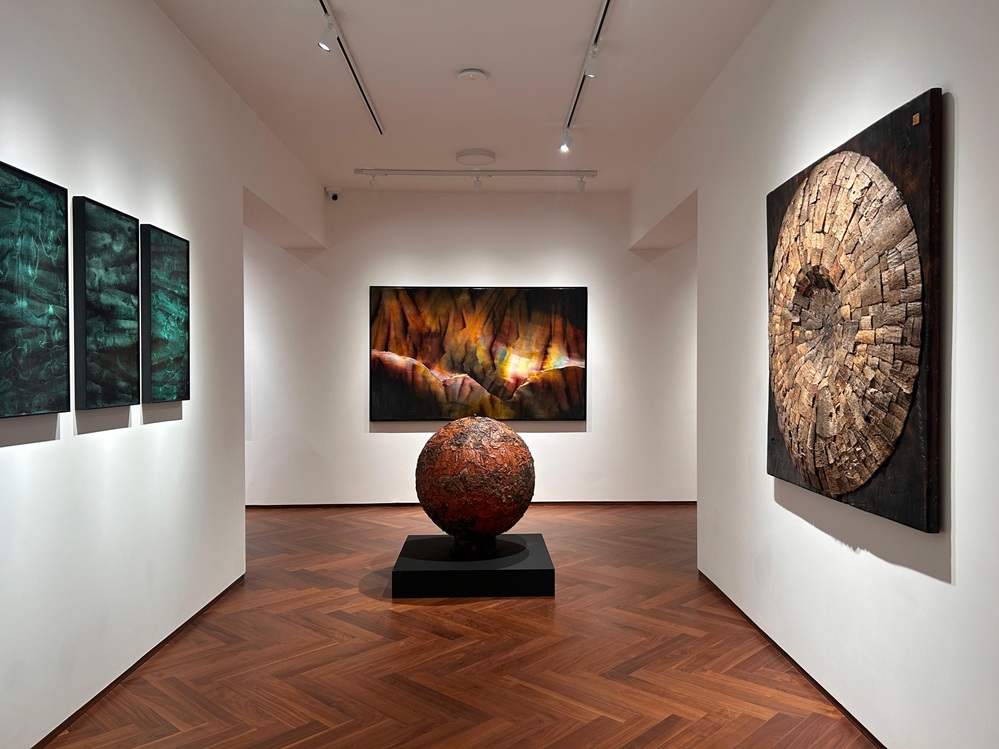
India: Although markedly different in their physical and material vocabularies, the practices of Meenal Singh and Sandilya Theuerkauf converge at KYNKYNY, Mumbai, through a shared attentiveness to ecology, abstraction and the processes through which forms emerge and transform. Their work resists the predictability of conventional image-making, instead developing deeply personal modes of working in which material, gesture and perception remain in continual dialogue.
Morphology – the study of form, structure and the ways in which forms develop, provides a productive lens through which to encounter these practices. Here, form is not understood as fixed or predetermined, but as something in a state of continual becoming. This is particularly resonant in relation to the natural world, where growth, decay, adaptation and transformation operate without the rigid binaries through which human experience is often organised.
For Sandilya Theuerkauf, morphology begins with the material itself. His relief works incorporate tree bark, twigs, thorns, dried vines and other organic matter, allowing materials that are often overlooked to become active participants in the construction of the work. Informed by close observation and scientific curiosity, yet equally guided by intuition, Theuerkauf responds to the inherent structures within these materials, their textures, irregularities, densities, colours and organic rhythms.
His compositions occupy a space between geometric and organic abstraction. Linear systems, systematic arrangements, repeated marks, dots, textures and solid forms accumulate across the picture plane, generating surfaces animated by rhythm and movement. The works do not describe nature so much as investigate its underlying principles of formation. Organic matter is fragmented, ordered, repeated and reconfigured, becoming a vocabulary through which questions of space, structure and transformation can be explored. In this sense, Theuerkauf’s work is morphological not simply because it employs natural forms, but because it considers how forms come into being, change and ultimately dissolve.
Meenal Singh approaches morphology through a more psychological and chromatic register. Working extensively with oil and pigment, she constructs expansive fields in which colour, memory and perception become intertwined. Her process is not concerned with representing an external landscape, but with giving visual form to an interior and continually shifting terrain.
Paint becomes both material and language. Singh allows pigment to move, pool, drip, dissolve and intersect across the surface, while layering and transparency establish shifting relationships between density, openness and light. Curves, smudges and flowing passages of colour create rhythms that appear simultaneously spontaneous and deliberate. At moments, these formations suggest geological strata, atmospheric phenomena or unfamiliar topographies; elsewhere, they recall patterns and structures encountered in the natural world without becoming representational.
In Singh’s work, therefore, morphology is experienced through transformation. A mark becomes a field; a field suggests a landscape; colour becomes atmosphere; memory becomes form. The image remains in a state of flux, resisting a singular reading and allowing perception itself to become part of the work.
What brings these two practices together is not a shared visual language, but a shared understanding of abstraction as a mode of enquiry. Both artists privilege process over predetermined image, allowing material and gesture to generate unexpected possibilities. Their surfaces become records of a negotiation between intention and accident, structure and intuition, matter and imagination.
The idea of morphology also extends beyond the physical properties of the works to the artists themselves. The act of making becomes a process of reciprocal transformation: as the artists shape their materials, their understanding of themselves and the world is also reshaped. The artwork is consequently not an endpoint, but evidence of an ongoing process of becoming.
Morphology brings these divergent practices into a productive conversation. Singh’s chromatic fields and Theuerkauf’s organic constructions offer two distinct propositions about how form can emerge from experience, material and perception. One moves through colour, memory and the interior imagination; the other through matter, observation and the structures of the natural world. Both, however, remain concerned with the same fundamental question: how does something come into form?
The exhibition proposes abstraction as a space in which that question need not have a fixed answer. Form can accumulate, dissolve, mutate and reconstitute itself. It can be observed, remembered, imagined or discovered. In the work of Singh and Theuerkauf, morphology becomes less a study of what forms are than of how they become.
‘MORPHOLOGY’, an Exhibition Featuring Meenal Singh & Sandilya Theuerkauf