


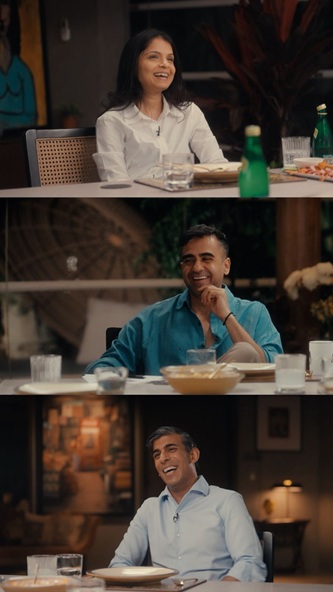
In a three-hour conversation on People by WTF, investor and entrepreneur Nikhil Kamath engaged in an unusually intimate dialogue with former UK Prime Minister Rishi Sunak and his wife Akshata Murty—exploring the intersecting themes of leadership failure, technological disruption, and how India’s next generation of entrepreneurs can build enduring consumer brands in a world reshaped by AI.
The episode stands out for its candor: Kamath pressed Sunak on what it means to lose high office, how to extract wisdom from failure, and what young Indians should learn from a life spent navigating both finance and politics. Equally, Kamath and Murty discussed the burden of inherited success, the philosophy of balance across triumph and disaster, and whether India’s education system is preparing its young people for an economy being remade in real time.
Sunak described a liberation he did not expect. After two years in government and months as Prime Minister, losing the 2024 election thrust him—for the first time in his professional life—into an unscripted future. “I don’t know what the next thing is,” he told Kamath. “And that’s actually exciting.” This uncertainty became the episode’s emotional core. Where ambitious people are often taught to see failure as catastrophic, the conversation reframed it: as opportunity for genuine learning, for building wisdom rather than just accumulating experiences. “The story you tell yourself about failure matters enormously,” Sunak reflected. “If you tell yourself you’re a victim, you’ve given away your agency. The truth is usually in the middle—you had agency, but you weren’t omnipotent.”
The discussion pivoted sharply toward India’s economic moment. Sunak and Kamath explored the gap between decision-makers and citizens—a recurring thread in Kamath’s work throughout the conversation. They discussed how India’s consumer sector is growing at 12-13% annually while GDP grows at 6-7%; how younger Indians are saving less and borrowing more than their parents; and how this creates a historic opportunity for entrepreneurs building indigenous consumer brands. Kamath revealed his Foundry initiative: a three-month residential program in Alibaug for 20-30 founders building consumer companies—candy brands, toothpaste makers, clothing lines. No tech-first mandate. Just founders with ideas about how to serve Indians better, with capital, access to manufacturing, distribution, and mentorship to compress years into months. “We’re building 20 consumer brands in parallel,” Kamath said. “The goal is to make founders into heroes before their product hits the market. Create narrative. Create stakes. Make business cool again.” Sunak, speaking from his experience in both finance and government, validated the insight: many young people underestimate the leverage of building something in a growth market.
A major portion of the conversation turned to education and the fear gripping parents worldwide: that the skills they invested in for their children may become irrelevant within a decade. Both Sunak and Kamath argued that the answer isn’t more specialization, but more breadth—what Sunak calls
“horizontal skills.” Critical thinking, curiosity, the ability to learn how to learn. “I use Claude for research every day,” Kamath revealed. “I ask it to explain physics concepts I haven’t done since I was 16. The person who becomes comfortable using AI to think, not as a replacement for thinking, but as a tool to extend thought—that person will be fine.” Murty added a perspective on her own unconventional education path—she did not follow the India-to-engineering pipeline, but chose a liberal arts education in California instead. She pushed back on the notion that credentials matter as much as the ability to adapt. “I carved my own path because I knew that path wasn’t me. That willingness to be non-linear, to make your own decisions about what matters—that’s what matters now.”
One of the conversation’s most philosophical moments arrived when Kamath and Murty discussed the concept of balance—not as compromise, but as active oscillation between opposing forces. Murty spoke about reading Hermann Hesse’s Siddhartha during the pandemic, when Sunak became Chancellor with shocking speed. “The Buddha’s middle path,” she explained. “Not renouncing desire entirely, but not being consumed by it either. You embrace both—the highs and the lows—as two sides of the same coin.” Kamath pushed on this: Are there moments when you need to fully commit to one extreme? Or is balance the only sustainable way to live? “You have to drift between both,” Murty answered. “But you always know your anchor—your values, your sense of who you are. The balance comes from knowing where you belong, even when you’re exploring the edges.” For Sunak, this philosophy crystallized his experience losing office. It wasn’t the loss itself that defined him; it was his ability to reflect on the loss without either victimizing himself or pretending it didn’t hurt, and then to extract lessons and move forward.
The conversation also surfaced a theme rarely discussed in mainstream Indian media: should young Indians enter politics? Kamath framed it as a challenge: India’s average age is 28, yet the political class remains predominantly older. Sunak made the case directly: “You need resilience. You need patience. And you need to be motivated more by service than ambition. But if you have those three things, the leverage is enormous. One law you change. One policy you champion. That affects 1.4 billion people.” He gave the example of William Wilberforce, who entered Parliament at 28 and spent 40 years of his life on a single mission: abolishing slavery. He was never Prime Minister. But his impact was civilization- altering. “The romantic notion is that one person can’t change things,” Sunak told Kamath. “The truth is that if you combine deep passion with patience and integration into institutions—if you come inside rather than stay outside—you can move mountains. It just takes longer than movies make it seem.”
By the end of the conversation, a clearer picture emerged of what Kamath is attempting with Foundry and his broader investment strategy: backing founders who are building for the Indian market first, not the global market later. Building products Indians actually want, not products that happen to be built in India. “Companies that combine domain knowledge and build quickly will be huge,” Kamath said. The difference here is sector: not AI infrastructure, but consumer staples, fashion, household goods. Boring things. Legacy categories. The kind of categories that seem passed over by Silicon Valley but represent trillions of dollars in emerging-market value creation. Murty, speaking from her own experience as the daughter of Infosys founder Narayana Murthy, offered a final note on why the timing matters: “My father didn’t start Infosys because he wanted to get rich. He started it because he believed India could stand taller globally through economic credibility. That’s the real story. Not the money. The platform.”
What was striking about the three-hour exchange was what it didn’t resolve. The conversation didn’t end with answers. It ended with harder questions: How do we raise a generation that is educated for possibility, not just credential? Is balance a sustainable philosophy, or a luxury of the already-secure? Can India’s consumer economy scale without becoming extractive? What does success look like after you’ve already succeeded at the highest level? Kamath seemed to be taking notes. So might his audience.