


By Suresh Unnithan
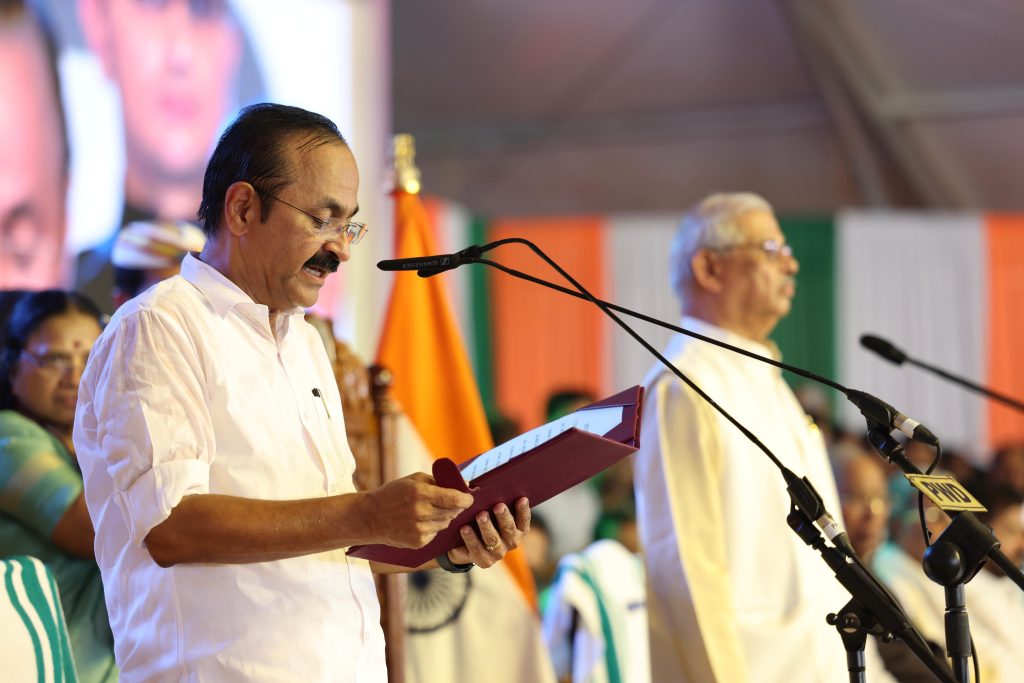
Vadassery Damodaran Satheesan took oath today as Kerala’s 13th Chief Minister, guiding the United Democratic Front (UDF) to a historic landslide victory with 102 seats in the 140-member Assembly. The emphatic mandate not only ends a decade of Left Democratic Front rule but also signals a powerful public endorsement of his leadership style. For a politician celebrated for his impeccable integrity and uncompromising principles, however, the real test begins now — not from the opposition benches, but deep inside the intricate and often suffocating factional labyrinth of Kerala Congress.
Satheesan’s elevation followed ten days of intense negotiations, lobbying, and strategic manoeuvring involving senior leaders like Ramesh Chennithala and K.C. Venugopal. He was not the preferred choice of any single power centre. Instead, he was selected for his broad public appeal, organisational revival efforts, and proven ability to unify the alliance. As a six-term MLA from Paravur with a relatively independent image, he now inherits the challenging task of governing through a cabinet deliberately designed to appease rival factions.
A Record of Unblemished Integrity
Born in 1964 into a Nair family in Nettoor, Satheesan cut his teeth in politics through the Kerala Students Union and Youth Congress before practising law at the Kerala High Court. While many of his contemporaries built influence through patronage networks and group loyalty, Satheesan deliberately stayed outside the dominant factional trenches. His consistent victories since 2001, combative yet issue-driven performance as Leader of Opposition, and refusal to indulge in political compromises have earned him a rare reputation for uprightness in Kerala’s often murky politics.
Unstained by major corruption allegations or dynastic ambitions, Satheesan has wasted no time signalling change. His announcement to end the VIP-convoy culture is a small but symbolic step towards a more accountable style of governance.
His secular credentials are equally robust. Satheesan has consistently shown zero tolerance for hate-mongering, drawing fierce criticism from powerful caste organisations. SNDP Yogam general secretary Vellappally Natesan and NSS leaders have repeatedly targeted him, accusing him of neglecting backward Hindu communities and tilting too far towards the IUML and minorities. Ironically, sections of the Sangh Parivar attack him for the very same reason — perceived closeness to Muslim and Christian forces. This crossfire only reinforces his image as a genuine centrist secularist who refuses to play caste or communal vote-bank politics. The UDF’s massive victory suggests Kerala’s voters strongly approved of this principled approach.
The Factional Labyrinth
For more than five decades, Kerala Congress has been defined by entrenched factionalism — fuelled by personality cults, community equations, regional rivalries, and fierce competition for power and patronage. The historical divide between the A Group (linked to A.K. Antony and Oommen Chandy) and the I Group (led by K. Karunakaran and later Ramesh Chennithala), along with the rise of influential figures like K.C. Venugopal, has created a political ecosystem where balancing rival interests frequently overrides governance priorities.
Satheesan, who does not command a large personal faction, must now navigate this very system. The 21-member ministry (including the Chief Minister) is a classic exercise in factional engineering. It carefully apportions influence between major Congress camps, gives important berths to UDF allies like the IUML, blends veterans with 14 fresh faces, and maintains community and regional balance.
While this arrangement has ensured immediate stability and prevented open revolt, it comes with serious risks. Several ministers owe primary loyalty to groups that were not fully supportive of Satheesan’s claim to the top post. In such a setup, critical decisions on fiscal correction, education, port development, and sensitive communal issues could easily get delayed or diluted through endless negotiations. Kerala’s political history is littered with examples of factionally balanced cabinets sliding into patronage or paralysis — precisely the ailments Satheesan has pledged to cure.
Formidable Priorities Amid Internal Constraints
The new government has set an ambitious agenda: implementing the five ‘Indira Guarantees’ (notably the Rs 3,000 monthly welfare pension), fast-tracking port-led development, tackling the state’s mounting fiscal crisis, addressing unemployment, and restoring administrative efficiency. Delivering on these promises before a mandate-driven and impatient electorate will be exceptionally difficult in a cabinet where every major decision requires painstaking consensus.
Coalition management adds yet another layer of complexity. Satheesan’s firm secular convictions will be repeatedly tested whenever IUML pushes its core demands. Any perceived compromise risks fresh attacks from caste organisations, while excessive firmness could strain the alliance.
In this challenging environment, Satheesan’s greatest strength remains his unblemished personal and political record. It grants him the moral authority to appeal directly to party workers and the public when internal resistance surfaces. His real task is to gradually shift Kerala Congress’s entrenched culture from group loyalty and patronage to performance and principled governance.
The Ultimate Test
V.D. Satheesan assumes office at a critical juncture in Kerala’s history. Weary of policy fatigue and deepening polarisation, voters have reposed significant faith in him for renewal. His personal qualities — integrity, grassroots credibility, and forthright communication — make him uniquely equipped for the challenge.
Yet his tenure represents a rare political experiment: can a leader known for non-compromising integrity successfully run a government built on factional accommodation? The impressive swearing-in ceremony, attended by national leaders including Rahul Gandhi and Mallikarjun Kharge, projected unity. Converting that symbolism into coherent, effective governance will ultimately define his legacy.
For Kerala, the stakes could not be higher. The state’s proud model of social harmony and development urgently needs economic reinvigoration and administrative renewal. Satheesan’s journey will determine whether a man of principles can rise above the factional labyrinth or whether the old patterns of Kerala Congress will constrain even this decisive mandate.
The sentinel who stood firm against external communal and caste pressures must now prove equally resolute within the corridors of power. Kerala’s discerning public will judge him not by his intentions or promises, but by whether his integrity survives — and ultimately triumphs — in this acid test of governance.