


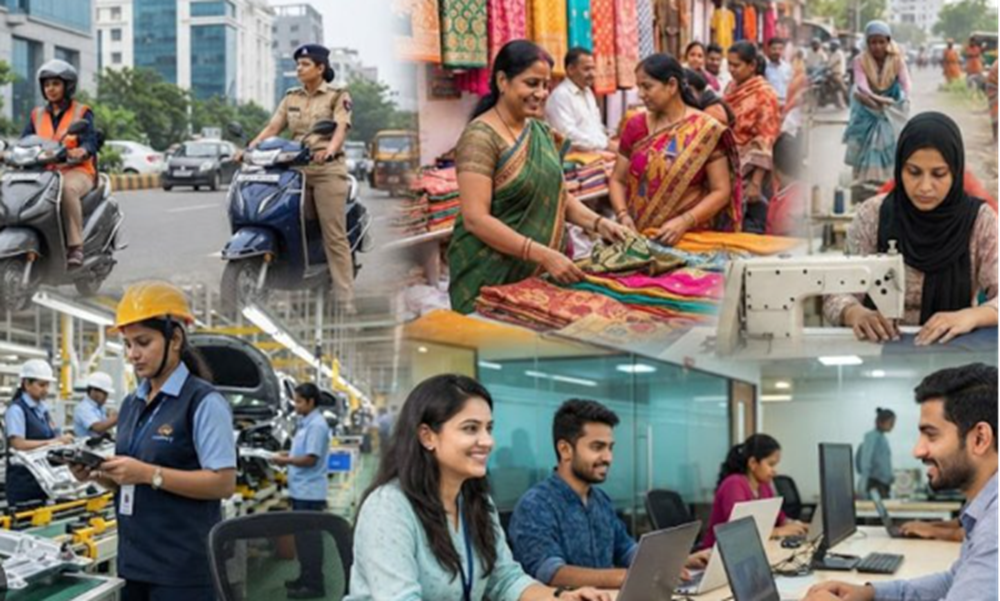
For decades, India’s employment story has followed a familiar pattern: people move to where the jobs are. But for millions of women, that equation has never been straightforward. Long commutes, migration, safety concerns, unpaid care responsibilities, and family expectations often determine whether a job is accessible at all.
What if the next chapter of women’s employment is not about helping women move to jobs, but helping jobs grow closer to where women already live?
Let’s take the beauty and wellness industry to understand this better. India’s beauty and personal care market is projected to reach nearly USD 34 billion, with the broader wellness economy expected to exceed USD 72 billion in the coming years. Unlike manufacturing or IT, however, beauty services cannot be centralised. Salons, wellness centres, beauty retailers, bridal studios, and home-service professionals operate within neighbourhoods, creating jobs where customers already are.
This makes beauty one of India’s most naturally hyperlocal employment sectors.
Recognising this opportunity, a diverse ecosystem has quietly emerged around the industry. Government initiatives such as the Skill India Mission, the Beauty & Wellness Sector Skill Council, and PMKVY have helped standardise training and certification. Industry-supported skilling programmes have expanded access to vocational education for women from underserved communities. But perhaps the most interesting shift has come from organisations that are redefining what employability actually means.
Quest Alliance, for example, focuses on digital literacy, communication, and social-emotional learning, recognising that workplace success depends on far more than technical ability. Magic Bus prepares young people for formal employment through interview readiness, workplace communication, and life skills. Across the ecosystem, the emphasis is gradually moving from simply teaching a trade to preparing women for sustainable careers.
At the same time, organisations such as Sambhav Foundation are demonstrating that local employment does not have to end with placement. Working with industry and community partners, their programmes combine technical training, workplace readiness, structured industry exposure, and entrepreneurship support, helping women transition into jobs, self-employment, or locally rooted businesses. The approach is built on aligning skilling programmes with local employment opportunities so that young people can access livelihoods closer to where they live. This not only makes employment more accessible and sustainable but also strengthens local economies by connecting training directly to local demand. The Foundation has also supported the incubation of more than 13,000 micro-entrepreneurs across vocational trades, illustrating how skilling can create opportunities beyond traditional employment.
The significance of this model extends well beyond beauty. As India’s service economy expands across healthcare support, childcare, retail, wellness, home services, and other customer-facing sectors, many of tomorrow’s jobs will also be created within local communities rather than distant economic centres.
Perhaps that is the bigger lesson. Increasing women’s workforce participation is not only about creating more jobs or training more women. It is about building employment ecosystems that recognise where women live, the constraints they navigate, and the opportunities that already exist within their communities.
The future of women’s employment, it turns out, may be much closer to home than we think.
***