


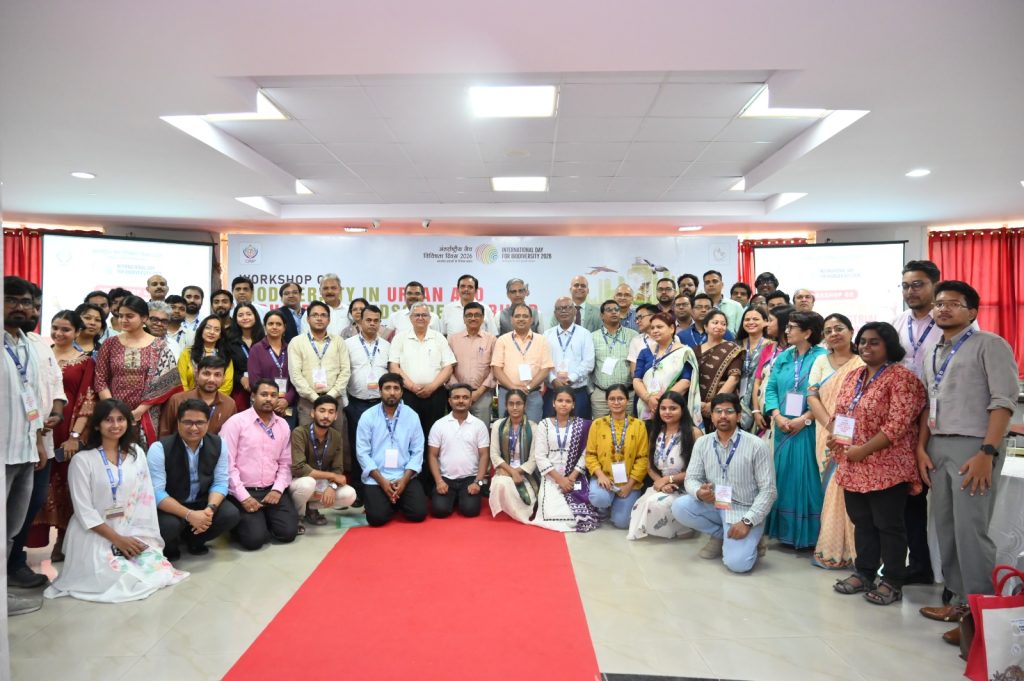
Patna : A workshop on “Biodiversity in Urban and Industrial Landscapes in Bihar” was organized by the Bihar State Biodiversity Board (BSBB) in collaboration with Chandragupt Institute of Management Patna (CIMP) on 19th May 2026 at the CIMP campus, Patna. The workshop brought together policymakers, academicians, researchers, urban planners, and stakeholders to deliberate on biodiversity conservation in the context of Bihar’s rapidly growing urban and industrial landscapes.
The inaugural session was graced by Prof. (Dr.) Rana Singh, Director, CIMP; Shri Bharat Jyoti, Chairman, BSBB; Shri Amit Kumar, Secretary, BSBB; and Shri Surendra Kumar, Advisor, NHAI.
In his opening address, Shri Amit Kumar emphasized the need to balance development with ecological sustainability and highlighted the role of institutions, knowledge partners, and stakeholders in preparing effective biodiversity action plans and governance frameworks. Shri Surendra Kumar spoke on the ecological significance of every tree species and stressed the need to prioritize environmentally significant plantation practices in urban areas. Prof. (Dr.) Rana Singh highlighted the importance of integrating biodiversity concerns into Bihar’s urban and industrial development process, while Shri Bharat Jyoti emphasized inter-departmental coordination for strengthening urban biodiversity governance.
Following the inaugural session, Technical Session-I focused on biodiversity strategy and governance dimensions for Bihar’s urban and industrial regions. Shri Bharat Jyoti presented on “Biodiversity Strategy and Action Plan for Urban and Industrial Landscapes”, where he highlighted the importance of conserving green and blue spaces, protecting water bodies, promoting native species, and integrating biodiversity concerns into urban planning and infrastructure development. He also emphasized biodiversity-sensitive planning for industrial zones, satellite towns, and redevelopment projects.
The second presentation on “Governance and Management Dimensions for Urban Biodiversity of Patna Urban Agglomerate” was delivered by Dr. Nitish Nigam and Prof. Dr. Sibananda Senapati from CIMP. Their presentation focused on governance challenges arising from rapid urbanization and emphasized the need for inter-departmental coordination, biodiversity benchmarking, promotion of Miyawaki forests and terrace gardening, and development of city-specific biodiversity action plans for environmentally resilient urban growth.
During the post-lunch Technical Session-II, parallel thematic discussions and stakeholder consultations were conducted. Under Parallel Track-I, Prof. Debabrata Samanta presented on governance and management dimensions for Patna Urban Agglomerate, followed by discussions on biodiversity-sensitive urban governance and institutional coordination. Simultaneously, Parallel Track-II featured presentations by knowledge partner teams on biodiversity studies from Patna, Bhagalpur, Gaya, Muzaffarpur, Ara-Buxar, and Bihar Sharif, focusing on ecosystem linkages, urban ecological challenges, and sustainable urban biodiversity planning.
The workshop concluded with interactive discussions and recommendations aimed at integrating biodiversity conservation into Bihar’s future urban development strategies and strengthening sustainable ecological governance across urban and industrial landscapes.
The valedictory address was delivered by Shri Surenra Kumar, IFS (Retd.) and now Advisor, NHAI.