


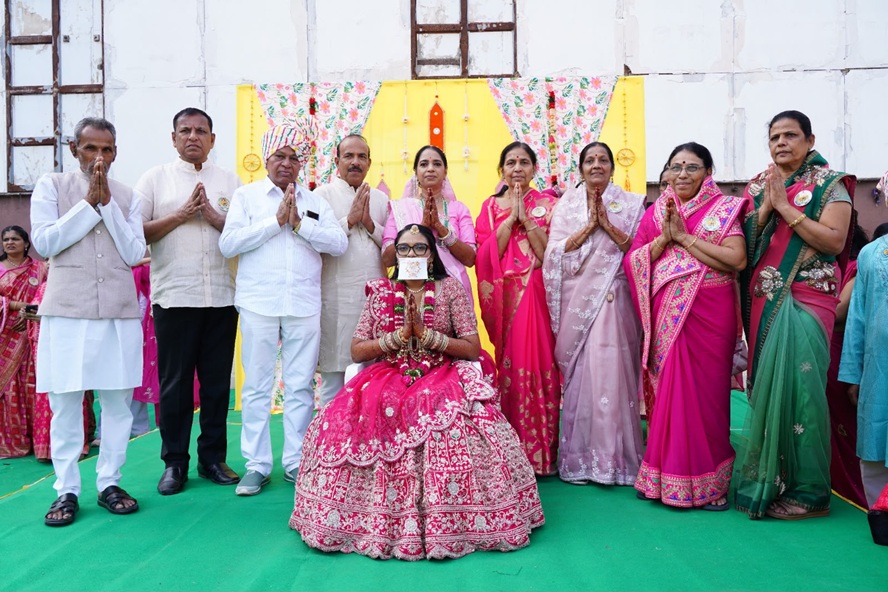
Hyderabad : At 25, Sanjana Lunawat has already ticked several boxes that many young women aspire to achieve. She has an MBA degree, professional work experience with a multinational company, training in fashion designing and a boutique business that was beginning to establish itself. Coming from a financially comfortable business family in Maharashtra, she had every opportunity to pursue a promising career, expand her business, enjoy the comforts of modern life and look forward to a conventional family life.
But Sanjana has chosen an entirely different destination.
This Sunday, on November 15, she renounced worldly life and embraced Jain Sadhvihood at a ceremony held at Exhibition ground in Hyderabad. She gave up her fashionable clothes, business interests, personal possessions, financial independence and the comforts of modern living to enter a life of simplicity, discipline, celibacy and spiritual pursuit.
She plucked her hair, draped herself in white clothes formally became a Jain Sadhvi. Prior to that she was taken in a procession. Completed all religious formalities and became Sadhvi in the presence of 5000 plus jains gathered in a Diksha Mahotsav function
For a young woman who had been building a promising future in the world of fashion and business, this is perhaps the most unexpected career change imaginable.
Yet, Sanjana does not see it as giving up something valuable. She sees it as moving towards something far more meaningful.
“I do not find the kind of happiness and peace I am seeking in this materialistic world. I believe I will find that happiness and peace through a life dedicated to Jain Dharma,” she says.
It is this conviction that has taken her towards a decision that is as extraordinary as it is deeply personal.
A journey that began at 12
Sanjana’s spiritual journey did not begin recently. Its roots go back to her schooldays, when she was barely 12 years old.
Born in Bhadgaon, a town in Maharashtra’s Jalgaon district, Sanjana completed her early education in her hometown. She subsequently moved to Nashik for her undergraduate studies, completing her BBA, and later shifted to Mumbai to pursue an MBA.
It was during her schooldays, however, that she first developed an attraction towards Jain philosophy and religious teachings.
While staying in a hostel, she would quietly make arrangements to attend Jain religious discourses and spiritual gatherings, sometimes without her parents’ knowledge. Her interest in Jain Dharma gradually deepened through listening to religious scholars, attending spiritual meetings and studying scriptures.
Her parents occasionally came to know about these visits through relatives. They were concerned that their daughter’s growing spiritual inclination might eventually lead her to renounce worldly life.
It was a fear they could hardly imagine becoming reality.
But the little girl who was drawn towards Jain teachings at 12 was nurturing a spiritual aspiration that would remain with her through her teenage years and into adulthood.
What began as curiosity gradually became conviction.
Sanjana did not withdraw from worldly responsibilities while pursuing her spiritual interests. On the contrary, she went on to build an impressive educational and professional profile.
After completing her MBA in Mumbai, she took up a job with Big Five. She subsequently pursued fashion designing, another field that reflected her creative interests.
She eventually ventured into entrepreneurship by starting a boutique in partnership with her cousin. The business began doing well, and Sanjana earned recognition for her work.
For a 25-year-old, it was a promising beginning. She had education, professional exposure, business opportunities and the confidence that comes with becoming financially independent.
Yet, even as her professional life was taking shape, her spiritual interests continued to occupy a significant place in her heart.
She remained engaged with religious discourses, the teachings of Jain monks and nuns, devotional practices and the study of scriptures.
The contrast between these two worlds was becoming increasingly evident. While one offered professional recognition, financial prospects and material comforts, the other promised a life of restraint, self-discipline and detachment.
Eventually, she made her choice.
Embracing Jain Sadhvihood is not an impulsive decision. It involves a complete transformation of one’s lifestyle, relationships, priorities and understanding of the world.
Sanjana says she spent nearly three years preparing herself mentally and spiritually for the demanding life ahead.
“Though it was a difficult decision, I prepared myself over a period of three years for the much tougher life ahead,” she says.
Her decision was not simply about leaving a business or giving up a career. It meant consciously preparing herself to live without the possessions and conveniences that most people take for granted.
A Jain Sadhvi’s life is governed by five great vows: Ahimsa (non-violence), Satya (truthfulness), Asteya (non-stealing), Brahmacharya (celibacy) and Aparigraha (non-possession).
These are not occasional spiritual practices but lifelong commitments.
A Sadhvi must observe strict disciplines, walk barefoot, wear simple white clothing, practise detachment from material possessions and adhere to prescribed food restrictions. She must also undergo the traditional ritual of Kesh Loch, the plucking of hair, symbolising renunciation of attachment to physical appearance.
There will be no fashionable wardrobe, boutique, shopping, personal business or the familiar comforts of home. Even conveniences such as fans and electricity will no longer be part of her personal lifestyle.
For someone trained in fashion designing, the transition from creating and wearing fashionable clothes to a life of complete simplicity is particularly striking.
But Sanjana says she is prepared.
“I know this is not going to be an easy life. There will be physical discomforts and many restrictions. But I have consciously prepared myself for them. My decision is not based on what I am leaving behind, but on what I want to pursue,” is a suggested formulation of her stated conviction, subject to her approval.
One of the interesting aspects of Sanjana’s decision is the way she looks at conventional family relationships.
For most young women, marriage and starting a family are considered important milestones. Sanjana, however, has a different perspective.
“Even if I get married and settle down, I will still be away from my family and would only be able to visit my parents occasionally. But as a Jain Sadhvi, I can meet them at Jain religious gatherings. They may initially miss me and find it difficult to accept my decision, but they can still see me in such gatherings,” she explains.
She also says that witnessing how people gradually come to terms with the loss of loved ones made her reflect deeply on the temporary nature of worldly relationships and human life.
Death, separation and the inevitability of change prompted her to question the permanence that people often associate with relationships, possessions and achievements.
For Sanjana, these reflections strengthened her belief that lasting peace cannot be found in accumulating material possessions or pursuing conventional milestones.
The life of restraint offered her a different meaning of fulfilment.
If Sanjana’s decision required courage, accepting it required an entirely different kind of strength from her parents.
Her father, Kanwarlal, is engaged in the automobile business, while her elder brother, Shubham, is also involved in business. Her mother, Mamata, admits that it was emotionally difficult for the family to accept that their daughter, who had a promising future, wanted to renounce everything.
The parents had been aware of Sanjana’s spiritual inclination since her childhood. They had hoped that her interest in Jain Dharma would remain an important part of her life without necessarily leading her to become a Sadhvi.
But their daughter was increasingly determined.
According to her mother, Sanjana even stopped eating sweets and fruits until her parents agreed to her decision. It was an emotional way of communicating how deeply committed she was to her spiritual aspiration.
For parents, allowing a daughter to leave home permanently for a life of asceticism is no ordinary decision. The instinct to protect, nurture and remain close to one’s children makes such a separation particularly painful.
Yet, Mamata and Kanwarlal eventually found the strength to support their daughter’s calling.
Their acceptance is an important part of Sanjana’s story. It is not merely about a young woman choosing renunciation, but also about parents learning to respect a decision that takes their daughter far away from the life they had imagined for her.
Sanjana’s preparation has also involved the systematic study of Jain religious literature.
She has studied several important Jain Agamas and scriptures, including Dashanga Sutra, Vipak Sutra, Jnata Dharmakathanga Sutra, Upasak Dashanga Sutra, Anuttaropapatika Sutra, Jambudweep Prajnaptि Sutra, Niriya Valiya Panchak Sutra, Bhagavati Sutra and Prajnapana Sutra.
Her studies have also included Thokadas, Gati-Agati and Samiti-Gupti, which deal with important aspects of Jain philosophy, spiritual conduct and discipline.
She has learnt and recited devotional compositions such as Bhaktamar Mahastotra and Kalyan Mandir Stotra.
Her spiritual journey has been nurtured under the guidance of Acharya Pravara 1008 Shri Gyanandchandraji Maharaj Saheb, with the blessings and inspiration of Mahasadhvi Shri Lalitashreeji Maharaj Saheb.
The decision to embrace Sadhvihood is thus the culmination of years of spiritual interest, learning, reflection and preparation.
At an age when many young people are still discovering their ambitions, Sanjana believes she has discovered hers.
A life beyond the boundaries of material success
Sanjana’s decision also raises an interesting question about how society defines success.
For some, success is a high-paying job. For others, it is owning a business, building wealth, travelling the world or enjoying the comforts that money can provide.
Sanjana has experienced some of these opportunities. She has studied, worked, pursued a creative profession and tasted the beginnings of entrepreneurial success.
Yet, she has arrived at a very different understanding of fulfilment.
Her choice should not be seen simply as a rejection of education, career or business. Rather, it reflects her personal belief that material achievements alone cannot provide the kind of peace she is seeking.
“I see more happiness and peace in becoming a Jain Sadhvi than in this materialistic world,” she says.
It is a statement that perhaps captures her entire journey.
Jain asceticism is also not restricted exclusively to those born into the Jain community. People from different religious and social backgrounds have embraced Jain monastic life. According to Swarupchand Kothari, Chairman and Chief Convenor of the Diksha Mahotsav, over 1,000 of the approximately 20,000 Jain monks and nuns are believed to have come from non-Jain backgrounds.
He believes Sanjana’s decision is a powerful expression of personal conviction and spiritual commitment.
“Renouncing worldly life at such a young age, giving up one’s career, ambitions, family life and material comforts is undoubtedly an extraordinary and deeply personal decision. It calls for immense conviction, courage, discipline and spiritual commitment. We must truly appreciate Sanjana for her determination and her parents for finding the strength to support her spiritual calling,” he says.
Manoj Kothari, Planning Convenor of the Diksha Mahotsav, points out that the life Sanjana now entered will demand extraordinary self-discipline.
He says she has consciously prepared herself for the rigorous practices of Jain ascetic life and that her decision should be understood in the context of the five great vows and the pursuit of spiritual liberation.
The Jain Bhagwati Diksha Mahotsav was held at Exhibition Grounds, Nampally, Hyderabad, under the guidance of Pujya Acharya 1008 Shri Gyanandchandraji Maharaj Saheb.
The two-day celebrations began on Saturday, the November 14 with a grand procession from Lalit Kala Thoranam, featuring vintage cars, horses and traditional bands.
The celebrations culminated in the Diksha ceremony on November 15, when Sanjana formally embraced Sadhvihood in the presence of an expected gathering of more than 5,000 devotees.
The event was organised by Shri Vardhaman Sthanakvasi Jain Shravak Sangh, Greater Hyderabad.
For Sanjana, however, the significance of November 15 has gone far beyond a grand religious celebration. It marks the beginning of a completely different existence.
The girl who once quietly attended Jain spiritual meetings as a 12-year-old hostel student will now dedicate her entire life to the path she discovered during those early years.
She has left behind a promising business, a professional identity and the comforts of a conventional life. But she believes she is moving towards something that cannot be measured in money, professional recognition or worldly achievements.
At 25, when the world often tells young women to dream bigger, acquire more and achieve more, Sanjana Lunawat has chosen a rather different definition of a dream.
She wants to own less, desire less and detach herself from the material world.
Whether one shares her philosophy or not, her decision invites us to pause and reflect on a question that is rarely asked in today’s achievement-driven society:
How much does one really need to be happy?
For Sanjana, the answer lies in a life of simplicity, restraint and spiritual liberation.
And on November 15, her new journey just begun.
****