


From Our Correspondent
In a Pune ground packed with young women on Saturday evening, Rahul Gandhi did not merely address students. He stepped into the raw nerve of a generation that has spent months on the streets, watched papers leak, futures cancelled, and peers die under pressure — and told them the cage itself must be smashed.
The fourth edition of ‘Chhatron ki Goonj’, deliberately made exclusive to girls and young women at the AISSMS ground, was the latest and most pointed expression of an opposition strategy that treats youth discontent not as a side issue but as the central political battlefield. Coming weeks after one of the largest student-led agitations in recent years forced the resignation of a Union Minister; the event carried an unmistakable message to the BJP and its ecosystem: the Leader of Opposition is no longer watching from the sidelines. He is in the middle of the anger, amplifying it, and inviting young women to claim the space the system has long denied them.
The immediate backdrop is the 2026 NEET-UG paper-leak scandal. More than 2.2 million medical aspirants saw their results cancelled after the question paper was compromised. A retest followed. The human cost was brutal: at least a dozen students (reports put the figure higher in some tallies) took their own lives in the aftermath of the cancellation and the crushing pressure of starting over. What began as outrage over one exam quickly became a broader revolt against a pattern of leaks, unaffordable education, delayed recruitments and vanishing secure jobs. The Cockroach Janta Party-led protests at Delhi’s Jantar Mantar, which ran for more than a month, culminated on 20 July when tens of thousands attempted to march towards Parliament. Police responded with batons and tear gas. Over a hundred protesters were injured or hospitalised; dozens were detained. Videos of force used against young women circulated widely. Five days later, Education Minister Dharmendra Pradhan resigned — a rare concession extracted by sustained youth pressure. Rahul Gandhi had earlier cited 152 paper leaks over a decade that he said affected 7.5 crore students with virtually no convictions, framing the system as both rigged and extractive.
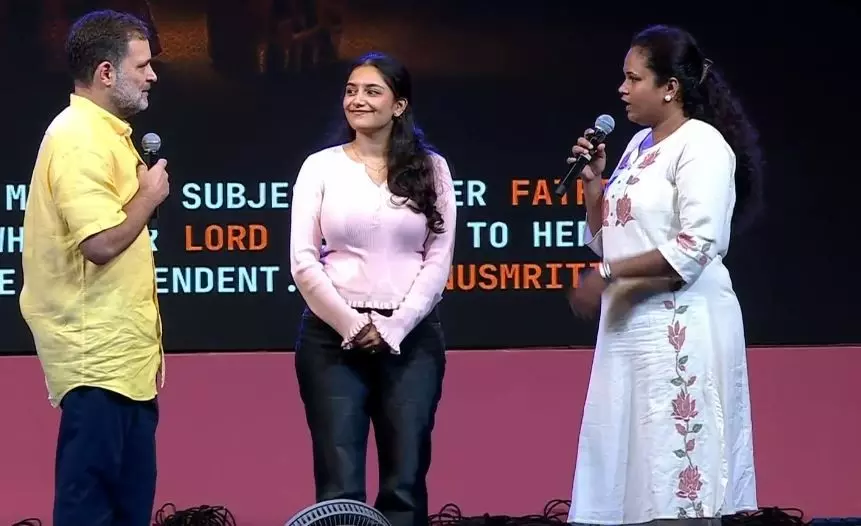
Against that charged atmosphere, the Pune interaction was deliberately different. Previous ‘Chhatron ki Goonj’ editions had drawn predominantly male crowds. Here the ground was filled with Gen Z women. Gandhi told them India’s greatest strength is its 70 crore women — their journeys, imagination and dreams — not the conventional metrics of economy or military power. He rejected the reduction of women to three identities defined by men: daughter, wife, and mother. “This cannot be your only identity,” he said. Quoting the Manusmriti passage that places a woman under the control of father, husband and son, he called the idea shameful and declared: “You belong to nobody. You do not belong to anybody except yourself.” His call was direct: “Be loud, be proud and fight for your space in society. Smash the patriarchy.”
Students responded with lived experience. They spoke of harassment on the way to school and in public transport, of rural parents refusing to send daughters for higher education because of safety fears, of specialised courses priced at ₹3 lakh that shut out poorer families, and of AI-generated deepfakes used for blackmail. Gandhi answered with data on the multiple forms of control — physical violence, the “violence of opportunity” that makes women reject jobs over safety concerns, the financial cost of security, high dropout rates linked to household duties and early marriage, and the stubborn gap in independent property ownership and equal pay.
The political impact is already visible. The programme has given Congress a consistent platform to speak the language of examination integrity, safety and opportunity at a moment when large sections of the youth no longer trust official assurances. The Pune turnout, the willingness of young women to share personal accounts on stage, and the energetic response suggest the outreach is connecting where earlier political messaging often failed. For the BJP, the message is sharper still: the same generation that forced a ministerial resignation over paper leaks is now being courted directly by the opposition leader on the related issues of safety, autonomy and dignity. Young women, long treated as a demographic to be protected or managed, are being invited to become a political force that refuses the cage.
Rahul Gandhi’s Pune evening was therefore more than another student meeting. It was a calculated escalation — an attempt to convert the anger that spilled onto the streets of Delhi in July into organised political pressure. Whether that anger hardens into lasting electoral realignment remains to be tested. What is already clear is that a significant section of India’s youth, and young women in particular, is restless, articulate and no longer willing to stay silent. And the Leader of Opposition has placed himself firmly in their midst, telling both the government and its supporters that the challenge is no longer distant. It is already in the ground.