


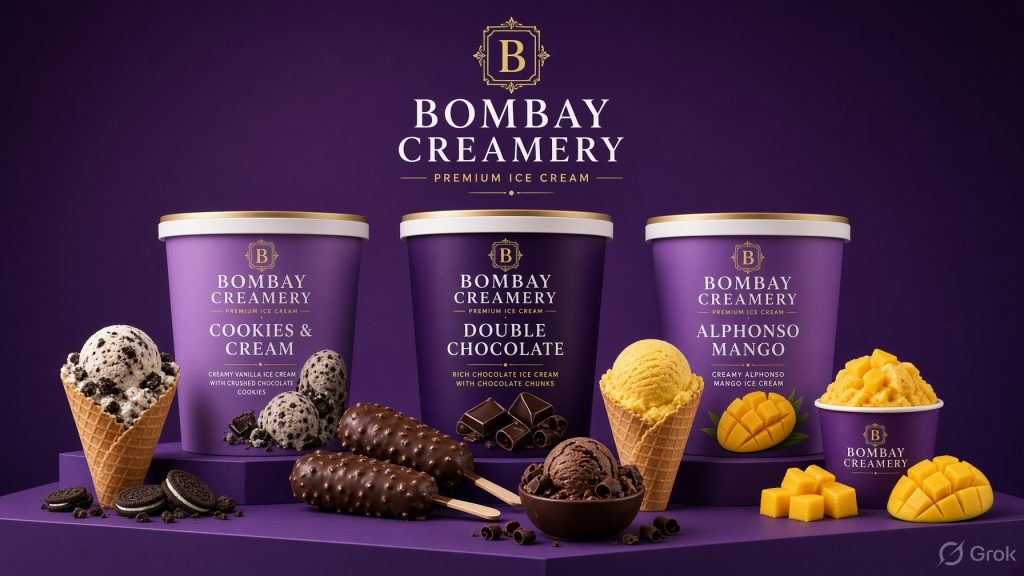
Reliance Consumer Products Limited (RCPL), the FMCG arm of Reliance Industries, stepped into India’s crowded ice cream segment with Bombay Creamery. Positioned as the country’s first “accessible premium” dairy ice cream, the brand is made with real dairy cream and carries the promise of “Global Quality at Affordable Price.”
The range covers the full spectrum of everyday formats—cones, cups, tubs, bars and sticks—with prices starting at ₹10. Products were first made available in Western India, with a pan-India rollout planned shortly thereafter. The entry price is notably lower than many established options; a Reuters check around the launch found Amul’s mango stick at ₹20.
T. Krishnakumar, Director at RCPL, framed the brand’s philosophy clearly: “We built Bombay Creamery around one simple idea that dairy shouldn’t need shortcuts. RCPL is not just entering the ice cream category — we’re committing to it. Made with real dairy cream, Bombay Creamery guarantees the promise of genuine taste of a real ice cream every single time, at a price every Indian family can afford.”
India’s organised ice cream market is estimated at roughly ₹18,000 crore. Long-standing players include Amul, Mother Dairy, Vadilal, Kwality Wall’s, Hatsun Agro’s Arun, and premium names such as Magnum and Baskin-Robbins. Regional brands and private labels further fragment the space. Summer peaks, impulse purchases at kirana stores and modern trade, and growing in-home consumption of tubs all define the category.
Reliance’s edge lies less in novelty and more in infrastructure. RCPL can draw on the group’s national distribution network, extensive retail footprint (including Reliance Retail stores and quick-commerce partnerships), and consumer data. Analysts have noted that the combination of aggressive pricing, freezer placement and scale could pressure both national and regional rivals, provided the company converts trial into repeat purchases and expands its cold-chain reach.
The launch continues Reliance’s broader push into packaged consumer goods. After reviving Campa Cola and building presence in staples and snacks, ice cream represents another high-volume, high-frequency category where price and availability matter as much as brand prestige. By insisting on real dairy cream rather than vegetable-fat alternatives while keeping entry prices low, Bombay Creamery attempts to occupy a middle ground that has often been underserved: quality without the premium markup.
Early market reaction focused on the ₹10 starting point and the potential for a price war. Whether the brand can sustain quality at scale, secure sufficient freezer space outside its own retail network, and build loyalty beyond the initial curiosity will determine its success. For now, Bombay Creamery has announced itself with a straightforward proposition: real dairy ice cream, familiar formats, and a price designed to make premium feel ordinary for Indian families.
As the pan-India expansion unfolds, competitors will watch freezer space, trade margins and consumer trial closely. In a market where a single summer can make or break volume, Reliance’s latest consumer foray has begun with characteristic scale and a clear price signal.