


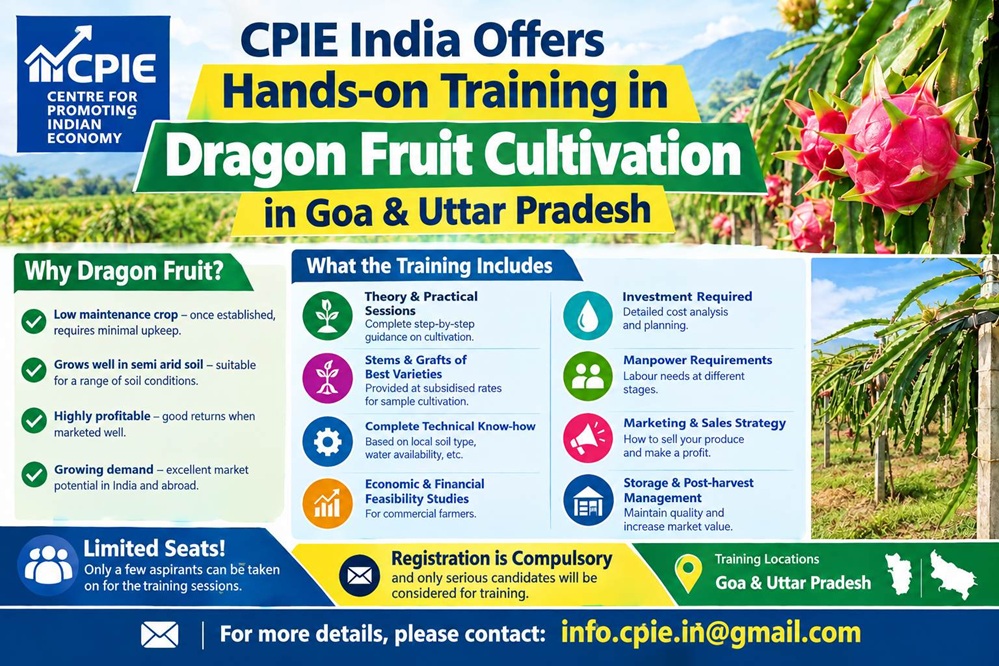
PANAJI/LUCKNOW: CPIE India (Centre for Promoting Indian Economy) is offering a specialized, hands-on training programme in dragon fruit cultivation, aimed at farmers, aspiring entrepreneurs, landowners and individuals interested in developing dragon fruit as a commercial agricultural enterprise in Goa and Uttar Pradesh.
The training programme has been designed to combine theoretical knowledge or theory sessions with practical, field-oriented sessions, giving participants an understanding of the complete process involved in establishing and managing a dragon fruit plantation. According to a CPIE India spokesperson, the programme is intended not merely to teach cultivation techniques but to provide participants with the technical and commercial knowledge required to evaluate dragon fruit farming as a potential business opportunity.
Dragon fruit has attracted increasing interest among farmers because the crop can be cultivated with comparatively low maintenance and low water requirements, once an appropriately designed plantation is established. It can also perform in a range of soil conditions, including semi-arid environments, laterite soil found in Goa and semi dry soils of Uttar Pradesh, provided that essential requirements such as drainage, irrigation and soil suitability are properly addressed.
From Plantation to Commercial Production
The CPIE India training programme covers the fundamentals of establishing a dragon fruit farm, including land selection, soil characteristics, planting systems, irrigation, crop management, support structures, nutrition and general maintenance.
An important component of the programme will be the introduction of participants to different varieties and planting material. Trainees will be provided stems and grafts of selected dragon fruit varieties at subsidised rates for sample cultivation. This will allow participants to gain practical experience with planting material before making larger investments in commercial cultivation.
For individuals planning to establish a commercial dragon fruit farm, CPIE India will provide complete technical know-how and cultivation methodology based on local conditions, including soil type, water availability and other site-specific factors, including soil testing, etc.
The approach is particularly relevant because agricultural conditions can differ substantially between locations. A cultivation model suitable for one region may require modification in another depending on soil, rainfall, irrigation availability, temperature and other factors.
Understanding Investment and Financial Feasibility
The programme also addresses one of the most important questions for any prospective farmer: How much investment is required and whether the proposed farm can be financially viable?
Participants will be introduced to the various cost components associated with dragon fruit cultivation, including land preparation, support structures, planting material, irrigation infrastructure, fertilisation, labour and ongoing maintenance.
For farmers considering commercial-scale cultivation, practical economic viability and financial feasibility studies can also be undertaken. Such assessments can help prospective growers understand the expected investment, operating costs, manpower requirements and potential revenue scenarios before committing substantial capital.
The programme also examines manpower requirements, enabling participants to understand the labour involved at different stages of cultivation, maintenance, harvesting and storage and transportation.
Marketing Is Central to Profitability
While cultivation is an essential part of dragon fruit farming, CPIE India says that marketing and post-harvest storage, management and transportation are equally important to the commercial success of the crop.
Dragon fruit can have attractive market potential when growers are able to produce good-quality fruit and establish appropriate sales channels. However, profitability depends on several factors, including production costs, yield, variety, quality, market prices, transportation and the ability to reach suitable buyers.
Consequently, the training programme includes a dedicated module on how to sell dragon fruit and develop a profitable marketing strategy. Participants will be introduced to considerations such as identifying potential markets, dealing with buyers, pricing, direct sales and other approaches that can help farmers improve the commercial value of their produce.
Storage and post-harvest handling are also covered, since maintaining fruit quality between harvesting and sale can have a direct impact on marketability and returns.
Limited Seats and Compulsory Registration
CPIE India has emphasised that the programme will have limited seats, with only a selected number of aspirants being accommodated in the training sessions. Registration is therefore compulsory.
The organisation says the programme is intended for serious candidates who genuinely wish to learn dragon fruit cultivation, whether for sample cultivation, future commercial farming or agricultural entrepreneurship.
By combining classroom theory, practical exposure, planting material, technical guidance, financial assessment and marketing knowledge, the programme seeks to provide participants with a broader understanding of dragon fruit farming—from selecting the right site and planting material to cultivation, harvesting, storage, marketing and profitability.
For aspiring growers of dragon fruit in Goa and Uttar Pradesh, the programme offers an opportunity to study the crop before making major commercial investments and to develop a cultivation strategy suited to their individual land and resource conditions. Interested individuals can contact CPIE India via their Facebook page or on email: info.cpie.in@gmail.com.