


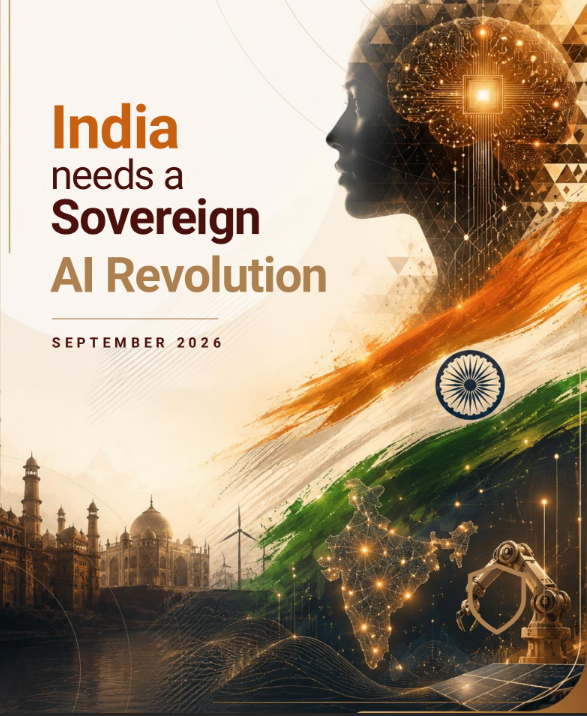
Bengaluru : India’s growing dependence on foreign-owned AI models and technology infrastructure could create strategic vulnerabilities as access to frontier technologies becomes increasingly shaped by geopolitics, export controls and national interests, according to a new report by Primus Partners, India needs a Sovereign AI Revolution.
The paper argues that India must move beyond being a large-scale adopter of global AI technologies and build sovereign capabilities across the AI stack, including compute, models, data, infrastructure, talent and applications. While global technologies will continue to play an important role, the report stresses that critical infrastructure, public services and strategic sectors should not become dependent on AI systems that India does not control.
“AI sovereignty is not about operating in isolation. It is about ensuring that India has the capability to build, control and adapt the technologies that underpin its critical systems. We need to invest in indigenous IP, compute, talent and R&D today so that access to frontier AI does not become a strategic vulnerability tomorrow,” said Devroop Dhar, Co-Founder and Managing Director, Primus Partners.
The paper identifies increased investment in R&D as a critical priority. India’s gross expenditure on R&D currently stands at around 0.84% of GDP, significantly below the global average of 1.92%. Primus Partners has called for more private-sector involvement in R&D, particularly in fields like AI, quantum technologies and semiconductors, and greater incentives to boost research led by industry.
India has a strategic lever – the mandatory CSR spend (2% of net profit). The Schedule VII of the Companies Act enables CSR funds toward R&D, but only via public institutions (CSIR, DST, IITs), and this spend gets no tax deduction under Section 35. Widening this to cover in-house R&D in priority areas and frontier technologies such as Quantum, AI, semiconductors would unlock a private pool for R&D. Amendment to Schedule VII and Section 35 can easily enable this. Redirecting even 10% of India’s annual CSR pool could create a Rs 4,000 Cr. kitty every year for in-house R&D, driving private research in this area. Over a 5 year period, it can provide in excess of Rs 20,000 Cr. for research in frontier technologies, which can be a game changer.
The report also recommends businesses and government systems to adopt a model-agnostic approach so that applications can run on different AI models and are not tied to a single provider. This, it argues, would give organisations greater flexibility as the AI ecosystem evolves and reduce the risks associated with dependence on one technology provider.
Talent is another key piece of the equation. Primus Partners has called for greater efforts to bring Indian researchers and AI professionals working overseas back into the country, with targeted support for research, relocation and leadership opportunities.
The larger message is that India’s AI journey cannot stop at adoption. Building the ability to develop, control and scale critical AI capabilities will be important for the country’s technology competitiveness, economic resilience and strategic autonomy.
—-