


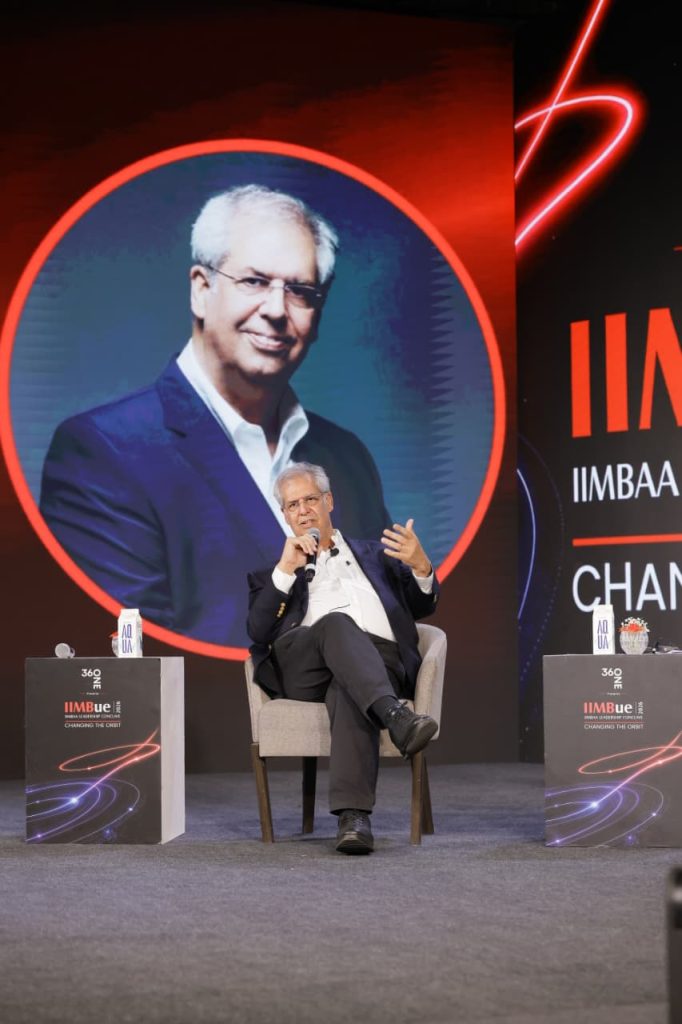
Bengaluru : Declaring that businesses must ultimately serve society and not merely generate wealth, Tata Trusts Chairman, Noel Tata on Sunday spoke about the roadmap for India’s largest philanthropic organisation, signalling a strategic intent towards creating enduring assets in healthcare and education in particular, while seeking greater accountability in social spending.
In a comprehensive articulation of the Trusts’ future direction, Noel Tata speaking at the Indian Institute of Management Bangalore’s flagship alumni leadership conclave IIMBue 2026, stated that the guiding philosophy inherited from the founders of the Tata Group remained unchanged. The founders settled the Trusts with one message, he said – ” do good for India. They never said become the biggest company. The companies exist to serve India and improve the quality of life,” he said.
Calling his transition from corporate leadership to philanthropy a fundamental shift in mindset, Noel Tata said, “You stop trying to make money and start trying to spend it.” Working in the social sector, he added, exposes one to the enormity of challenges faced by ordinary people and the responsibility of ensuring every rupee creates lasting value. He said the Tata Trusts will continue to build on their legacy of institution building, exemplified by institutions like Indian Institute Of Science, Bengaluru; Tata Institute Of Fundamental Research, Mumbai ; Tata Memorial Hospital ; Tata Institute Of Social Sciences; National Centre For Performing Arts, Mumbai and several others.
As part of this strategy, Tata announced plans to expand affordable healthcare by developing several not-for-profit multi-speciality hospitals across India after partnering with the Assam government to establish 17 cancer care hospitals in the state. The proposed hospitals will operate on a cross-subsidy model, with paying patients helping finance treatment for underserved sections without compromising on the quality of doctors, medicines or medical facilities.
Education, he said, would continue to be another major pillar of the Tata Trusts’ next phase. Describing the proposed undergraduate institution being established in partnership with IIM Bangalore as a significant milestone, Tata said India urgently needs many more world-class educational institutions. He noted that thousands of talented Indian students currently pursue higher education abroad every year because of the limited availability of quality institutions at home.
“There is no reason why India cannot build enough quality institutions so students can study in India instead of leaving simply because there are too few seats,” he said.
Pointing to the large number of Indian-origin faculty members teaching at leading global universities, including Harvard, he said India has no shortage of academic talent and with adequate institutional infrastructure, the country will be able to attract and retain it.
The address marks Noel Tata’s future direction of the Tata Trusts, placing institution-building, measurable social impact and nation building at the centre of the organisation’s mandate while reaffirming a philosophy that has guided the Tata Group for over a century.
Earlier Day 2 of IIMBue 2026 opened with a panel discussion: ‘Beyond Diversity: Humans in an Alien World’ featuring Alina Alam, Founder & CEO, MITTI Café, and Safeena Husain, Founder, Educate Girls, hosted by Prof. Mukta Kulkarni, Dean Programmes and Professor of OBHRM with deep research interests in workplace inclusion and accessibility. Safeena and Alina shared that education opens doors and opportunities, even more so for the disadvantaged and the disabled. Highlighting the need to challenge perceptions and patriarchal attitudes, in the country, about both disability and daughters, Alina and Safeena drew attention to the scale and cost of exclusion, and the crying need for education to be the “unlocker” to opportunity Safina went on to share stories of resilience and grit displayed by girls who are fighting for a second chance. Alina recounted how a staffer on the autism spectrum came up with the brilliant idea of using the resources at the locked-down Mitti cafes, during the peak COVID period, to provide meals to hundreds of hungry migrant workers. Urging people in the room to repay their social debt, Alina called for compassion and courage to lessen differences.
The second panel on Day 2 IIMBue 2026 brought together alumni including Prof. Das Narayandas, PGP ’84, Harvard Business School; Manish Tiwary, PGP ’95, Managing Director, Nestlé India; Seshadri P R, PGP ’88, MD & CEO, South Indian Bank; and Prabha Narasimhan, PGP ’97, MD & CEO, Colgate-Palmolive India, to examine how organizations renew themselves amid technological disruption and shifting markets. On the biggest things that leadership must do to stay relevant, the panellists listed reading early signs, reducing the time between decisions and actions, and learning new skills.
Reflecting on technology adoption, Manish Tiwary observed, “As leaders, we must be comfortable with change instead of hunkering down and protecting our roles and tasks”.
For Prof. Das Narayandas, reinvention depends on leaders who enable others to lead. Teams must be “reskilled and retooled”, while “30-40 per cent” of both tasks and decision-making should move closer to where the work happens. Echoing this, Prabha Narasimhan remarked, “Working with leaders who move decision-making downwards is indeed the biggest joy”. Drawing on the transformation of banking, P R Seshadri reflected that lasting change rarely comes through sweeping overhauls. It comes from “reading the need right” and building efficiencies through small, palatable changes that accumulate over time. Closing with advice for the next generation, Prof. Das Narayandas urged participants to “Find a culture, a company or a cause that allows you to fail because through such failure comes learning”.
During the fireside chat ‘Stars that Shifted Orbits’, Bhumi Satish Pednekar, Actor, Entrepreneur, UN SDG Advocate and Climate Warrior, spoke with PGP ’88 Saif Qureishi, CEO & MD, KRYFS Power Components and Past President, IIMB Alumni Association, and shared her own story of reinvention. Looking back at the decision that shaped her life, Bhumi recalled knowing she wanted to become an actor at 12. “I was a gawky but very opinionated teenager. The only place I found solace and peace was on stage because that was the only place where I was positioned way above the school bullies”. From choosing films that shape public discourse to becoming an entrepreneur to “clean up the beverage space,” her choices, she said, have been driven by purpose. “I am a very success-hungry person, and I want to leave behind a legacy of genuine and tangible change”.
The fireside chat, ‘From Molecules to Markets: Scaling Healthcare Across Borders’ on Day 2 of IIMBAA’s leadership conclave #IIMBue2026, featured Prasad G V, Co-Chairman & MD, Dr. Reddy’s Laboratories Ltd, and PGP ’88 Devendra Surana, Managing Director, Bhagyanagar India Ltd. “More than orbit change to stay relevant, it is all about growing adjacencies”, said Prasad, tracing the evolution of Dr Reddy’s Laboratories through the growth of its products, people and culture. “Access and innovation have remained the cornerstones of our business”. According to Prasad, to scale as a global enterprise, the company’s leadership had to learn many things, including understanding legal and regulatory frameworks, and listing and compliance systems, across borders. “Success is also beyond profits. To us, it is about reaching as many patients as possible”. On long-lived companies, he said fiscal conservatism, creating space for people to fail and learn, and being a learning-focused organization are important to create resilience, as the potential life span of a company is much larger than the life of a company. “Common sense must prevail over processes”.