



By Shary Rajan
There are evenings when the mind refuses its chair. It prowls the same corridors, recites the same
injuries, and breeds the same fears until thought itself becomes a climate— close, unseasonal,
inescapable. I learned, late and almost by grace, that a single point of colour can part that weather.
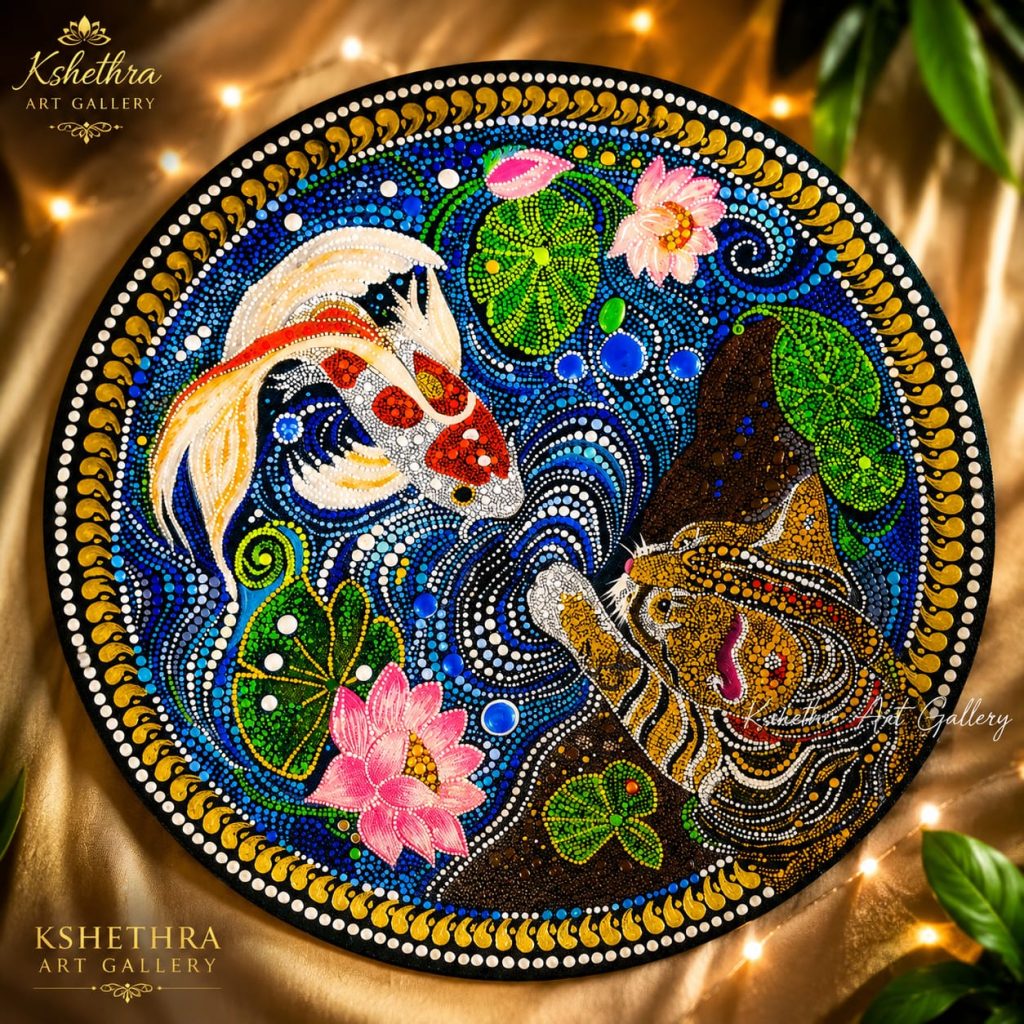
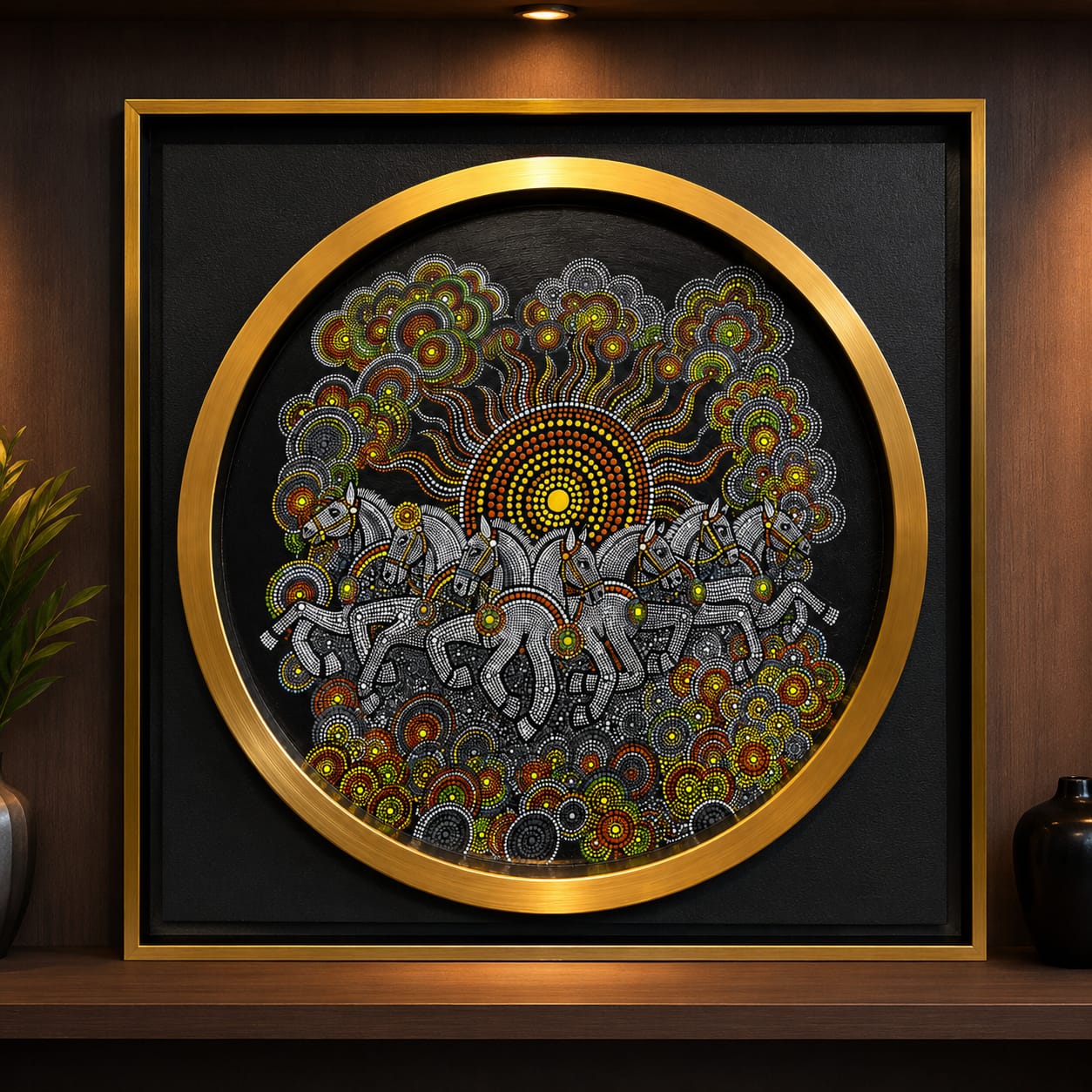
I am a woman who paints with dots. I do not begin with a landscape, nor with a face does the world
already know how to praise. I begin with a bindu—one deliberate drop at the heart of a darkened
circle—and I allow thousands of quieter lives to gather around it, as pilgrims gather around a flame.
For me it is a dedication: a vow spoken not with the tongue but with the wrist. Each sitting offers the
scattered self a centre it may orbit until stillness ceases to feel like exile.
That is the secret the mandala has always kept. Before it was a craft or a hashtag, it was a discipline
of attention. It can take a thought locked in panic’s tight ellipse and teach it a nobler geometry. I
have watched hardness loosen at the rim of a ring I had not planned. I have watched grief, which
arrived as a stain, consent at last to become a pattern. The art does not abolish what we carry. It
rearranges the burden until the bearer can breathe.
The word mandala first appears in the Rig Veda, composed in the second millennium BCE. There it
means a circle of hymns—a completed orbit of knowing. Wisdom, the hymns imply, is not a corridor.
It returns around a still point. Later Tantric thought made the circle a map of cosmos and inner body.
The Sri Yantra locked triangles around a bindu, the seed from which form issues and into which it
dissolves.
The Buddha era gave that circle a moral and mental use. The historical Buddha did not paint palace-
mandalas as later Vajrayana would. He set in motion the Dharmachakra—the Wheel of
Dharma—whose rim is the path and whose hub is awakening. Early communities walked
pradakshina around the stupa, a circular mound that held relic and silence. The body learned what
the sermon said: the mind does not heal by charging forward. It heals by returning, again and again,
to a centre that does not agitate. In Buddhist psychology this is not decoration. It is training.
Scattered attention multiplies suffering. A gathered mind—one-pointedness—softens craving, fear
and the restless story of “I.” The circle became a device for that gathering: look inward, walk around,
rest at the hub.


Centuries later, Indian Mahayana and Vajrayana clothed that insight in form. Monks built sand
palaces of coloured grain—walls, gates, a deity at the unmoving middle—then swept the splendour
inward and gave it to water. The lesson was anicca, impermanence without cruelty. What the
Buddha-era wheel taught the feet, the sand taught the hand: beauty is a path, not a possession. The
elevation lives in the making, not the keeping. That is why the mandala still works on the human
mind. It does not argue with panic. It gives panic a rim, a rhythm and a place to sit.
There is a lineage I claim as a woman, nearer the kitchen door than the monastery gate. Across India,
women have long laid dots upon the swept earth of the threshold until a kolam, muggu or rangoli
appeared. In Kerala, kalam ezhuthu draws deities in powder; at Onam the pookalam widens from a
living centre. The first act is always the point. It was already a mandala: a daily rewriting of the mind
at the edge of ordinary life.
The Western chapter belongs to Carl Gustav Jung. After his break with Freud he walked into the
weather of his own psyche. In 1916 he began drawing a small circle every morning. Later he wrote
that he had found, in the mandala, “the Self”: not the everyday ego, but the totality of the psyche.
Patients in crisis spontaneously produced circles. The psyche, he said, draws a sacred enclosure
when it is threatened with disintegration. Individuation is a walking around the centre—the same
motion the stupa asked of the pilgrim.
I am not a licensed analyst. When I sit to dot, I practise what Jung called active imagination, and
what the Buddhist path called one-pointedness: allowing the mind a form the hands can follow. The
bindu is a point I serve. A misplaced drop is shadow work. A series of boards across months is a case
history written in points instead of words.
Any honest history of the dot must also bow toward Aboriginal Australia—and must bow without
theft. Aboriginal peoples marked Country with dots in rock, body paint and sand—law, story, kinship
and map. This tradition is sovereign. Contemporary “dot mandala” work must never masquerade as
Aboriginal art. What must be said, with respect, is that a field of points can carry cosmology.
The board most people now call a “dot mandala” is a late child of Vedic circle, Buddha-era wheel,
Vajrayana sand, Jung’s inner enclosure, and folk craft. Acrylic replaced sand. The ritual could be done
alone. A mandala without intention is only a pretty pattern. I paint as a dedication so the dots do not
become another product.
Dotting teaches through the hand. Dip on the inhale. Place on the exhale. Panic is a thought that has
forgotten the body. Then a drop lands off-orbit. The old self wants to wipe the board and begin
again. The practice asks something kinder: work the error into the next ring. A mind that can
metabolise a mistake without self-erasure has already changed its religion.
Before the first mark I name what the centre is for—peace, clarity, forgiveness, or the courage to
remain. I treat the table as a threshold. The phone is exiled. Dedication collapses the moment it
becomes display. Sometimes I keep a sequence. The boards of a year tell a story no diary told: the
month the centre held, the month the left side went dark, the month gold returned without being
invited.
We live in an age that multiplies images and starves attention. The mandala is almost embarrassingly
simple against that noise: a centre, a return, a limit. That is why it is returning. The form has
changed. The hunger has not.
My selected paintings are available for sale. Contact – kshethraartgallery@gmail.com, Phone:
+916282450195