


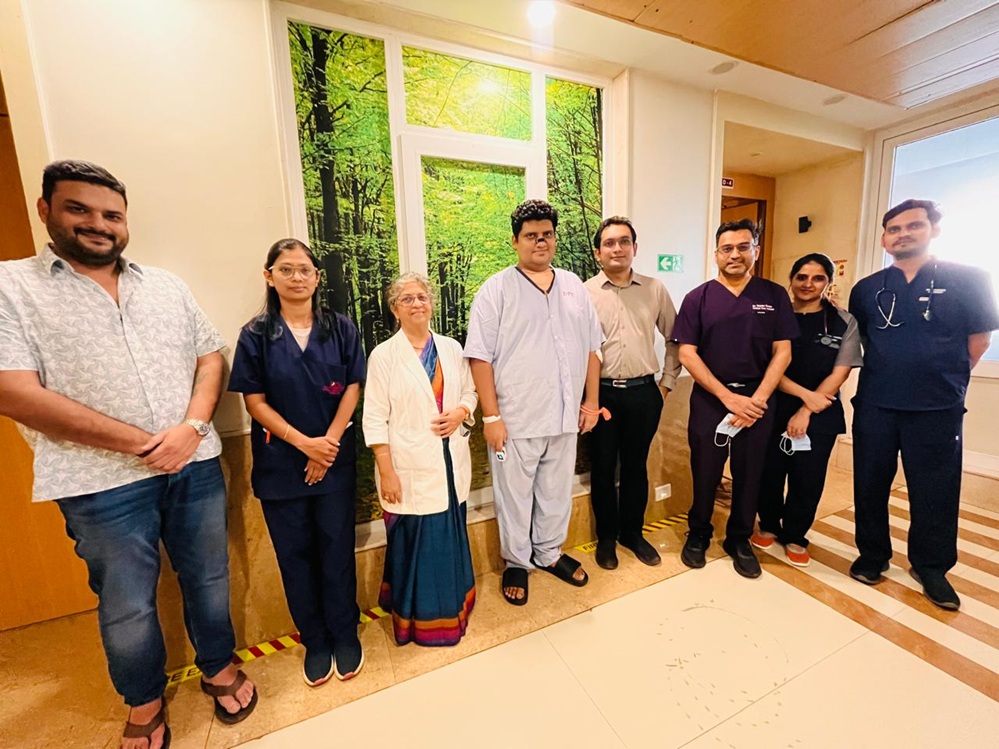
Pune : With H1N1 and severe respiratory infections continuing to be a concern across the country, the importance of early recognition of respiratory deterioration and access to advanced critical care therapies such as Extracorporeal Membrane Oxygenation (ECMO) is increasingly relevant. In a life-threatening case of H1N1 pneumonia, the Critical Care Medicine team and dedicated 24/7 ECMO Retrieval Team at DPU Super Specialty Hospital, Pimpri, Pune, successfully supported a critically ill patient whose oxygen saturation had dropped to critically low levels of below 40 percent helping bridge him through severe respiratory failure towards recovery.
The patient had been suffering from symptoms of pneumonia for approximately five to seven days and had initially been managing his symptoms at home. Following deterioration, he was admitted to private hospital on August 4 with severe respiratory failure and oxygen saturation of less than 40 per cent. The DPU Super Specialty ECMO team received an emergency call at approximately 10:30 pm on August 4.
Recognising the urgency, the DPU ECMO Retrieval Team was mobilised immediately. The team reached the referring hospital, stabilised the patient and initiated the process of transferring him safely to DPU Super Specialty Hospital. Transporting a critically ill patient who is dependent on a ventilator and has severe respiratory failure is highly complex and requires an experienced retrieval team capable of providing continuous critical care during the transfer.
Within approximately four hours of the emergency call, the patient was placed on VV ECMO at around 2:00 am on August 5 and transferred to DPU Super Specialty Hospital for continued advanced critical care.
ECMO (Extracorporeal Membrane Oxygenation) is an advanced life-support therapy that temporarily supports the function of the lungs. Blood is circulated outside the body through an ECMO circuit, where it is oxygenated and carbon dioxide is removed before the blood is returned to the patient. This allows the lungs to rest and recover while the underlying condition is treated.
In simple terms, ECMO can be thought of as a “dialysis machine for the lungs”—providing crucial support when the lungs are unable to adequately oxygenate the body on their own.
For patients with potentially reversible lung failure, such as severe pneumonia, ECMO can act as a bridge to recovery. The timing of initiation is particularly important. Early recognition of worsening respiratory failure and timely consideration of ECMO can provide a window in which the underlying disease can be treated while the lungs are given an opportunity to heal.
Under the care of the Department of Critical Care Medicine, the patient received ECMO support along with comprehensive intensive care and treatment of the underlying H1N1 pneumonia. He remained on ECMO for approximately eight days. As his lung function improved, ECMO support was gradually reduced, and the patient was successfully decannulated on the ninth day.
He has since been successfully weaned off ECMO and is recovering well and has been discharged from the hospital.
The patient was managed by a multidisciplinary team comprising Dr. Prachee Sathe, Professor and Head, Department of Critical Care Medicine; Dr. Asir Tamboli, Associate Professor and In-charge, Department of Critical Care Medicine; Dr. Viren Attarde, Associate Professor, Department of Critical Care Medicine; and Dr. Riddhi Kundu, Assistant Professor, Department of Critical Care Medicine, Dr. Rahul Kendre, Transplant Pulmonologist, Dr. D. Y. Patil Medical College, Hospital & Research Centre, Pimpri, Pune supported by the hospital’s ECMO, nursing, perfusion, respiratory care and rehabilitation teams.
Speaking about the case, the Dr. Prachee Sathe, Professor and Head, Department of Critical Care Medicine Critical Care Medicine team at DPU Super Specialty Hospital said, “In carefully selected patients with potentially reversible lung failure, such as severe pneumonia, ECMO can act as a bridge to recovery. It gives the lungs time to rest and recover while providing the body with the oxygenation it needs. In this case, the objective was not simply to sustain the patient; it was to create a window in which his lungs could heal.”
The team further emphasised the importance of early recognition and timely intervention. “There can be a point in severe pneumonia where conventional ventilation is no longer sufficient to maintain adequate oxygenation. Recognising this deterioration early and considering ECMO at the appropriate time can potentially change the trajectory of the illness. ECMO does not treat the infection itself; it provides the lungs with the time and support they need while the underlying disease is treated.”
24/7 ECMO Retrieval Capability
The case also highlights the importance of having an ECMO retrieval capability that can respond rapidly to critically ill patients outside the hospital. In severe respiratory failure, transferring an unstable patient without appropriate support can be extremely challenging.
DPU Super Specialty Hospital has developed a dedicated 24/7 ECMO team and retrieval capability, bringing together critical care specialists, ECMO-trained clinicians, perfusionists, nurses, respiratory care professionals, physiotherapists and other specialists. The integrated team can assess, stabilise and retrieve critically ill patients requiring advanced extracorporeal support. DPU Super Specialty Hospital has successfully managed more than 50 ECMO cases over the past three years, reflecting its growing expertise, specialised critical care capabilities and readiness to provide advanced life support to patients with severe cardiac and respiratory failure.
“ECMO is not simply a machine; it is a highly coordinated system of care. The technology, retrieval team, intensivists, perfusionists, nurses, respiratory care professionals and the entire critical care infrastructure have to work together seamlessly. The ability to respond around the clock and bring a critically ill patient to an ECMO-capable centre at the right time is an important part of ECMO care,” Dr. Prachee Sathe added.
Rehabilitation Begins During ECMO
Recovery does not begin only after ECMO is stopped. At DPU Super Specialty Hospital, early rehabilitation is incorporated into the ECMO journey wherever clinically appropriate. Specially trained nursing and physiotherapy teams work with patients to initiate rehabilitation and mobilisation as early as their clinical condition permits.
This multidisciplinary approach is aimed at reducing the impact of prolonged critical illness and helping patients progress from life support towards functional recovery.
DPU as an ECMO Training Centre
DPU Super Specialty Hospital’s ECMO programme also focuses on training and capacity building. The hospital serves as an ECMO training centre, with structured ECMO training and fellowship programmes associated with the ECMO Society of India, contributing to the development of specialised expertise in this area of critical care.
The hospital’s approach encompasses the entire continuum of ECMO care from early identification and referral to rapid retrieval, timely initiation, advanced critical care, rehabilitation and successful weaning.
Dr. Bhagyashree P. Patil, Pro-Chancellor, Dr. D. Y. Patil Vidyapeeth (Deemed to be University), Pimpri, Pune, said, “This successful case reflects our commitment to ensuring that patients facing life-threatening medical emergencies have access to advanced, timely and comprehensive care. The ability of our dedicated ECMO Retrieval Team to respond rapidly, stabilise a critically ill patient and bring him safely to our hospital for advanced treatment demonstrates the strength of a well-coordinated healthcare ecosystem. We are proud of our Critical Care Medicine and ECMO teams for their expertise and dedication. Most importantly, this case gives hope to patients and families by demonstrating that with the right intervention at the right time, even severe and potentially life-threatening respiratory failure can have a path towards recovery.”
Dr. Rekha Arcot, Dean, Dr. D. Y. Patil Medical College, Hospital & Research Centre, Pimpri, Pune, said, “This case highlights the importance of combining advanced technology with clinical expertise, rapid decision-making and seamless teamwork. ECMO is a highly specialised form of life support, and its successful use depends not only on the technology but on an entire multidisciplinary team working together at every stage from identifying the right patient and initiating support to providing intensive care, rehabilitation and safely weaning the patient off ECMO. The successful recovery of this patient demonstrates the role ECMO can play as a bridge to recovery in carefully selected patients with potentially reversible lung failure. Our focus remains on continuously strengthening our critical care capabilities and ensuring that patients with the most complex medical needs receive timely, specialised and compassionate care.”
The successful recovery of this patient reinforces an important message in the management of severe respiratory failure: ECMO can provide a crucial window of time for the lungs to recover while the underlying disease is treated.
At DPU Super Specialty Hospital, the focus is on building ECMO readiness across the entire continuum of care, from rapid retrieval and timely initiation to advanced critical care, early rehabilitation and successful weaning, giving critically ill patients the best possible opportunity for recovery.