


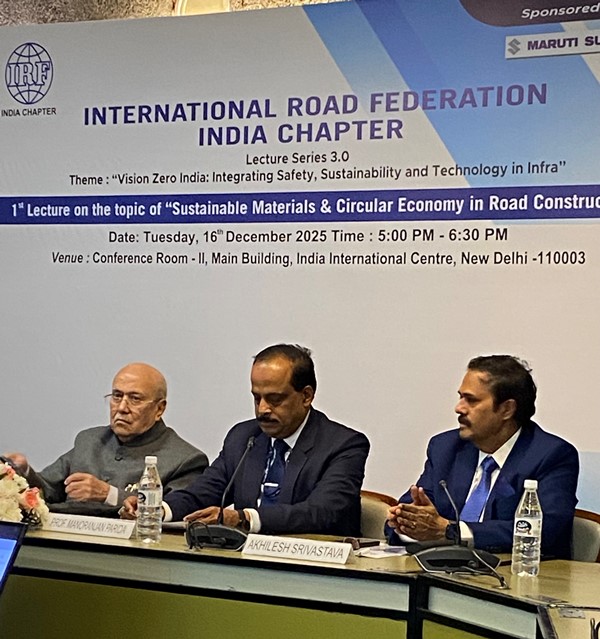
New Delhi: Eminent infrastructure and road safety experts have stressed on the need of finding and developing innovative solutions, best practices, and policies to transform India’s roads for the future.
“India’s infrastructure growth is happening at an unprecedented scale, and with it comes a tremendous demand for natural aggregates and binders — materials whose extraction is depleting our environment. At the same time, we are facing a parallel crisis of waste generation. Plastic, steel slag, red mud, construction and demolition debris, municipal solid waste are all posing serious disposal challenges. Central Road Research Institute (CRRI) is focused on pioneering innovative and sustainable road construction materials by heavily utilising various industrial wastes and advanced technologies. “ said Prof. Manoranjan Parida, Director, Central Road Research Institute (CCRI) while speaking at a seminar on ‘Sustainable Materials and Circular economy in road construction’ organised by India chapter of International Road Federation (IRF).
“To meet the challenge of waste management including plastic, steel slag, red mud, construction and demolition debris, municipal solid waste which are all posing serious disposal challenges CRRI has developed innovative materials and technologies for use in road construction including Steel Slag technology using processed steel slag, a waste product from the steel industry, as a substitute for natural aggregates in road construction. India’s first national highway steel slag road section was built using this technology on NH-66 (Mumbai-Goa National Highway), resulting in a stronger and more eco-friendly pavement that is 30% shallower than conventional roads.” said Prof Parida.
“The other innovative products include incorporating plastic waste into pavements by developing plastic-modified bitumen and geocells made from end-of-life plastic, in collaboration with entities like BPCL. “Bio-bitumen” is produced through the pyrolysis of lignocellulosic biomass. This provides an alternative, durable, and cost-effective binder to traditional bitumen, suitable for diverse climatic conditions. And Ecofix , The ready-to-use pothole repair mix is looked upon as an instant solution for distressed roads, which worsen during the monsoon. It has been used by the Delhi government and other states to fix potholes .” said Dr Satish Pandey , Senior principal scientist ,CRRI speaking on the occasion.
“At present road construction is one of the biggest environmental polluters in the country with 37% emissions coming from road construction. Roads and highways being constructed in the country with lifecycle of about 25-30 years including Delhi-Mumbai highway are getting damaged within two years of construction. We need sustainable road infrastructure” said Dr Ambika Behl of CRRI.
“Despite major advances in the road Infratech sector, the country still stands at the crossroads of safety, sustainability, and innovation, we must reaffirm our commitment to building safe, efficient, and sustainable roads. The Road to Vision Zero – both aims for Carbon Zero and Fatality Zero” said Mr K K Kapila, President Emeritus, International Road Federation (IRF) a global road safety body working for better and safer roads worldwide.
“Every year, over 1.7 lakh lives are lost on Indian roads, a crisis that demands urgent intervention. While global road fatalities have declined by 5%, India has seen a 10% rise, underscoring the need for technology-driven, policy-backed, and infrastructure-led interventions. As India progresses towards becoming a $5 trillion economy, infrastructure plays a pivotal role in enabling economic growth, connectivity, and road safety. Despite major advancements, road congestion, safety concerns, climate resilience, and technological integration remain key challenges.” Said Mr Kapila
For smart & sustainable infrastructure development green highways & resilient road designs are needed with help of climate-adaptive materials and low-carbon technologies. Circular economy principles including Promoting Reduce, Recycle, and Reuse in road construction for sustainability.
For Technology-Driven Road Infrastructure, Intelligent Transport Systems (ITS): Enhancing efficiency with AI-based traffic management, IoT-enabled road monitoring, and digital twins. Integration of EV-ready corridors and charging infrastructure to support sustainable mobility.
The others who spoke on the occasion included Mr Akhilesh Srivastava, President India chapter of IRF, and Mr Dhruv Rathi , Director , Shri Rathi steel group.