


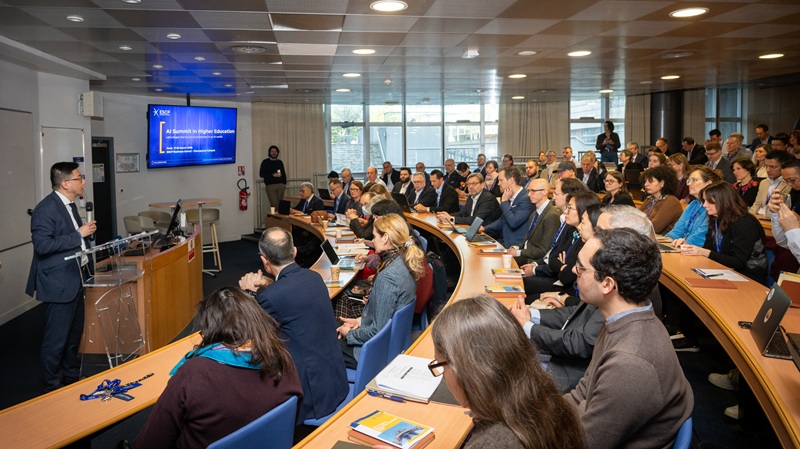
As artificial intelligence rapidly transforms industries, a global gathering of academic leaders and industry experts has highlighted a critical gap between higher education and workforce readiness, one that holds significant implications for countries like India.
At the AI in Higher Education Summit 2026 held at ESCP Business School in Paris, experts from over 27 countries, 67 universities, and leading global organizations underscored a pressing concern: while AI adoption in education is accelerating, institutions are struggling to prepare students for an AI-driven workforce.
The summit emphasized that the future of education must move beyond traditional skill-building to focus on critical thinking, problem framing, and human judgment capabilities that remain uniquely human in an AI-augmented world.
Léon Laulusa, Dean and Executive President, ESCP said, “Adoption is a human challenge, and organizations move at the speed of trust,” highlighting the importance of building institutional readiness alongside technological adoption.
The discussions also highlighted the need for stronger governance frameworks. While AI tools are increasingly being integrated into classrooms, institutional policies and ethical guidelines remain fragmented and underdeveloped. Experts stressed that responsible AI adoption must be built on clear governance, transparency, and accountability.
For India, home to one of the world’s largest student populations these insights carry particular urgency. As industries increasingly priorities AI literacy alongside human-centric skills such as creativity, empathy, and strategic thinking, higher education institutions will need to rapidly adapt curricula, teaching methods, and assessment models.
The summit also introduced new frameworks to guide this transition, including a three-pillar approach focused on accountability, experimentation, and creativity, called the ABC framework, offering a roadmap for universities aiming to become AI-ready.
As AI continues to redefine the nature of work, the message from global academic and industry leaders is clear: the future of education will not be defined by how well students use AI tools, but by how effectively they think, question, and lead alongside them.
Some of the key insights shared in CarringtonCrisp’s report during the summit highlighted important trends in AI readiness. One of the most striking insights revealed that 58% of employers believe universities are not doing enough to equip graduates with relevant AI skills, even as 77% expect incoming talent to have AI experience. At the same time, 44% of faculty admitted that students are more knowledgeable about AI than they are, pointing to a growing capability gap within institutions themselves.