


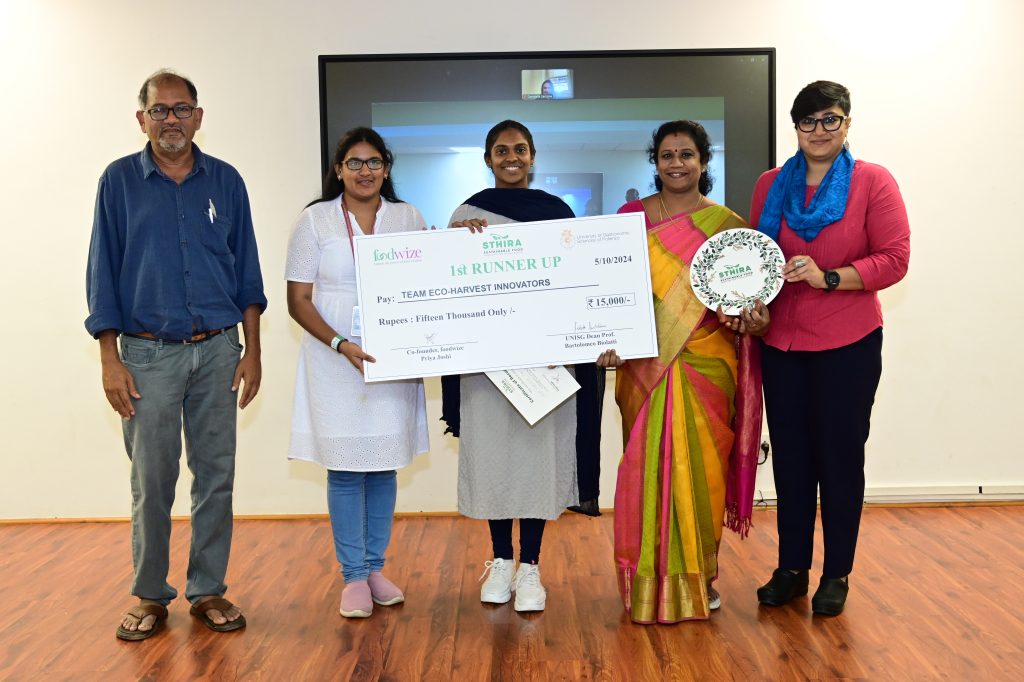
Bengaluru: Foodwize today announced the launch of STHIRA 2026 in collaboration with the University of Gastronomic Sciences of Pollenzo, Italy, the third edition of its Sustainable Food Innovation Challenge, marking an important evolution in how India identifies and supports solutions for the future of food. Moving beyond idea discovery, STHIRA 2026 introduces a new virtual incubation program designed to help promising concepts progress into prototypes, ventures, and real-world interventions capable of addressing some of the country’s most urgent food system challenges.
At a time when India’s food ecosystem sits at the intersection of multiple pressures, from persistent malnutrition and rising lifestyle diseases to climate volatility, food waste, and changing patterns of production and consumption, STHIRA 2026 is a platform where young people can engage with these realities and develop solutions that are locally grounded, multidisciplinary, and future-facing.
India continues to face a paradoxical food landscape. While nutritional inequity remains a challenge across communities, urban demand for food is rising rapidly, agricultural livelihoods remain vulnerable to climate disruption, and significant food loss continues across value chains. At the same time, younger generations are increasingly disconnected from food systems as an area of innovation and long-term impact.
The 2026 edition is built around a renewed ambition: enabling students not only to imagine new possibilities but also, to build them. Through Foodwize’s newly introduced Virtual Incubator for Sustainable Food, selected participants will receive structured support to strengthen concepts, validate assumptions, develop prototypes, and create implementation pathways. The programme is designed to ensure that strong ideas do not remain presentations but, continue evolving into interventions with tangible outcomes.
STHIRA 2026 invites university students from across India to work across themes that reflect the interconnected nature of food systems. Participants will explore challenges linked to improving access to nutrition, strengthening local food economies and supply chains, reviving indigenous ingredients and practices, and shaping more resilient urban food futures. The programme encourages collaboration across disciplines, including food studies, sustainability, design, urban planning, business, health sciences, engineering, and technology, recognising that the future of food cannot be designed in silos.
Over the last two editions, STHIRA has emerged as one of India’s distinctive youth-led platforms dedicated exclusively to sustainable food innovation. The initiative has generated more than 200 ideas, engaged over 300 students, reached participants across more than 45 universities and 18 disciplines, and extended awareness efforts across more than 125 cities and 400 colleges nationally. Winning concepts from previous editions have addressed challenges ranging from hidden hunger and indigenous food revival to circular solutions for post-harvest losses, rooftop farming systems, and household-scale food waste conversion.
Commenting on the launch, Srijata Sengupta, Co-founder and Partner, Foodwize, said, “STHIRA sits at the intersection of young curiosity and the complex realities shaping the future of food. Over the past three years, we have engaged with more than a thousand students who are attempting to respond to challenges that are ecological, cultural, and deeply systemic. Through STHIRA, we hope to be a catalyst for youth-led transformation. We believe that the future of food can be shaped by ideas that are inclusive by design, rooted in local contexts, simple to adopt, and that embrace long-term impact.”
The initiative brings together academics, practitioners, and ecosystem leaders across food systems, sustainability, entrepreneurship, and design. Participants will receive certificates, access to mentorship, learning resources, and opportunities to engage with experts from India and internationally. Winning teams will receive cash prizes and trophies, while shortlisted teams will be able to progress into deeper incubation and venture development.
Open to university students across India in teams of two to three members from any discipline, STHIRA 2026 will accept registrations until 31 July 2026. Semi-final presentations will take place virtually in September 2026, followed by a final prototype exhibition in Bengaluru in November 2026.
At its core, STHIRA 2026 seeks to spark a broader national conversation: that food must be seen not only as something we consume, but as a powerful medium through which health outcomes improve, livelihoods strengthen, biodiversity is preserved, and resilient futures are built.