


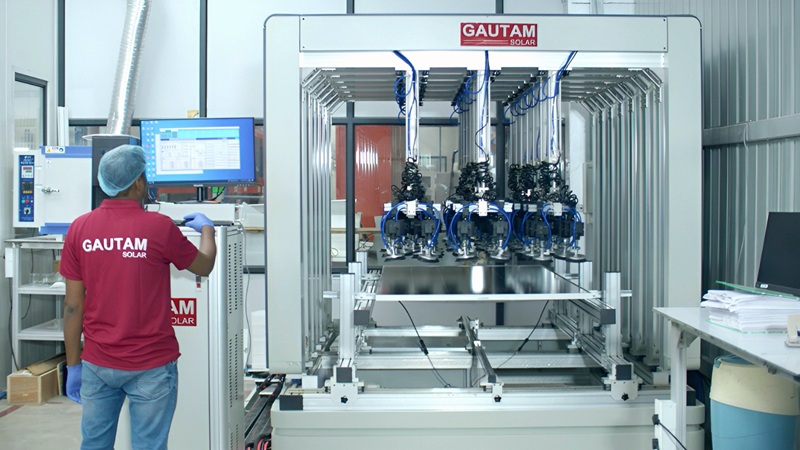
Living up to the commitment of delivering the best quality products, Gautam Solar Pvt. Ltd., one of India’s leading solar module manufacturers, has recently added advanced technologies in the , in-house Solar Module Reliability Testing Laboratory at its manufacturing facility in Bhiwani, Haryana. This new step aligns with the company’s aim to ensure optimal quality control in each product. The facility is one of the most comprehensive in-house module testing capabilities in the Indian solar industry — built to validate performance, ensure durability, and accelerate R&D across Gautam Solar’s full product range.
Objective of the Lab
The Reliability Lab has been established with three core purposes: independent accelerated lifetime testing of every module type in Gautam Solar’s portfolio before it reaches a project site; R&D support to test and validate new module architectures and cell technologies faster than external testing cycles allow; and durability validation under real-world Indian operating conditions — extreme heat, coastal humidity, UV intensity, and mechanical stress — for projects designed to run for 25 to 30 years.
Key Features — Testing Capabilities
The lab conducts 18 distinct module qualification tests across mechanical, thermal, environmental, electrical, and corrosion disciplines — all in-house, with parameters aligned to IEC and industry standards:
• Visual Inspection & AI-Assisted EL Testing — detects micro-cracks and defects pre- and post-lamination using Gautam Solar’s patented AI system
• Sun Simulator (Flash / IV Test) — verifies nameplate wattage and full IV curve for every module
• Thermal Cycling (TC 50 & TC 200, IEC/UL) — -40°C to +85°C cycling to validate solder joint and interconnect durability
• Damp Heat (DH 1000, IEC 60068-2-14) — 1000 hours at 85°C and 85% RH for encapsulant and delamination resistance
• Humidity Freeze (HF 10, IEC 60068-2-38) — combined humidity and freeze cycling for high-altitude and northern environments
• Pressure Cooker Test — 121°C at 100% RH for accelerated moisture ingress screening
• Mechanical Load Testing — 5400 Pa snow load and 2400 Pa wind load, no frame deformation
• Wet Leakage Test — confirms zero current leakage under wet conditions
• Peel Test — validates encapsulant and glass layer adhesion against delamination
• PID Resistance Testing (IEC 62804) — 60°C, 85% RH, 1000V DC for 96 hours
• LETID Testing — 75–80°C for 162 hours, confirming degradation below 1–2%
• UV Pre-Conditioning & UV Exposure — up to 5× sun intensity for encapsulant stability
• Hail Impact Test (IEC 61215) — 25mm hailstone at 84 km/h for glass resilience
• High Voltage / HiPot Testing — insulation and dielectric strength per IEC 61730
• Salt Mist Corrosion Test — validates frame and connector durability for coastal installations
• Sand & Dust Test (IEC 60068-2-68) — 4 positions, 90 minutes each at 9 m/s
• Ammonia (NH₃) Corrosion Test — 6667 ppm over 480 hours across 20 cycles for agri-solar environments
• Cell Test — individual cell EL screening before module assembly for defect-free production
Business Impact
The lab strengthens Gautam Solar’s product reliability by enabling every module to be validated against a full accelerated lifetime test programme before leaving the factory. For customers — developers, EPC contractors, and institutional lenders who require in-house testing capability alongside third-party certifications — the lab provides the quality infrastructure that long-term supply relationships are built on.
For export markets, the lab reinforces Gautam Solar’s credibility with international buyers in Europe, the United States, and Southeast Asia where in-house testing capability is increasingly a prerequisite for premium supply partnerships. Combined with Gautam Solar’s existing IEC, UL, CE, CEC, and ALMM certifications, the lab positions the company at the global frontier of Made-in-India solar quality.