


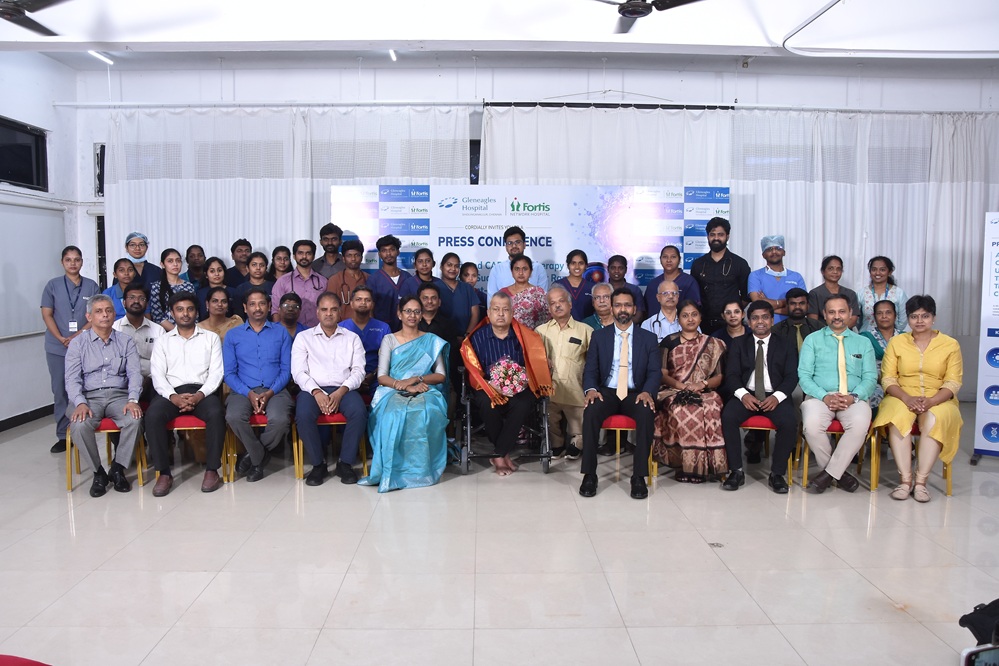
Chennai : Gleneagles Hospital Chennai, a part of Fortis Healthcare, has successfully treated a 49-year-old patient from Andhra Pradesh diagnosed with a rare and aggressive form of CNS(brain) lymphoma using advanced CAR-T cell therapy. Despite developing multiple serious treatment-related complications, the patient achieved complete remission and is doing well.
The patient presented with complaints of persistent headache, giddiness, difficulty in walking, and weakness in his left arm and leg. Detailed investigations confirmed Primary Central Nervous System Lymphoma (PCNSL), a rare type of lymphoma that affects the brain and is known to be difficult to treat.
The patient initially received high-dose chemotherapy, the standard first-line treatment for this condition. However, the disease continued to progress despite four cycles of treatment. He subsequently underwent radiotherapy with chemotherapy, followed by oral targeted therapy as bridging treatment. As the lymphoma remained resistant to treatment, the multidisciplinary team at Gleneagles Hospital Chennai discussed advanced treatment options with the patient and his family, following which the patient proceeded with NexCAR19 (Talicabtagene Autoleucel), India’s indigenous CAR-T cell therapy.
The patient’s immune cells were collected through a specialised procedure called leukapheresis, modified to recognise and attack the cancer cells, and later infused back into his body as CAR-T cell therapy.
Following the treatment, the patient developed several serious but known complications associated with CAR-T cell therapy, including Cytokine Release Syndrome (CRS), a severe inflammatory response, and Immune Effector Cell-Associated Hemophagocytic Syndrome (IEC-HS), a rare but potentially life-threatening condition. His recovery was further complicated by severe infections and a significant drop in blood cell counts.
A dedicated multidisciplinary team comprising specialists from Medical Oncology, Haematology, Infectious Diseases, Intensive Care, and the dedicated CAR-T nursing team closely monitored and managed the patient throughout his treatment. After approximately one month of intensive treatment, he recovered and was discharged.
A follow-up PET-CT scan performed two months after CAR-T cell therapy showed a complete metabolic response, with no evidence of active disease. At his latest follow-up, three months after treatment, the patient continues to do well, has recovered normal blood counts, has experienced no further CAR-T-related complications, and remains on regular follow-up.
Dr. Arun Ramanan V, Clinical Lead & Senior Consultant – Medical Oncology, TRIUM ONCOLOGY GROUP, Gleneagles Hospital Chennai, a part of the Fortis Healthcare Network, said,
” Primary Central Nervous System Lymphoma is a rare and aggressive cancer with limited treatment options when it does not respond to standard chemotherapy. CAR-T cell therapy represents a significant advancement in the treatment of such complex cases. This patient’s successful recovery highlights the importance of timely intervention, advanced treatment options, and a multidisciplinary approach in managing both the disease and its treatment-related complications.”
Highlighting the hospital’s commitment to advanced patient care, Dr S. Niranjani, Chief Operating Officer & Hospital Head, Gleneagles Hospital Chennai, a part of the Fortis Healthcare Network, said,
“Delivering advanced therapies like CAR-T cell therapy requires specialised infrastructure, clinical expertise, and coordinated patient care. We remain committed to making world-class treatment options accessible while ensuring the highest standards of quality and safety.”
Speaking about the hospital’s commitment to advancing cancer care, Mr R. Y. Bharath Kanth Reddy, Chief Executive Officer, Chennai & Hyderabad Cluster, Gleneagles Hospitals, a part of the Fortis Healthcare Network, said,
“This successful outcome reflects our commitment to making advanced cancer care more accessible to patients. By bringing innovative therapies such as CAR-T cell therapy closer to those who need them, supported by multidisciplinary expertise and world-class clinical care, we aim to improve outcomes for patients with even the most complex cancers.”