


Bengaluru: Some of India’s most enduring culinary traditions are not found in cookbooks, but in memory. They live in family kitchens, festive meals, royal courts and the hands of generations of cooks who have preserved recipes and techniques over time. A particular spice, the aroma of something cooking, the first rain of the monsoon or a dish remembered from childhood can transport us instantly to another place and time.
It is this relationship between food and memory that forms the foundation of Goonj, a new 75-seater Indian bar and restaurant on 100 Feet Road, Indiranagar, Bengaluru. Spread across 2,500 sq. ft. on the fourth floor, Goonj brings together lesser-seen Indian recipes, time-honoured cooking techniques and a contemporary cocktail programme, creating an experience that looks at Indian food and culture through the lens of what we remember.
The concept has been developed by Chef Pratik Sharma, Research and Development Chef at Kompany Hospitality, and Manjunath U Gouda, Beverage Head at Kompany Hospitality, bringing together their perspectives on Indian cuisine and contemporary cocktails. The name Goonj, derived from the Urdu word for “echo”, reflects the idea that food, traditions and cultural experiences continue to resonate long after the moment has passed.
Rather than attempting to recreate tradition literally, Goonj takes familiar references and reinterprets them for the contemporary table. The food menu draws from the depth and diversity of Indian cooking, with particular attention to the slow, considered processes associated with the country’s grand kitchens and dum pukht traditions. Traditional dishes are not altered simply for novelty; their character, flavour and process remain central, while presentation and accompanying elements are allowed to evolve.
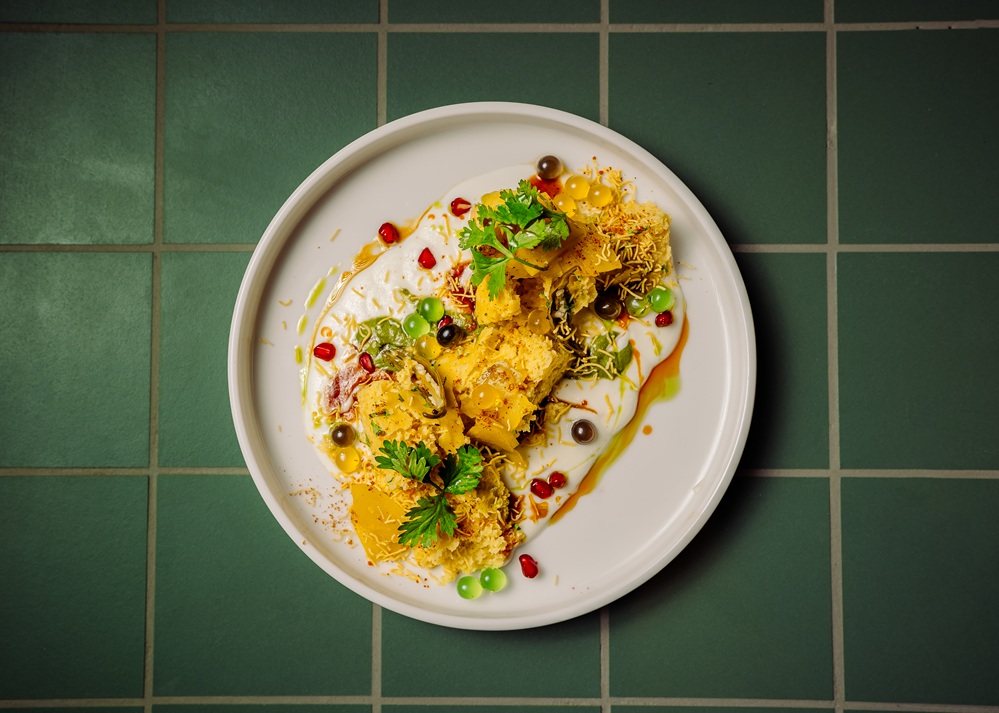
At the heart of the menu is Daastaan-e-Zaika, a selection inspired by recipes and techniques that are increasingly difficult to find on contemporary menus. The offering includes dishes such as overnight-cooked Dal Bukhara, Indore’s Bhutte Ka Kees Chaat, Kashmiri Nadru Yakhni and Paneer Jalebi served with fried ice cream, each drawing from a different region and chapter of India’s culinary landscape.
“The soul of the dish has to remain intact. The presentation can evolve, but the flavour and the process must stay honest,”says Chef Pratheek.
This emphasis on process is central to Goonj’s culinary philosophy. The menu celebrates the patience, technique and knowledge that sit behind dishes that have travelled through generations, while giving them a setting that feels contemporary and relevant to the way people dine today.
At the bar, the same philosophy takes a more experimental form. Manjunath, Beverage Head at Kompany Hospitality, draws on familiar Indian ingredients and cultural references to create a cocktail programme that uses contemporary techniques including clarification, infusions, carbonation, distillation, foams and house-made components. Raw mango, jasmine, sandalwood, banana, tulsi and Indian spices form the foundation of the drinks.
The cocktail programme is divided into two expressions: Nostalgia and Colour. The nostalgia-led selection includes Nazaakat, Sawan, Alaap, Murki, Darbaar, Raaga, Jugalbandi and Antara, drawing inspiration from monsoons, gardens, family kitchens, royal courts and Indian music. The colour-led selection, comprising Saffron, Gulal, Asmaan, Hariyali, Kohinoor and Sooraj, interprets India’s vivid visual identity through flavour, aroma and texture. A selection of classics and a dedicated zero-proof menu complete the beverage offering.
For Goonj, hospitality is as much a part of the experience as food and drink. Inspired by the generosity, warmth and ceremony traditionally associated with Indian dining, the restaurant incorporates small rituals throughout the meal, from the welcome and amuse-bouche to mukhwas served at the close of the experience. These details are designed to make the experience feel personal and considered, while keeping food, conversation and conviviality at its centre.
The interiors extend the concept through a contemporary interpretation of Indian design. Neoclassical influences meet Indian colours, motifs and materials, while the idea of an “echo” is expressed through repetition, rhythm and ripple-like forms across lighting, partitions, patterns and curves. The result is a space that feels rooted in Indian visual language without relying on overtly traditional décor.
At its heart, Goonj is an exploration of how cultural memories evolve. A recipe passed down through generations, an ingredient associated with a particular place, an aroma that recalls a childhood kitchen or a melody connected to a moment in time can all become starting points for something new.
“Goonj is about the India we remember. We wanted to take familiar flavours, aromas and memories and interpret them in a way that feels relevant to how people dine and drink today. The idea was never to recreate tradition literally, but to create an experience where people can recognise a part of India while discovering something new,” says Shashaank Shekhar and Siddharth Kumar Gupta, Founders, Goonj.
With its focus on lesser-seen Indian recipes, traditional cooking processes, contemporary cocktails and the rituals of Indian hospitality, Goonj brings together different expressions of India’s culinary memory creating a dining experience that is rooted in where we come from, while looking firmly at where Indian dining is headed.