


Authored by Ms. Yogita Tulsiani, Director & Co-founder, iXceed Solutions (Global Tech-Recruiter Provider).


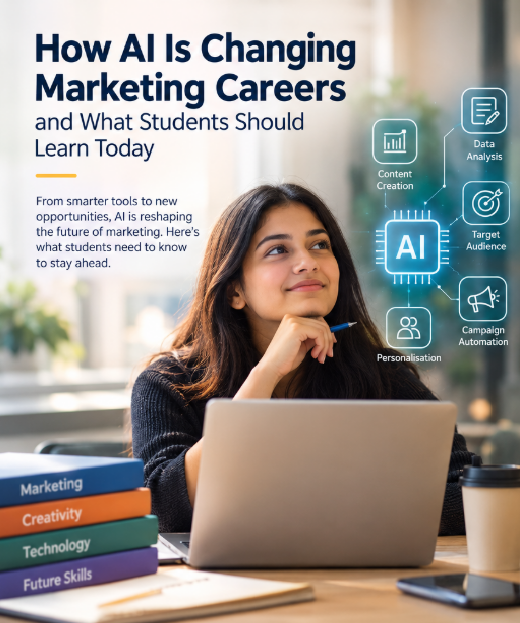
Artificial intelligence is rapidly becoming part of everyday marketing. From generating content and analysing consumer behaviour to automating campaigns and personalising customer experiences, AI is changing how marketing teams work and what businesses expect from marketing professionals.
For students planning to build a career in marketing, this transformation brings both opportunities and new expectations. The question is no longer whether AI will become part of marketing, but whether future marketers will know how to work effectively with it.
As repetitive tasks become increasingly automated, skills such as strategic thinking, creativity, data interpretation and communication are becoming more important. Students entering the field today will need to develop a combination of marketing knowledge and technological understanding to remain relevant in a rapidly changing industry.
From Executing Tasks to Solving Marketing Problems
Marketing has traditionally involved several execution heavy activities. Creating social media content, preparing reports, conducting basic research, drafting emails and analysing campaign performance could take considerable time.
AI tools can now assist with many of these activities within minutes.
This does not necessarily mean that marketing professionals will become less important. Instead, their role is gradually shifting from executing individual tasks to solving broader marketing problems.
A marketer may spend less time creating the first draft of a campaign and more time deciding which audience should be targeted, what message will resonate with them and how the campaign connects with the company’s larger business objectives.
For students, this makes it important to understand marketing fundamentals rather than becoming dependent on individual tools. AI can support execution, but strategic decisions still require context and judgement.
AI Is Becoming Part of the Everyday Marketing Toolkit
AI is increasingly being used as a day to day assistant by marketing teams. It can help professionals brainstorm ideas, summarise research, analyse customer feedback, develop content outlines and identify patterns in large datasets.
For students, learning to use these tools effectively can become an important career advantage.
However, AI literacy should involve more than knowing how to write prompts. Students need to understand how to evaluate the information produced by AI, identify inaccuracies and improve the output based on their own understanding.


The ability to give AI the right context and then critically evaluate its response will be more useful than simply knowing how to generate content quickly.
Creativity Will Become More Valuable, Not Less
One common concern around AI is that it could reduce the importance of creativity in marketing. However, the widespread availability of generative AI could have the opposite effect.
When several marketers have access to similar tools, producing content quickly may no longer be a major differentiator. The ability to develop an original idea, understand an audience and create a compelling narrative can become more important.
Students should therefore continue investing in creative skills such as storytelling, writing, ideation and visual communication.
AI can generate multiple campaign concepts, but marketers still need to decide which idea fits the brand and why it should matter to the audience.
Understanding Data Will Become a Core Marketing Skill
Marketing is becoming increasingly measurable. Businesses can track customer journeys, website behaviour, campaign engagement, conversions and other indicators of performance.
AI can process this information at scale, but marketers need to understand the meaning behind the data.
Students entering marketing should therefore develop basic data literacy. They should be comfortable working with spreadsheets, dashboards and analytics platforms and should understand how to convert information into actionable insights.
The ability to move from “What happened?” to “Why did it happen?” and eventually “What should we do next?” can help distinguish a data aware marketer from someone who simply reports numbers.
Consumer Psychology Remains at the Centre
Despite the growing role of technology, marketing continues to be fundamentally about understanding people.
AI can identify patterns in consumer behaviour, but marketers need to understand the context behind those behaviours. Why does a customer choose one product over another? What influences their purchase decision? How do cultural trends or changing expectations affect their preferences?
Learning consumer psychology can help students answer these questions.
A strong understanding of human behaviour, combined with the ability to use AI and data, can help future marketers develop more relevant campaigns and customer experiences.
Communication Skills Still Matter
Marketing professionals rarely work in isolation. They communicate with customers, sales teams, designers, agencies, journalists, influencers, business leaders and other stakeholders.
As AI takes over more routine tasks, communication and collaboration can become even more important.
Students should focus on developing clear writing, presentation skills, active listening and the ability to explain complex ideas in simple language.
Technology can help produce a message, but understanding the audience and knowing how that message should be communicated remains a critical marketing responsibility.
Students Need Marketing Fundamentals Before AI Skills
The growing popularity of AI tools should not lead students to overlook the fundamentals of marketing.
Understanding branding, positioning, market research, digital marketing, public relations, customer experience, advertising and consumer behaviour provides the foundation for using technology effectively.
For example, a student who understands SEO can use AI to support keyword research and content development more effectively than someone who simply asks an AI tool to write an article.
The technology becomes more valuable when it is combined with domain knowledge.
Learning to Question AI Is as Important as Learning to Use It
One of the most important skills for future marketers will be knowing when to question an AI generated answer.
AI can produce information that appears convincing but may contain factual errors, outdated information or missing context. In marketing, these mistakes can affect brand credibility and business decisions.
Students should therefore develop the habit of checking sources, validating data and reviewing AI generated content before using it.
This is particularly important when working on market research, customer communication, advertising claims and public relations.
Being AI literate means understanding both its capabilities and its limitations.
New Career Opportunities Are Emerging
The impact of AI is also creating new opportunities within the marketing industry.
Roles connected to marketing analytics, automation, growth, customer experience, AI enabled content, marketing operations and technology are becoming increasingly relevant.
At the same time, traditional marketing roles are evolving.
A content marketer may need to understand AI assisted content workflows. A social media professional may need to work with automated analytics. A brand manager may increasingly rely on customer data and AI generated insights.
The boundaries between marketing, technology and data are therefore becoming increasingly interconnected.
Adaptability Could Become the Most Important Career Skill
The technology students learn today may change significantly over the next few years. New AI platforms, tools and workflows are likely to continue emerging.
This makes adaptability particularly important.
Rather than focusing only on mastering one particular tool, students should develop the ability to understand new technologies and identify where they can add value.
This can happen through internships, personal projects, online courses, experimentation and practical exposure to real marketing challenges.
The objective should be to become comfortable with learning, unlearning and relearning as the industry evolves.
Building the Future Ready Marketer
The marketing professional of the future is unlikely to be defined by one technical skill.
Instead, successful careers could increasingly be built around a combination of marketing knowledge, AI literacy, data understanding, creativity and communication.
Students entering the industry today have an opportunity to develop this combination from the beginning of their careers.
AI may change how marketing work gets done, but the fundamentals of understanding people, creating value and communicating effectively remain.
The future of marketing will therefore not simply be about humans competing with machines. It will be about professionals learning how to combine human judgement with technological capabilities.
For students, the most important lesson is simple: learn marketing deeply, understand technology and remain curious enough to keep adapting.
****