


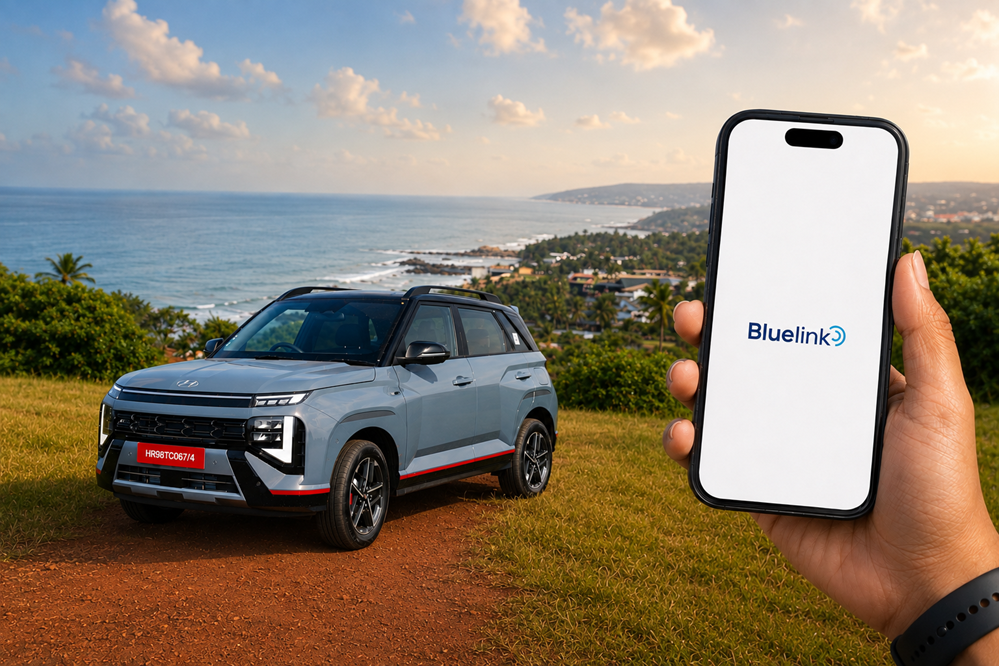
Mumbai : Hyundai Motor India Limited (HMIL) today announced a major milestone in its connected mobility journey, with over 0.8 million connected cars currently on Indian roads. Building on strong customer adoption of Hyundai Bluelink, HMIL’s AI-powered connected car technology platform, the company is targeting cumulative connected car sales of 1 million units by 2027.
What features does Hyundai Bluelink offer to customers?
Through Bluelink, customers can access more than 70 features across various categories such as safety, security and convenience. The key features include remote vehicle monitoring, vehicle health diagnostics, location tracking, trip history, remote commands, in-car payment powered by Hyundai Pay, Digital Key, Digital Passport, Remote Immobilizer and Home-to-Car Connectivity. Bluelink also supports 450+ AI-powered voice commands across five languages.
Speaking on HMIL’s endeavor to offer advanced tech to customers, Mr. Tarun Garg, MD & CEO, HMIL, said “The growing adoption of connected vehicles reflects the evolving expectations of customers and the increasing role of technology in shaping mobility. As we move towards our goal of 1 million connected car sales by 2027, we remain focused on advancing software-defined mobility and expanding connected technologies across our portfolio. Our upcoming mass-market electric SUV, which will offer next-generation connected car technology as standard across all variants, marks an important step in strengthening the convergence of connected and electric mobility while delivering future-ready ownership experiences for customers.”
How has connected car technology adoption evolved in India and what role has Hyundai Motor India played in this growth?
Connected car technology adoption in India has grown significantly in recent years, reflecting increasing customer demand for enhanced convenience, safety and a better vehicle ownership experience. HMIL has played a pioneering role in this evolution through the introduction of Hyundai Bluelink in 2019, which brought OEM-fitted connected car technology to Indian customers. Since then, connected vehicle penetration across HMIL’s portfolio has increased five-fold, rising from 4% in 2019 to 20% in 2026, highlighting the growing relevance of connected technologies in the Indian automotive market.
What is HMIL’s tech vision for future mobility?
HMIL’s vision for future mobility is centred on advancing Software Defined Vehicles (SDVs) and connected mobility through continuous software innovation and Over-the-Air (OTA) capabilities. This vision has been supported by strong customer demand across key models such as CRETA, VENUE and i20.
HMIL’s connected mobility journey has evolved through multiple technology generations:
o 2019: Hyundai Bluelink introduced with the launch of the Hyundai VENUE, India’s first OEM-fitted connected SUV
o 2020: Introduction of OTA map updates with Hyundai i20
o 2022: Introduction of next-generation AVNT (Audio Video Navigation Telematics) connected technology
o 2025: Launch of Connected Car Navigation Cockpit (ccNC) with Controller OTA update capability, marking a significant step in HMIL’s Software Defined Vehicle (SDV) roadmap for India
These advancements allow vehicles to continuously evolve through software enhancements, ensuring vehicles remain updated with the latest technology and features over time.
How has HMIL’s Bluelink technology helped customers in distress?
In addition to convenience, Bluelink has delivered meaningful customer impact, assisting over 0.5 million motorists through SOS and roadside assistance services, supporting around 15,000 crash notification interventions and aiding law-enforcement agencies in vehicle tracing and recovery efforts. Beyond safety, features such as Driving Score and Digital Passport are also helping customers adopt smarter and safer driving habits and more proactive vehicle care through personalized insights and recommendations. These innovations highlight how connected mobility is enhancing both safety and the overall ownership experience.