


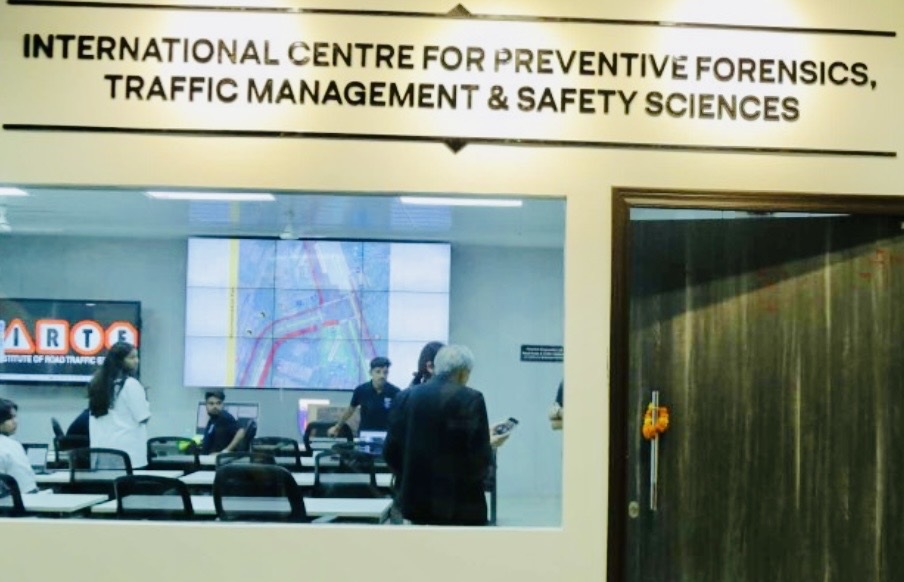

New Delhi: The Institute of Road Traffic Education (IRTE), in collaboration with the College of Traffic Management & Forensic Science (CTM), has set up an International Centre for Preventive Forensics, Traffic Management & Safety Sciences (ICPF) at the CTM campus in Faridabad, Haryana, marking a significant step towards strengthening scientific and preventive approaches to road safety.
‘ The new centre has been established as a multidisciplinary scientific hub dedicated to preventing road crashes, injuries and fatalities by applying forensic science, traffic engineering and safety sciences to the diagnosis of traffic violations, high-risk road-user interactions and systemic failures.’ said Dr Rohit Baluja , Director, IRTE .
” Unlike conventional approaches that primarily investigate crashes after they occur, the ICPF will focus on identifying the warning signs before a crash takes place. The centre will study near misses, unsafe manoeuvres, traffic conflicts and other high-risk interactions to understand their underlying causes and develop preventive interventions.” said Dr Baluja .
The initiative brings together forensic auditing and traffic-engineering analysis, enabling experts to examine road-user behaviour, infrastructure deficiencies, traffic management systems and other contributing factors in an integrated manner. The objective is to move road safety from a predominantly reactive system towards a more predictive, preventive and evidence-based approach.
As part of the launch, IRTE also introduced the INTERCEPTOR AFORE mobile laboratory, a specialised field platform designed to support road safety audits, crash investigations and preventive safety research. The mobile laboratory is expected to facilitate scientific assessment and data collection directly at roads, intersections and other high-risk locations.
The ICPF will operate from the College of Traffic Management & Forensic Science campus in the Aravali Hills, Surajkund-Badhkal Road, Faridabad, providing a platform for collaboration among traffic-management professionals, forensic experts, engineers, researchers, law-enforcement agencies and other stakeholders working towards safer mobility.
The establishment of the centre comes at a time when India is rapidly expanding its road and transport infrastructure and faces the continuing challenge of reducing road crashes and fatalities. By examining unsafe conditions and near-miss events before they develop into serious crashes, the ICPF aims to contribute to a more scientific and proactive road-safety ecosystem.
The centre is also expected to support research, training, field investigations, professional capacity building and knowledge development in preventive forensics, traffic management and safety sciences.
With the launch of the ICPF and INTERCEPTOR AFORE mobile laboratory, IRTE and CTM have sought to create a new institutional framework in which every near miss becomes an opportunity to prevent a future crash and scientific evidence becomes the foundation for safer roads and transportation