


By Dr Kriti Hedge, Consultant, Paediatric Oncology
A 14-year-old boy from Eritrea presented with fever and progressive abdominal distension for two months. For one month prior to his presentation in India, he had been receiving blood transfusions to support his haemoglobin and platelet counts.
He was initially admitted to a paediatric intensive care unit (ICU) in Mumbai for a week, where a mass in the ileocecum (connecting the small intestine to the large intestine) was identified and biopsied. During his admission to the hospital, the boy’s condition continued to deteriorate.
Admission to Narayana Health SRCC Children’s Hospital: A child in critical condition
The boy was transferred to Narayana Health SRCC Children’s hospital on 7 May, 2026. At the time of admission, he was critically unwell — drowsy, in respiratory distress, with a large abdominal mass and hypotensive shock. He was immediately admitted to the Paediatric ICU and put on respiratory and inotropic support (where medicines are given to help the heart pump blood more effectively).
By this time, the referral biopsy had confirmed Burkitt’s lymphoma. However, formal staging to find out the extent of the spread of cancer could not be done because of his critical condition.
Cytoreductive chemotherapy was initiated with cyclophosphamide, vincristine and prednisolone, to reduce the cancer cells and shrink the ileocecal mass.
A bone marrow examination revealed features of haemophagocytic lymphohistiocytosis (HLH) – a severe and rare immune disorder – with no evidence of lymphoma growing or spreading in the bone marrow.
This helped doctors find out the degree of bone marrow suppression which pointed to the severity of the case.
A fight against multiple life-threatening complications
On Day 4, the boy developed an episode of pulseless ventricular tachycardia, a life-threatening heart rhythm leading to cardiac arrest. But he was quickly and successfully revived after one round of CPR.
He subsequently developed multidrug-resistant, Gram-negative Klebsiella sepsis – a severe, life-threatening bloodstream infection – adding another major challenge to an already critical clinical situation.
Despite these complications, the tumour began to shrink by the second week of treatment and the boy showed considerable clinical improvement. He was eventually extubated. However, surviving the immediate crisis was only the beginning of his road to recovery.
Rebuilding strength gradually
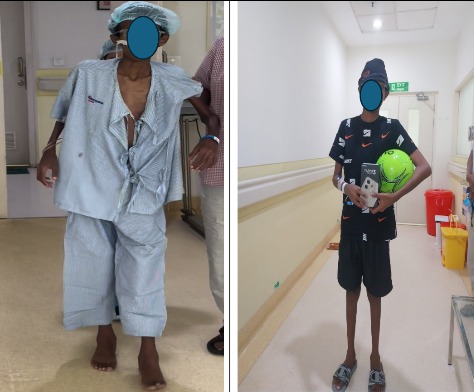
The child’s recovery was prolonged. He was morbidly cachexic and severely deconditioned, having lost 12 kilograms weight with significant muscle wasting and extreme body weakness. At his weakest point, he was unable to speak or sit up even with support.
His recovery, therefore, required more than just controlling the lymphoma. He underwent aggressive physical rehabilitation, supported by the hospital’s team of physiotherapists, alongside nutritional rehabilitation supported by Cuddles Foundation, an NGO dedicated to nutritional support in paediatric oncology.
This nutritional and physical rehabilitation was critical in helping him regain strength and build the physiological reserve needed to tolerate further chemotherapy.
Diagnosis and treatment: A moving clinical picture
Initially, given the severity of his condition, the boy was presumed to have Stage IV lymphoma. But he was ultimately diagnosed with Stage III Burkitt’s lymphoma with secondary HLH.
This revised staging proved clinically significant. It was associated with a better expected outcome and allowed for a less intensive chemotherapy regimen than a Stage IV disease would have required. Chemotherapy dosing was carefully modulated during the first month to account for his overall morbidity.
As he began gaining weight through enteral nutrition (which was fed through a tube directly into the gastrointestinal tract), he showed sustained clinical improvement and was able to receive full chemotherapy as per protocol. He completed five cycles of chemotherapy, achieved metabolic remission after the third cycle.
Another setback: Measles during the final cycle
The boy’s treatment was largely uneventful until the final cycle, when he encountered yet another worrying setback as he developed measles. Measles in an immunocompromised child carries substantial risk, given the potential for pneumonitis (inflammation of lung tissue) or measles inclusion body encephalitis (MIBE), an inflammation in the brain that can turn fatal.
Early suspicion and prompt intervention allowed him to begin recovering by Day 8.
The happy outcome
The young patient has since completed treatment and returned home in good health.
What began as a near-fatal presentation – a boy in shock, requiring ventilatory and inotropic support, and unable to sit up or speak – ended in happiness with him walking out healthy.
The multidisciplinary fight behind the recovery
The positive outcome in this case was not the result of a single intervention or department. It was the result of several teams working together at every stage of the boy’s illness.
The Paediatric ICU team at Narayana Health SRCC Children’s hospital , led by Medical Director Dr Soonu Udani, stabilised him through cardiac arrest and sepsis. The Pediatrician Onoclogy care lead by Dr Kriti Hegde navigated a moving diagnosis and carefully modulated the chemotherapy plan around a critically frail child, while the Physiotherapy team helped rebuild his physical strength, taking him from being unable to sit up to eventually being able to walk again.
Cuddles Foundation provided nutritional support that helped address the boy’s 12-kilo weight loss, giving him the physiological reserve required to go through treatment. Intensive care bought time for chemotherapy to work, while vigilant infection management carried him safely through two life-threatening complications along the way.
The case is a clear reminder that outcomes like this are built by multidisciplinary teams, not individual departments, which also represents a genuinely happy ending for a young boy who, for a long time, had very little going in his favour.