


By Suresh Unnithan
Till now the US Department of Justice (DOJ) has unveiled nearly 30,000 pages of documents from its investigations into Jeffrey Epstein, the convicted sex offender whose web of influence trapped a few most prominent figures of America. Released a day ago, on December 23, under the Epstein Files Transparency Act—signed into law by President Donald Trump on November 19—this latest batch spotlights references to Trump, including subpoenas to his Mar-a-Lago resort. However, it builds on an earlier disclosure last week that cantered on former President Bill Clinton, weaving a fuller narrative of Epstein’s associations across political lines. No new allegations of criminality have emerged against either president, but the files underscore the financier’s knack for cultivating powerful friendships that have long fuelled public speculation and partisan battles.
Epstein, who died in a Manhattan jail cell in August 2019 under suspicious circumstances, while facing federal sex trafficking charges, built a sprawling network through his wealth and charisma. His private jet, dubbed the “Lolita Express” in tabloid lore, ferried elites to exotic locales, while his properties—from a New York townhouse to a private Caribbean island—served as hubs for social gatherings that prosecutors later alleged masked abuse. The documents, comprising emails, flight logs, subpoenas, and photos, aim to fulfil congressional demands for accountability, though critics argue the releases are politically timed.
At the heart of many revelations is Virginia Giuffre, one of Epstein’s most vocal accusers, whose story encapsulates the human toll of his operations. Giuffre, née Virginia Roberts, emerged from a troubled background in Florida, marked by childhood abuse and instability. Born in 1983, she endured molestation from a family friend starting at age seven, and later alleged abuse by her own father—claims he denied. By her mid-teens, Giuffre had run away from home, living on the streets and in foster care before finding a job as a spa attendant at Trump’s Mar-a-Lago club in Palm Beach in the summer of 2000, when she was 17.
It was there that Giuffre’s path crossed with Ghislaine Maxwell, Epstein’s British socialite partner and eventual co-conspirator. Maxwell, posing as a friendly recruiter, approached Giuffre while she was reading a book on massage therapy during a break. “We know someone who’s looking for a traveling masseuse,” Maxwell reportedly said, luring her with promises of training and adventure. Giuffre, eager for opportunity, accepted an invitation to Epstein’s nearby mansion, where what began as a seemingly legitimate massage session devolved into sexual abuse. Epstein, she claimed, assaulted her that day, initiating a years-long ordeal of trafficking.
In her posthumous memoir, “Nobody’s Girl,” published in October 2025—six months after her suicide on April 25—Giuffre detailed being groomed as Epstein’s “sex slave.” She described being flown around the world on his jet, coerced into sexual encounters with Epstein and his associates, and subjected to psychological manipulation. Key allegations included three instances of sex with Britain’s Prince Andrew, once involving Epstein and several other young women in an orgy-like setting. Andrew settled a civil suit with Giuffre in 2022 for an undisclosed sum, without admitting liability, and has consistently denied the claims.
Giuffre named other high-profile figures in court documents unsealed in 2019, alleging she was directed to have sex with hedge fund manager Glenn Dubin, attorney Alan Dershowitz, former New Mexico Governor Bill Richardson, MIT scientist Marvin Minsky, former Senate Majority Leader George Mitchell, and modelling agent Jean-Luc Brunel. All denied the accusations, and no criminal charges stemmed from them. Notably, Giuffre never implicated Trump or Clinton in any misconduct, though she claimed to have seen Clinton on Epstein’s Little St. James Island—known derisively as “Pedophile Island”—dining with Epstein and two young women. She emphasized, however, that she witnessed no impropriety from the former president.
Giuffre’s advocacy for trafficking survivors began in earnest after the birth of her daughter in 2010, prompting her to go public. Her 2011 interview with the Mail on Sunday revealed meetings with Clinton and others, thrusting her into the spotlight. She filed a defamation suit against Maxwell in 2015, settled in 2017, and played a pivotal role in Maxwell’s 2021 conviction on sex trafficking charges, for which Maxwell received a 20-year sentence. Giuffre’s death at age 41, ruled a suicide, was attributed by family to ongoing trauma, including a custody battle and the relentless scrutiny of her story. Her brother and sister-in-law told CBS News that losing contact with her children may have been a breaking point.
The documents tie Giuffre’s narrative directly to Trump through the Mar-a-Lago subpoenas. In 2021, during Maxwell’s trial (United States v. Ghislaine Maxwell), federal prosecutors issued at least one subpoena—possibly two—to the resort for employment records related to a redacted individual, widely believed to be Giuffre. This link highlights how Epstein’s recruitment often preyed on vulnerable young women in elite environments. Republicans, including House Oversight Chairman James Comer, have seized on Giuffre’s exoneration of Trump, accusing Democrats of selective redactions to fabricate a “hoax narrative” against him.
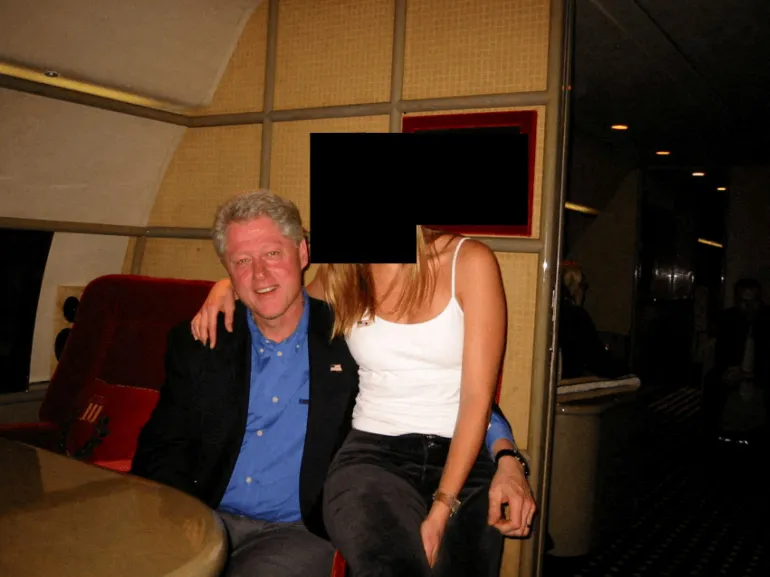
Shifting focus to the prior release, Bill Clinton’s connections to Epstein feature prominently, illustrating the bipartisan nature of the scandal. Flight logs show Clinton aboard Epstein’s jet for at least 26 segments between 2002 and 2003, including a high-profile Africa trip with actors Kevin Spacey and Chris Tucker to promote HIV/AIDS initiatives via the Clinton Foundation. Clinton also met Epstein in his Harlem office and briefly visited his New York apartment around the same time. Photos in the files depict the two in convivial settings, such as wearing matching Indonesian batik shirts or Clinton relaxing on the plane with a young woman nearby—though no wrongdoing is alleged.
Clinton’s spokesperson, Angel Ureña, has maintained that the former president severed ties in 2005, before Epstein’s Florida investigation into luring underage girls for sexualized massages. Clinton denies visiting Little St. James, Epstein’s New Mexico ranch, or Palm Beach home, despite Giuffre’s claim of spotting him on the island. No survivors have accused Clinton of abuse, and his team dismisses the releases as political distractions, noting even White House Chief of Staff Susie Wiles contradicted Trump’s insinuations about island visits. Trump has repeatedly amplified unproven theories, suggesting Clinton’s involvement in Epstein’s 2019 death or deeper complicity, calling for FBI probes into their “relationship.”
For Trump, the files reveal a friendship dating to the 1980s in New York’s social scene, with at least eight jet trips from 1993 to 1996. Four included Maxwell, one listed only Trump, Epstein, and a redacted 20-year-old woman, while others involved family like Marla Maples and children Tiffany and Eric. A 2020 prosecutor’s email noted these flights exceeded prior reports, circulated for “situational awareness” during Trump’s first term. Trump has distanced himself, citing a 2004 fallout over a real estate bid and Epstein poaching a Mar-a-Lago employee. He described the disclosures as tarnishing innocents by association.
The releases have ignited fierce partisan strife. Republicans decry Democrats’ alleged weaponization of the Epstein probe to target Trump, highlighting unserved subpoenas for the Clintons. Democrats counter that the DOJ under Attorney General Pam Bondi is withholding material, labelling the rollout “piecemeal” and insufficient. Debunked items, like a forged 2019 letter from Epstein to Larry Nassar implying Trump’s tastes, highlight the mix of fact and fiction in the archives.
Experts like Brookings’ Sarah Thompson argue the files reaffirm known associations without new bombshells: “Trump and Epstein shared circles, as did Clinton, but evidence of complicity remains absent.” Victims’ advocates hope the transparency aids civil suits and prevention, while Trump urges full disclosure, insisting “We have nothing to hide.” With releases concluding by year’s end, this chapter may close, but Epstein’s shadow lingers over American power structures.