


From Our Correspondent
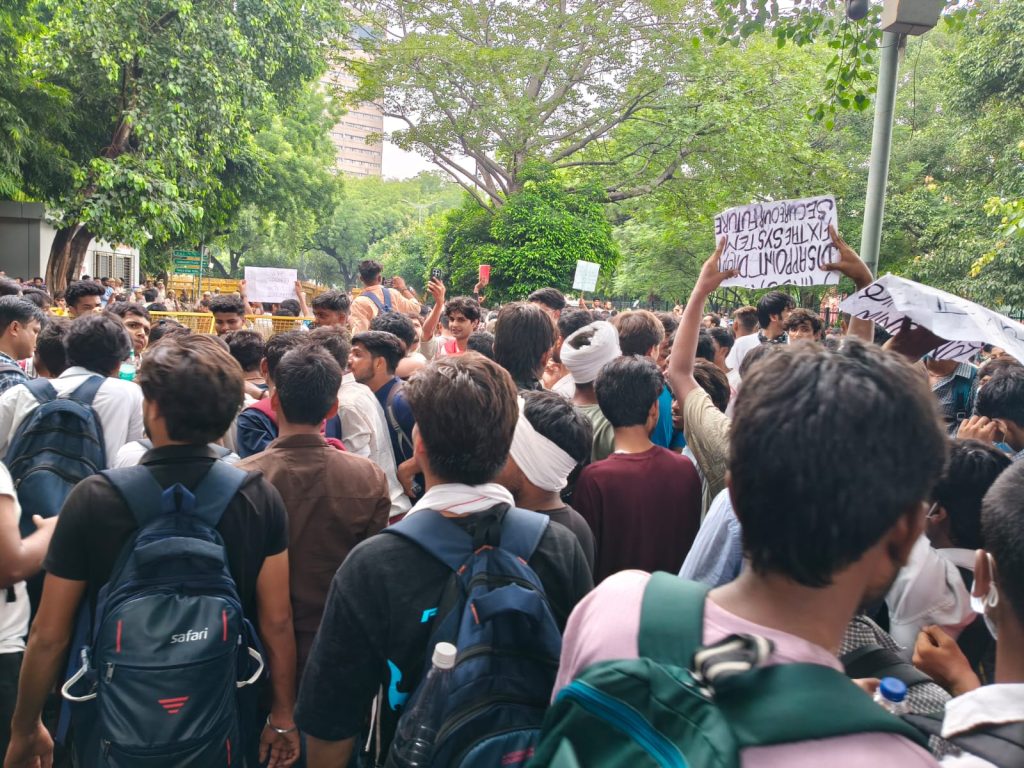
In the grand theatre of Indian democracy, there is a quiet, almost aching irony in watching a government treat its own restless students—young citizens simply demanding fairness—as if they were an invading army at the gates. On July 22, 2026, as the Monsoon Session of Parliament kicked off with all the solemnity of a damp firecracker, the authorities delivered a masterclass in overreaction. The Delhi Metro Rail Corporation (DMRC) was suddenly repurposed as a strategic barricade. Sixteen key stations in Central Delhi were shuttered “for security reasons” during the so-called Cockroach Janta Party (CJP) protests. Because nothing says “calm and collected governance” quite like turning Rajiv Chowk, Patel Chowk, and Mandi House into ghost platforms while trains ghost through without stopping.
Commuters, students, and hapless office-goers found themselves stranded, pondering the deeper philosophical question: Is reaching Jantar Mantar really that terrifying? The list of closures—Lok Kalyan Marg, Supreme Court, Janpath, ITO, Khan Market, Jor Bagh, and more—reads like a who’s-who of central Delhi landmarks. Interchange facilities at a few spots remained open, a small mercy that felt suspiciously like an afterthought. One can almost picture the emergency meeting where someone suggested, “What if we just… close the city?” And everyone nodded vigorously.
The protests stem from demands for the resignation of Union Education Minister Dharmendra Pradhan amid allegations of examination irregularities and paper leaks that have left countless young aspirants feeling short-changed. In any functioning democracy, such concerns might prompt reflection. Instead, we witnessed heavy police barricading and lathi-charges to thwart the “Sansad Chalo” march. Inside Parliament, proceedings unravelled within minutes. Opposition leaders, including Rahul Gandhi and Mallikarjun Kharge, were thwarted in raising these issues, leading to swift adjournments. The message seems clear: debate is fine, as long as it doesn’t involve uncomfortable questions.
This isn’t mere crowd control; it’s a symphony of panic. Shutting down metro stations broadcasts a narrative where student voices are a public nuisance rather than a democratic pulse. The irony is thick: a government that champions “youth power” suddenly viewing metro-riding students as a security threat requiring preemptive urban lockdown.
History offers a sharper mirror. India’s student movements have repeatedly shaped the nation. In the 1970s, the Navnirman Andolan in Gujarat began as a student-led crusade against corruption and soaring prices under Chief Minister Chimanbhai Patel. What started with campus protests snowballed into statewide agitation, forcing the resignation of the government and igniting Jayaprakash Narayan’s broader anti-Emergency movement that ultimately contributed to the Congress party’s historic defeat in 1977. Students weren’t dismissed as disruptors—they were catalysts for accountability.
Fast forward to the 1990 Mandal Commission stirrings, where students across North India took to the streets (and, in some tragic cases, extreme measures) over reservations in government jobs and education. Though deeply divisive, the movement compelled policy reckonings and underscored how youth unrest can force national conversations on equity. Even during the freedom struggle, students played pivotal roles in the Quit India Movement of 1942, facing lathis and arrests yet accelerating the momentum against colonial rule. These episodes remind us that student agitations, however inconvenient, have often signalled deeper societal fissures—and yielded course corrections.
Yet today’s response feels less like engaged governance and more like a hasty lockdown. Commuters delayed, exams leaked, futures disrupted—yet the swiftest action remains sealing stations and silencing the floor. Satirically speaking, one must admire the efficiency. In a country where major reforms can take years, the machinery of state can mobilise to close half of central Delhi’s metro network in record time. It’s almost reassuring—proof that when the establishment feels the heat, it doesn’t dither. It just… derails.
The students at Jantar Mantar, braving barricades, represent a familiar story: the idealism of youth clashing with the pragmatism (or panic) of power. Dismissing them with metro closures and adjournments doesn’t extinguish the fire; it merely fans it underground. History suggests that ignoring the echoes of Navnirman or the Mandal years rarely ends quietly.
As Delhiites navigated alternate routes and Opposition benches echoed with protest, one couldn’t help but chuckle at the spectacle. Perhaps next time, instead of closing stations, the wiser path lies in opening a dialogue. After all, in the long journey of nation-building, students aren’t the problem—they’re the passengers who keep the metro of democracy running. Shutting them out only ensures the ride gets bumpier for everyone.