


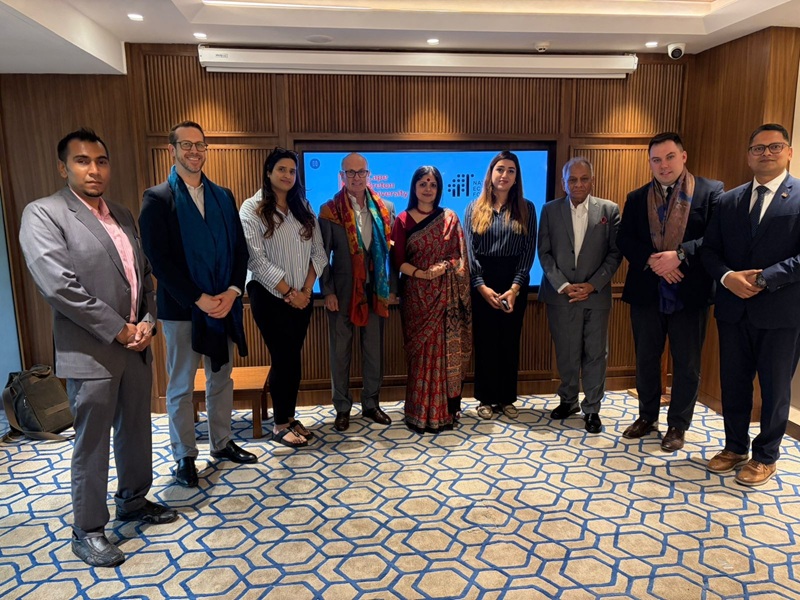
Cape Breton University (CBU), one of Canada’s leading public universities, and the National Economic Forum (NEF), today entered into a non-commercial Service and Cooperation Agreement, to support CBU’s India engagements, deepen institutional linkages and strengthen higher education collaboration between India and Canada.
The MoU was signed between Honourable David C. Dingwall, President & Vice-Chancellor, Cape Breton University, and Mr Jagdip Rana, Executive Director, National Economic Forum, during a high-level delegation visit to India.
The agreement establishes NEF as the official convening partner for CBU in India, facilitating structured engagements with stakeholders across Central and State Governments, as well as leading academic institutions. This partnership will promote a collaboration between the two institutes to work towards advancing key areas such as student mobility, faculty exchange, institutional partnerships, along with research and knowledge collaboration.
Designed to enable focused, protocol-aligned dialogue and strengthen institutional linkages, the MoU entrusts NEF to lead stakeholder mapping, outreach facilitation, and engagement structuring. This would open new opportunities to curate roundtables and institutional interactions, to enable meaningful and outcome-driven engagements, for CBU, driving deeper and more strategic engagements in India.
Speaking about this partnership, David C. Dingwall, President & Vice Chancellor, Cape Breton University, says, “India stands out as a priority geography for Cape Breton University, given the scale, ambition, and evolving strengths of its higher education ecosystem. This partnership provides a focused platform to deepen our engagement through meaningful institutional collaborations, expanded student pathways, and research partnerships aligned with shared global priorities, while building long-term academic linkages that deliver value for both countries.”
Mr Jagdip Rana, Executive Director, National Economic Forum, added, “This engagement is anchored in a clear objective—to translate global academic intent into structured, high-impact collaboration for India. By convening the right government and institutional stakeholders, we are enabling a more deliberate and outcome-driven approach to international partnerships, particularly in areas that strengthen talent mobility, research depth, and institutional capacity.”
The agreement is a stepping stone towards longer-term collaboration initiatives, including a framework for joint research programmes, academic exchanges, and knowledge partnerships aligned with shared priorities, contributing to the development of a more robust and future-oriented India–Canada higher education corridor.
This partnership reflects a shared commitment to strengthening international academic engagement through structured, high-impact collaboration frameworks.