


By Advocate Salini T S, LLM
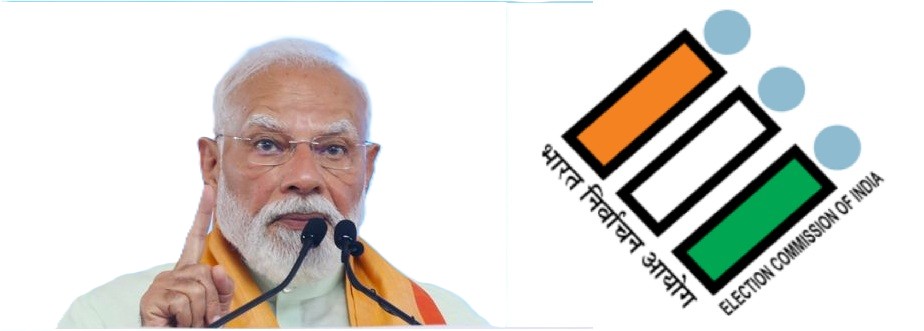
Petitions filed with the Election Commission of India (ECI) in April 2026 allege that Prime Minister Narendra Modi’s national address broadcast on 18 April 2026 on Doordarshan and Sansad TV violated the Model Code of Conduct (MCC) by misusing state-owned media for partisan purposes during ongoing Assembly elections in Tamil Nadu, West Bengal and other states.
Congress leader and former Kerala MLA Anil Akkara, an AICC member, was the first to lodge a formal complaint with the ECI on 19 April 2026. Subsequent complaints were filed by parties such as the CPI(M) and MPs including P. Sandosh Kumar and Manoj Kumar Jha. The petitions contend that the address, which criticised specific opposition parties by name (Congress, DMK, TMC and SP), amounted to political messaging rather than neutral governmental communication, thereby disturbing the level playing field while the MCC remained in force.
The MCC, though not statutory law, draws its authority from Article 324 of the Constitution, which confers on the ECI the power of superintendence, direction and control over elections to ensure they are free and fair. Section VII of the MCC explicitly prohibits the party in power from using government-owned media for partisan coverage or publicity intended to further its electoral prospects. Petitioners argue that broadcasting the address on public broadcasters without prior ECI clearance breached this provision, as established practice requires vetting of such governmental addresses during the MCC period.
The ECI’s primary role is administrative. Upon receiving complaints, it may call for reports from the Prasar Bharati Corporation and the Prime Minister’s Office, examine the script and broadcast details, and determine whether the content crossed into electioneering. If a violation is found, the Commission can issue a formal notice, record a censure, direct cessation of any repeat telecast, or advise ministries to maintain stricter neutrality. These measures align with past ECI actions on official advertisements or media usage, where enforcement relies on moral suasion and institutional directives rather than penal sanctions, given that the MCC itself contains no punitive provisions.
Petitioners have also invoked stronger statutory grounds under the Representation of the People Act, 1951 (RPA). Section 123(7) defines as a corrupt practice the procurement or obtaining of assistance from any person in the service of the Government—including employees of government-financed undertakings—for the furtherance of a candidate’s election prospects. Doordarshan and Sansad TV, being public broadcasters under the Union Government, fall within this ambit. The complaints allege that broadcaster officials provided such assistance by facilitating the national telecast of allegedly partisan content.
These allegations draw a parallel with the landmark 1975 judgment in State of Uttar Pradesh v. Raj Narain (popularly known as the Indira Gandhi case). The Allahabad High Court in that matter held that the then Prime Minister had committed a corrupt practice by securing the services of a gazetted officer (Yashpal Kapur) as an election agent while he remained in government service, and by using state machinery for constructing election rostrums. The election was declared void, and disqualification for six years followed under Section 8A of the RPA. The Supreme Court granted a conditional stay, but the High Court’s interpretation of misuse of government resources under Section 123(7) continues to serve as binding precedent. Petitioners submit that a nationwide broadcast on official media during an active election period represents misuse on a significantly larger scale.
However, translating these allegations into concrete legal consequences faces multiple procedural barriers. First, courts have consistently held that a standalone violation of the MCC, without linkage to a statutory offence under the RPA or other penal laws, does not by itself attract judicially enforceable penalties. Second, Article 329(b) of the Constitution generally bars courts from interfering in the electoral process once it has commenced. Any challenge on the ground of corrupt practice under Section 123 can ordinarily be raised only through an election petition filed after the declaration of results in the concerned constituency. Since the Prime Minister is not a candidate in the ongoing State Assembly elections, petitioners would need to demonstrate that the broadcast was intended to advance the prospects of specific BJP candidates and that assistance from broadcaster officials was obtained with the requisite consent.
If petitioners approach the High Court or the Supreme Court, the principal constitutional ground would be Article 324. They may seek a writ of mandamus directing the ECI to investigate the complaints and take effective measures to uphold electoral purity. In exceptional cases, courts have issued such directions when the Commission is perceived to have failed in its constitutional duty. Separately, if the speech content is alleged to promote enmity between groups, a complaint under Section 153A of the Bharatiya Nyaya Sanhita (formerly IPC) could lie, though this requires proof of specific intent and operates independently of election law.
The ECI retains residual powers under Article 324 to issue directions necessary for free and fair elections, including public reprimands or directives to government departments. In extreme scenarios involving corrupt practices, disqualification of a candidate for up to six years can result from a successful election petition. The Commission may also consider party-level sanctions, such as suspension of recognition, though such measures are rarely invoked solely on media-related complaints. Additionally, the District Election Officer may be directed to register an FIR where cognizable offences are disclosed.
Judicial precedent emphasises restraint during the election period. Courts typically defer to the ECI’s ongoing inquiry and dismiss premature petitions as misconceived. Even in a post-poll election petition, the burden remains heavy: the petitioner must prove not merely the broadcast but also the elements of “assistance” under Section 123(7), consent, and its direct link to furthering electoral prospects. The government may defend the address as legitimate official communication falling within the proviso to Section 123(7), which excludes acts done in the discharge of official duty.
In summary, while the petitions—beginning with that of Anil Akkara—raise important questions about the demarcation between governmental communication and partisan use of public resources, immediate outcomes are likely to remain within the ECI’s administrative framework. Possible actions include inquiry, notice, censure or advisory directives. Any finding of corrupt practice under the RPA would require a post-election petition before a High Court, subject to the stringent evidentiary standards illustrated by the 1975 precedent. The matter ultimately tests the ECI’s institutional capacity to enforce the MCC’s explicit bar on partisan utilisation of official mass media during elections, thereby safeguarding the constitutional guarantee of free and fair polls.
*Adv Salini T S is practicing in the High Court of Kerala