


By Suresh Unnithan
Agenda-setting theory holds that political actors can shape public priorities by elevating issues they believe they can control while marginalising those that expose structural vulnerabilities. The proposition that the BJP is attempting to manage or instrumentalise Gen Z discontent in order to deflect attention from the Ram Temple donation scandal, economic stagnation, price pressures, administrative failures and questions of institutional credibility conforms to this logic. It reflects a familiar calculation: shift the spotlight from crises that threaten core legitimacy—particularly the alleged embezzlement of devotees’ offerings at the party’s most potent ideological symbol—and toward a demographic terrain where messaging, outreach or selective concessions might still produce political returns.
The calculation, however, rests on a critical and potentially costly assumption: that Gen Z anger is sufficiently malleable to serve as a diversionary instrument. That assumption is open to serious challenge. India’s largest generational cohort is characterised by high educational aspiration, digital nativity, acute sensitivity to the gap between promised national ascent and lived economic outcomes, and a recently demonstrated capacity for rapid, cross-regional mobilisation that forced rare governmental accountability. These structural features make the cohort less a controllable narrative space and more an independent political force whose grievances are rooted in material conditions—graduate unemployment, compromised examination systems, stagnant real wages—rather than elite framing. When organic youth discontent becomes the chosen site for issue displacement, the strategy moves beyond conventional agenda management and enters the domain of high operational risk.
The analytical question is therefore not whether diversion is being attempted, but whether the underlying sources of Gen Z volatility can be contained or redirected without addressing the legitimacy deficits that produced them.
Two overlapping crises currently test that capacity. The first is the Ram Temple donation controversy. What was framed for decades as the culmination of a civilisational project has been overtaken by allegations of systematic misappropriation of offerings, official probes, arrests and resignations from the managing trust. For a party that has drawn substantial political capital from the temple’s symbolism, the episode introduces a legitimacy problem that is difficult to reframe. It is no longer only an opposition talking point; it has become a question of stewardship and institutional integrity at the heart of the party’s own ideological architecture.
The second crisis is economic and administrative. High graduate unemployment, persistent price pressures, and the repeated compromise of national entrance examinations have produced a concrete aspiration–reality gap. Young people who internalised the rhetoric of a rising India and a developed nation by 2047 encounter instead a labour market that absorbs far fewer quality jobs than the annual inflow of new graduates, and an examination system whose credibility has been repeatedly undermined. These are not abstract or elite-driven complaints. They are material experiences that travel rapidly through digital networks and resist easy narrative containment.
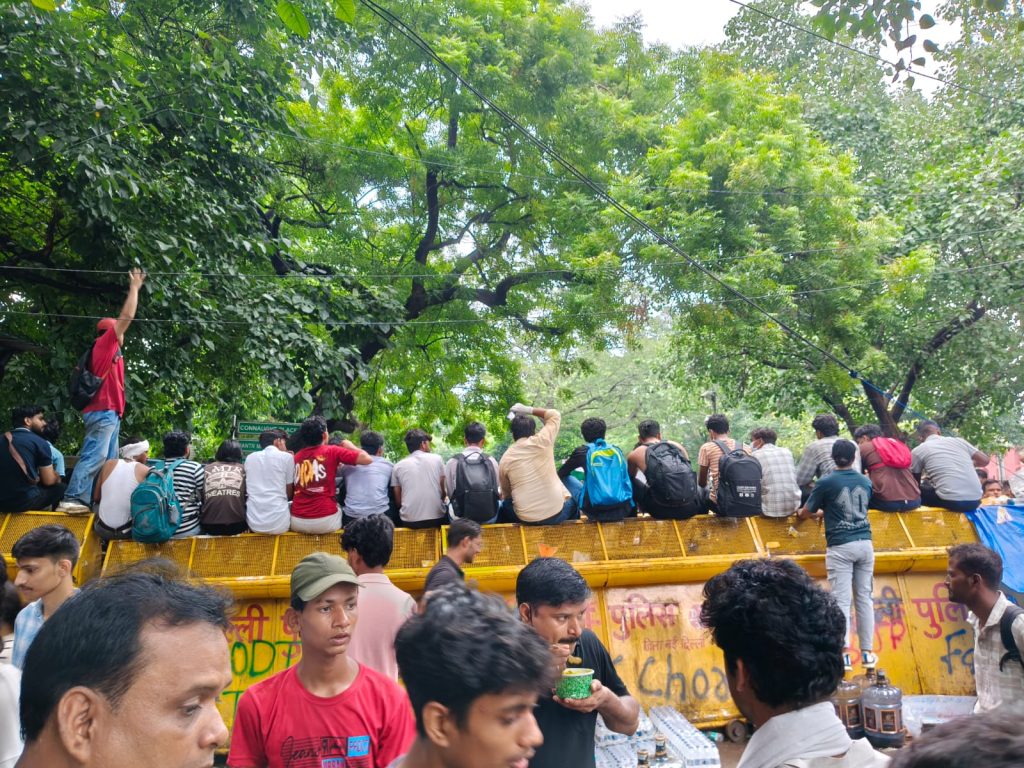
Gen Z’s structural characteristics amplify the danger of treating these grievances as manageable political assets. The cohort is demographically weighty, digitally fluent, and less deferential to traditional authority than previous generations. Its recent capacity to sustain nationwide pressure that culminated in a ministerial resignation demonstrated both organisational agility and a willingness to escalate beyond single-issue demands. Once a generation has experienced the efficacy of collective action, subsequent attempts to redirect or dilute its anger through selective engagement or symbolic outreach face higher barriers. Token measures or last-minute concessions are more likely to be read as tactical than transformative.
The operational risks for the ruling party are therefore layered. First, any visible effort to pivot public attention toward youth themes while leaving the temple funds controversy and the jobs–education nexus largely unaddressed risks being interpreted as cynicism. Second, the two crises are not easily separable in public perception. Economic frustration can fuse with a sense of symbolic betrayal, producing a more potent combination than either grievance alone. Third, the electoral arithmetic is unforgiving. Youth preferences matter in states heading into assembly contests, and a generation that has already forced accountability is unlikely to return quietly to passive observation. Attempts at suppression carry their own costs: images of force circulate permanently in digital archives and deepen alienation rather than restore control.
Historical patterns of youth mobilisation elsewhere suggest that once such discontent acquires both organisational form and a sense of collective efficacy, it rarely remains confined to the original trigger. It expands into broader questions of fairness, institutional credibility and the distance between rulers and ruled. The BJP has long benefited from the working assumption that India’s young could be selectively mobilised on cultural lines or largely ignored as politically indifferent. That assumption is now under measurable stress.
The safer course remains the more demanding one: transparent resolution of the temple donation allegations, credible repair of examination integrity, and structural attention to the scale of job creation required by the demographic bulge. Diversionary politics can rearrange the short-term conversation. It cannot extinguish pressures rooted in material conditions and generational expectation. For a party that has invested heavily in the narrative of national transformation, the failure to confront the lived realities of its largest demographic cohort is not merely a tactical inconvenience. It is a strategic vulnerability whose consequences may extend well beyond the current news cycle.