


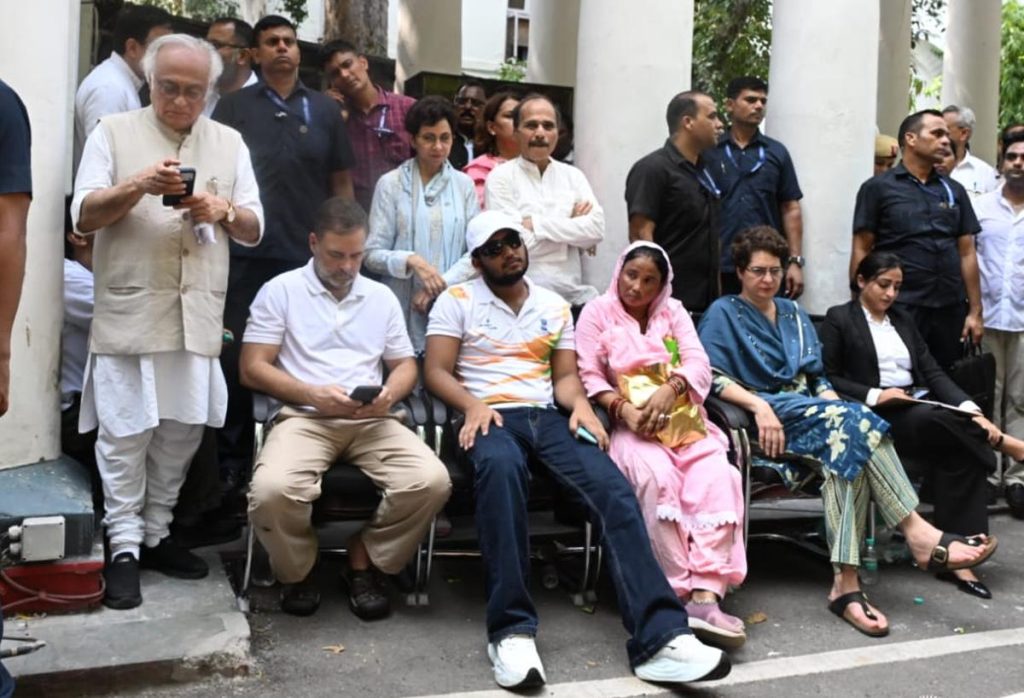
New Delhi: Leader of Opposition Rahul Gandhi’s sit-in outside Parliament Street Police Station on Friday compelled Delhi Police to register an FIR against unidentified persons in the July 20 pellet-gun incident. Gandhi, accompanied by 19-year-old victim Sahil Lochab, had refused to leave until the complaint was formally recorded.
Gandhi first approached Mandir Marg and then Parliament Street stations with Lochab and his lawyers. After officials declined to register the FIR, citing an ongoing Crime Branch probe and a Supreme Court committee, Gandhi sat on dharna outside the DCP’s office. His sister Priyanka Gandhi Vadra and other Congress leaders joined him. Gandhi alleged that police had “orders from the top” not to file the case. He displayed medical reports showing more than 200 pellets in Lochab’s body, including three in the right eye and some near the heart that cannot be removed. Lochab, a Delhi University student, underwent surgery at AIIMS after being hit during the CJP ‘Sansad Chalo’ march; his vision remains unclear.
Police eventually accepted the complaint and said the FIR would be registered against unknown persons. The development came after weeks of official denials. Delhi Police had issued a fact-check calling pellet-gun reports “false and misleading.” A General Diary entry at the same station, however, recorded that RAF personnel fired two rounds of plastic pellets from an anti-riot gun on a DCP’s orders. An RTI later confirmed at least ten people received treatment for pellet injuries.
The July 20 protest over alleged NEET paper leaks was the first time pellet guns were used against civilians in the national capital. The same weapons have a grim history in Kashmir, where they were introduced in 2010 as a “non-lethal” option after live ammunition killed 112 protesters. During the 2016 unrest, official data recorded 6,221 pellet injuries, 728 of them to the eyes, leaving dozens with permanent visual impairment. Hospitals described an “epidemic of dead eyes.” Rights groups have long demanded a ban.
The Supreme Court has declined a blanket prohibition. On July 30 it noted that existing police rules allow pellet guns in exceptional circumstances as part of a graded response. To ban them, those rules would have to be struck down as violating the right to life. On August 20 the court constituted a five-member High-Powered Committee headed by former Supreme Court judge Justice R. Subhash Reddy. The panel will examine whether force used on July 20 — including pellet guns, electric batons and lathi-charge — was proportionate, and whether metallic kinetic projectiles should be banned. It will also look at violence by protesters and harassment of women demonstrators.
The FIR, registered only after a high-profile political protest, does not name any officer. Both Delhi Police and the CRPF report to Union Home Minister Amit Shah. For the opposition, Gandhi’s dharna has exposed the government’s reluctance to acknowledge the use of a Kashmir-tested weapon on students in the heart of Delhi. The newly formed Supreme Court committee will now decide whether that reluctance withstands independent scrutiny.