


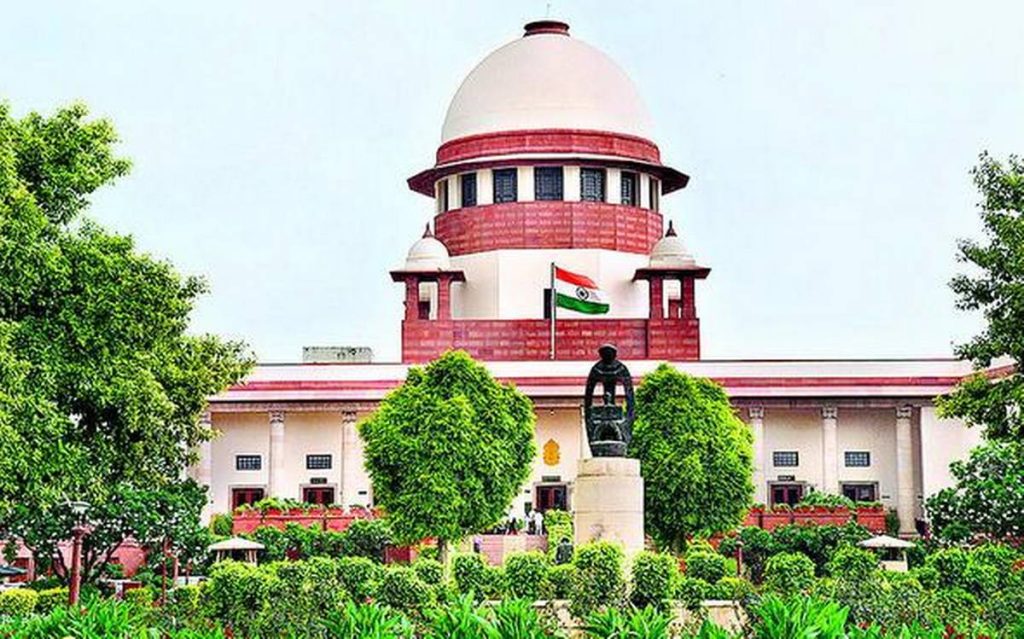
New Delhi: In a significant development on Tuesday, the Supreme Court of India agreed to hear the long-standing Bhojshala dispute on a day-to-day basis, aiming for an expeditious resolution. However, a bench comprising Chief Justice of India Surya Kant, Justice Joymalya Bagchi, and Justice V. Mohana declined the petitioners’ plea for an interim order restoring the status quo ante. This arrangement had previously allowed Muslims to offer namaz on Fridays alongside regulated Hindu worship on designated days.
The bench directed the Madhya Pradesh government and the Dhar administration to provide a separate open space adjacent to the disputed Bhojshala-Kamal Maula complex for offering namaz on Fridays between 1 PM and 3 PM. The court clarified that this is an ad-hoc arrangement, purely temporary and subject to the final outcome of the case. It also restrained the Archaeological Survey of India (ASI) from making any structural changes to the site without prior permission and issued notices for a detailed hearing after 15 days. Urging both sides to maintain patience, the bench described the matter as “highly sensitive.”
The top court was hearing a batch of appeals challenging a May 15, 2026, judgment by the Indore Bench of the Madhya Pradesh High Court. In a detailed 242-page verdict, Justices Vijay Kumar Shukla and Alok Awasthi declared the disputed Bhojshala complex in Dhar district a temple dedicated to Goddess Vagdevi (Saraswati). The High Court held that the religious character of the site has always been that of a Hindu temple and prohibited namaz inside the complex. It also directed the state to provide an alternative plot for Muslims to construct a mosque.
Historical Background
The Bhojshala complex, located in Dhar district of Madhya Pradesh, traces its origins to the 11th century during the reign of Raja Bhoja (c. 1000–1055 AD) of the Parmar dynasty. A celebrated scholar-king, Bhoja established it as a centre of Sanskrit learning and a temple dedicated to Goddess Saraswati (also known as Vagdevi), the deity of knowledge and wisdom. Historical texts, architectural evidence, and archaeological findings support this view. British surveys in the 19th and early 20th centuries, including the discovery of a Vagdevi idol, reinforced its temple origins.
Over centuries, the site witnessed layered historical developments. It is believed that parts of the complex were repurposed or built upon during later periods, leading to the Kamal Maula Mosque nomenclature among the Muslim community. The Archaeological Survey of India has protected the site, and in 2003, it permitted regulated worship: Hindus and Jains on Tuesdays and Muslims for Friday prayers. This arrangement maintained a delicate balance for years.
Tensions escalated in recent decades as Hindu groups asserted exclusive rights to the site as a Saraswati temple, citing historical continuity of worship. In 2024, the Madhya Pradesh High Court ordered an ASI survey to “demystify” the complex’s character amid competing claims. Archaeologist KK Muhammed and others have argued that the structure was originally a Hindu temple with later modifications. Jains have also claimed historical associations, viewing it sometimes as a gurukul.
The High Court’s 2026 verdict, based on historical literature, architectural analysis, and evidence of uninterrupted Hindu worship, marked a turning point. It ruled that the site’s core religious character as a temple was never extinguished, even amid historical shifts.
The Supreme Court’s interim order today seeks to preserve peace while the larger questions of ownership, religious character, and access are adjudicated. The case reflects broader patterns of disputes over shared heritage sites in India, where historical, archaeological, and legal evidence intersect with faith and community sentiments.
Both communities have been urged to respect the court’s directions and avoid any provocative actions. The apex court’s emphasis on day-to-day hearings signals its intent to resolve this emotive issue swiftly, balancing constitutional principles of religious freedom with the need for public order and historical truth.