


By Suresh Unnithan
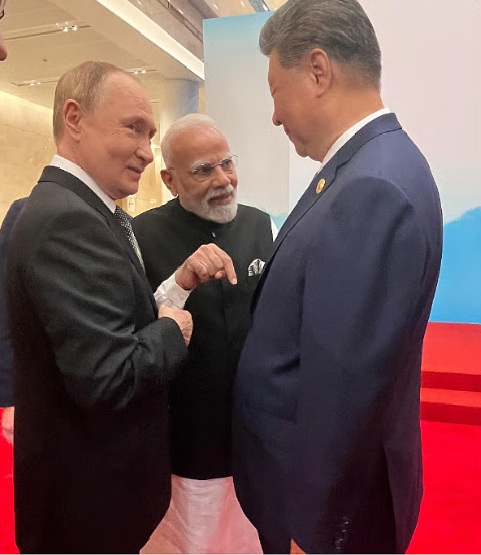
The 2025 Shanghai Cooperation Organization (SCO) summit, held in Tianjin, China from August 31 to September 2, has upset Washington and Brussels as well. The leaders from China, Russia, India, and other member states gathered to discuss a “new global order,” but Uncle Sam apprehends, the summit was to strengthen the emerging China-India-Russia (CIR) axis that could potentially jeopardise the U.S.-led Global Order.
This convergence is largely perceived as a “direct challenge to US and European supremacy in the global economy and politics. Economic interests, especially under President Donald Trump’s America First policies, which have strained alliances and prompted key players like India to pivot eastward.” At this critical juncture, “India’s role emerges as particularly influential, balancing its traditional non-alignment while leveraging SCO to amplify its global stature.”
Diplomats feel “the evolving triangular relationship between China, India, and Russia (CIR axis), has become a serious concern for the United States and Europe, escalating their geopolitical anxiety.” It is a fact, this alignment, fostered through SCO and bilateral engagements, is viewed not merely as regional cooperation but as a strategic challenge to Western dominance in global affairs. While the ties are not a formal alliance, their deepening coordination in economic, military, and diplomatic spheres raises concerns about a multipolar world order that could marginalize US and European influence.
International security experts observe that the CIR axis “amplifies threats to both US and European interests. Europe, grappling with Russia’s invasion of Ukraine, views the strengthening China-Russia partnership as enabling Moscow’s hostility through economic lifelines like Chinese technology and trade. India’s continued procurement of Russian arms and energy, despite Western sanctions, is seen as indirectly sustaining Russia’s war machine, potentially prolonging instability on Europe’s eastern flank.”
For the US, “the military dimension is particularly acute in the Indo-Pacific, where China’s territorial claims clash with American alliances. A CIR alignment could lead to coordinated responses in conflicts, such as joint military exercises or shared intelligence, complicating US operations in hotspots like the South China Sea or Taiwan Strait.”
On the economic front the CIR ties threaten Western access to markets and resources. “The US and Europe rely on global supply chains, but a consolidated Asian bloc could redirect trade flows, favouring intra-CIR commerce over Western partnerships.” China’s Belt and Road Initiative (BRI), bolstered by Russian energy exports and Indian market access, poses competition to U.S.-backed alternatives like the Build Back Better World (B3W) or Europe’s Global Gateway.
Europe, dependent on Russian gas and Chinese manufacturing, sees this axis as heightening vulnerabilities. “Joint CIR projects in Central Asia could control key transit routes, affecting European energy security and trade with the region. The US, facing trade deficits with China and tariff wars, interprets India’s hedging—maintaining ties with all sides—as a risk that could empower Beijing’s economic coercion tactics.”
The primary anxiety of the US is that the CIR ties could pose a direct threat to its post-World War II supremacy. “Washington perceives this axis as an attempt to create an alternative international framework that undermines institutions like the United Nations, IMF, and World Bank, which are heavily dominated by the U.S. Joint initiatives such as the proposed SCO development bank and enhanced trade in non-dollar currencies signal a push for de-dollarization, which could erode the US dollar’s status as the world’s reserve currency.”
According to foreign affairs experts, “at the heart of these dynamics is India, whose influence in SCO is increasingly seen as a game-changer.” As the world’s most populous nation and a rapidly growing economy, India’s participation lends credibility and balance to the organization, preventing it from becoming a mere Sino-Russian bloc.
“Prime Minister Modi has intelligently positioned India as a bridge between East and West, using SCO to advance economic interests while hedging against US unpredictability under Trump.”
Modi elicited a maximum of the SCO summit. His meeting with Putin reinforced India’s reliance on Russian oil and arms, “with Modi stating that India and Russia stand side by side even in difficult times.” This comes amid U.S. sanctions on Russian energy, which India has navigated by continuing imports, thereby effectively countering Washington’s efforts to isolate Moscow.
India’s SCO tilt is seriously worrying the European capitals. They seriously apprehend “India’s new inclination to the SCO could weaken NATO’s Indo-Pacific outreach, especially as India balances memberships in both SCO and the Quad.” Yet, India’s non-aligned ethos ensures it acts as a moderator, pushing for inclusive growth rather than confrontation, which could mitigate the axis’s anti-Western edge. “The SCO summit marked a watershed, with the CIR axis posing tangible threats to US and European interests through alternative financial systems, energy pacts, and security cooperation.”
In essence, India, through the Summit, could effectively challenge Trump’s tariff war (50% tariff) by strengthening economic ties with China and Russia, promoting Chabahar Port as a regional trade hub, and aligning with the SCO’s opposition to unilateral tariffs. These actions are a clear message to the US and Europe that India can, “manage trade through alternative markets and partnerships, leveraging SCO and BRICS frameworks to diversify exports and maintain economic resilience. By emphasizing strategic autonomy and exposing Western double standards,” India positioned itself as a pivotal player in a multipolar world, capable of mitigating tariff impacts while pursuing independent trade strategies