


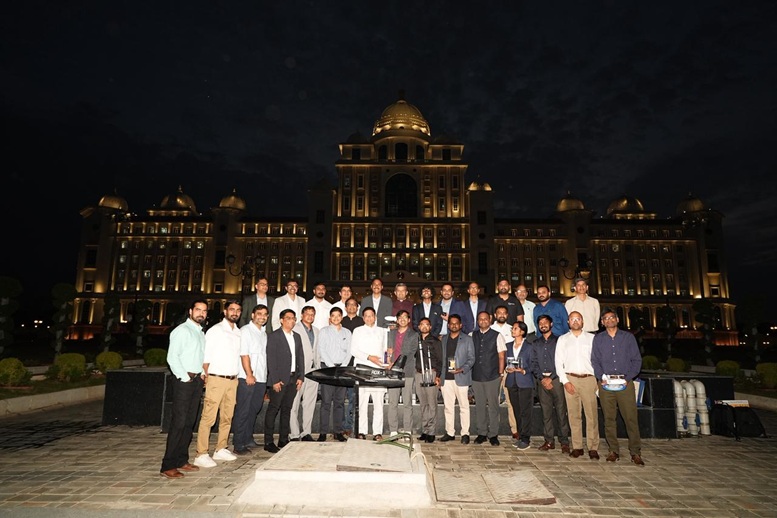
Hyderabad – Today, Shri D. Sridhar Babu, Hon’ble Minister for Information Technology, Electronics & Communications, Industries & Commerce, and Legislative Affairs, Government of Telangana, held a focused interaction with 14 of India’s leading space-tech companies. During the discussion, the companies recommended the development of a Space City to bring together the ecosystem and provide the specialised infrastructure needed to accelerate the growth of the space-tech industry. The Minister welcomed the recommendation and said the Government would look into it as part of its broader ambition to position Hyderabad among the world’s top five space-tech hubs. He said, after building globally competitive strengths in information technology, life sciences and aerospace and defence, Telangana is now setting its sights on space technology as a fourth pillar of its economic growth story.
The participating companies, Skyroot Aerospace, Dhruva Space, Constelli, TakeMe2Space, Cosmoserve Space, Abyom SpaceTech & Defence, Sanyark Space, XDLINX Space Labs, EON Space Labs, Red Balloon Aerospace, AnduraX, Bluj Aerospace, Apollyon Dynamics, and Vassar Labs, made brief presentations to the Minister, giving the Government a first-hand view of the innovation emerging from the ecosystem. Their work spans a broad range of space and deep-tech sectors, including launch vehicles, space debris removal, satellite systems, orbital infrastructure, spaceships, advanced sensing, geospatial intelligence, navigation, space communications and aerospace technologies.
Hyderabad is uniquely positioned to play a larger role in the global space economy. The city brings together deep technology and engineering talent, a strong aerospace and defence base, and one of the country’s deepest concentrations of national research and strategic institutions. Hyderabad is home to major organisations including the Defence Research and Development Organisation (DRDO), Defence Research and Development Laboratory (DRDL), Research Centre Imarat (RCI), National Remote Sensing Centre (NRSC) and the Advanced Data Processing Research Institute (ADRI), an ISRO facility focused on satellite data processing, remote sensing and geospatial intelligence.
Together, these institutions have built deep expertise across propulsion, advanced electronics, aerospace systems, remote sensing, satellite data and space technologies. The city also has a strong network of aerospace and defence SMEs, emerging technology companies, engineering firms and fabrication facilities. Global players such as Lockheed Martin, GE Aerospace, Collins Aerospace and Boeing add further depth to the ecosystem. This is supported by experienced industry talent and a strong pipeline of young engineers from institutions such as the IITs, IIITs and BITS. Together, these strengths give Hyderabad a strong foundation to build complex frontier technologies and advanced hardware, and a natural advantage in shaping the next phase of India’s space-tech growth.
Shri D. Sridhar Babu, Hon’ble Minister for Information Technology, Electronics & Communications, Industries & Commerce, and Legislative Affairs, Government of Telangana said, “Telangana has built globally competitive strengths in information technology, life sciences, and aerospace and defence. I believe space technology is the next growth pillar in our journey. What we saw in the room today gives us every reason to be ambitious. These startups are building rockets, satellites, space debris removal, orbital infrastructure and other frontier technologies that represent the next generation of advanced engineering and innovation from Hyderabad. As we work towards our trillion-dollar economy ambition, our focus is now on bringing these strengths together to accelerate Hyderabad’s space-tech growth and build one of Asia’s leading deep-tech hubs.”
The Minister noted that Hyderabad’s innovation journey had gathered significant momentum over the last two and a half years. The city, he said, was rapidly moving beyond its traditional identity as a services hub towards becoming a global innovation hub, with more than 150 Global Innovation Centres established in Telangana in the last 18 months. He said this momentum was now extending further into deep-tech and frontier industries, with space technology emerging as a strong example. With more than 30% of India’s cutting-edge space-tech companies coming from Hyderabad, he said the city was further strengthening its position as an emerging global hub for deep technology and innovation.
The participating startups reflected the breadth of the opportunity now emerging across the sector.
Pawan Kumar Chandana, CEO, Skyroot Aerospace said, “India’s first privately developed orbital rocket was built here in Telangana, and that is a reflection of the ecosystem the state has created for deep-tech innovation, advanced manufacturing and engineering talent. Telangana has given Skyroot an exceptional environment to grow from an idea into an orbital launch company. As we now move from our first successful orbital flight towards a higher launch cadence, Hyderabad will continue to be at the heart of where we design, build and scale our launch technologies for India and the world.”
Chaitanya Dora Surapureddy, Co-founder, Dhruva Space said, “At Dhruva Space, we are building from here for the world; from constellation missions and spacecraft systems to establishing one of South Asia’s largest manufacturing facility for scaled and indigenous production of satellites up to 500 kg. We are also helping build a strong talent pool of Space scientists in the city, while delivering missions for customers globally. The depth of talent, engineering capability and industrial ecosystem in Telangana gives us the confidence to think bigger and build at scale.”
Avinash Chenreddy – Co-Founder & CTO at Constelli said, “Constelli develops advanced defence technologies across Electronic Warfare, counter-drone and counter-swarm systems to address evolving threats of modern warfare. Our key differentiator is building critical technologies ground-up in India—from foundational components to complete systems—creating sovereign capabilities where strategic dependence is not an option.”
Anand Rajagopalan, EVP, TakeMe2Space said, “TakeMe2Space is building orbital data centres. Our proprietary radiation shielding and passive thermal management tech along with our indigenous satellite subsystems build the foundations for a sovereign orbital compute and data storage infrastructure for use cases ranging from agriculture and insurance to security and defence.”
Dr Chiranjeevi Phanindra, Founder & CEO, Cosmoserve Space said, “At Cosmoserve space, we are building solutions to the growing space debris problem. The robotic spacecraft will go to space, physically capture a dead satellite and remove it from the orbit. The soft robotic capture system will be able to capture any shape and size of objects from 10 cm to 2 m. The first technology demonstrator is launched to space in Vikram 1 maiden flight. Two more technology demonstration missions in space are planned by mid next year.”
Jainul Abedin, Founder, Abyom SpaceTech & Defence, said, “Abyom SpaceTech & Defence is building next-generation reusable rockets, advanced space infrastructure and dual-use technologies from Hyderabad. Our focus is to strengthen India’s capabilities in reusable and sustainable space transportation while building globally relevant space technologies from India.”
Raghava Kundrapu, Founder & CEO, Sanyark Space said, “While ISRO is building India’s navigation backbone through NavIC similar to GPS, Sanyark Space is building the next generation of LEO satellites for precision navigation (next-gen NavIC/GPS) and M2M communication. This will provide the critical infrastructure for centimetre-level positioning and seamless connectivity across autonomous vehicles, drones, robotics, smart mobility, precision agriculture and connected machines, laying the foundation for India’s and global autonomous future.”
Rupesh Gandupalli, Co-Founder & CEO, XDLINX Space Labs said, “XDLINX Space Labs is a 4-year-old, vertically integrated Space Infrastructure platforms company, set out to build satellites for Earth Observation, Communication, Navigation & Space Situational Awareness. Delivered and launched 3 satellites till date and on track to build 20 satellites to Government and Private customers across the globe in next 24 months. The core fundaments of XDLINX is to make space infrastructure affordable and realizable in shortest possible time by harnessing local manufacturing.”
Jayant Khatri, Co-founder & CEO, Apollyon Dynamics said, “We believe that goodness without strength is merely the belief that evil will show mercy. Therefore, our mission is to arm our nation to the teeth with the weapons of tomorrow, to protect what is ours. This is a belief we hold deeply at Apollyon.”
Amardeep Sri Vatsavaya, Co-founder & CEO, Bluj Aerospace said, “At BluJ, we envision an India where geography or infrastructure no longer limits how people and goods move, making flying possible for everything, everyone, everywhere. By building critical dual-use aviation technologies indigenously and in-house, we aim to strengthen India’s self-reliance while creating globally competitive aircraft for the future.”
Dr. Chakravadhanula Venkata Sai Kiran, Co-Founder & CEO, Red Balloon Aerospace, said, “A satellite passes overhead for minutes. A drone runs out of endurance in hours. Red Balloon is building the layer in between – and on 27th May 2026, Mission SANA flew India’s first super pressure balloon to prove it. Our ALTIS and HELIX platforms carry that into surveillance, connectivity and logistics, at a cost that lets you deploy in numbers rather than one at a time.”
Sree Supranayi, Co-founder and CEO, AnduraX said, “Space has the potential to solve some of humanity’s biggest challenges, and we want to bring those benefits closer to everyday life. At AnduraX, we’re building Reusable Space planes to make microgravity more accessible and accelerate the development of the next generation of medicines and pharmaceutical breakthroughs.”
Punit Badeka, Co-Founder, EON Space Labs said, “At EON Space Labs, we are developing advanced EO/IR imaging technologies for space, aerial and ground-based applications, with key optical and thermal technologies developed in-house. Our goal is to build high-performance, indigenous imaging solutions from India that can support critical applications and compete in global markets.”
Nikhilesh Kumar, CEO & Co-Founder, Vassar Labs said, “Today, our technology is already creating impact at scale—supporting 15 million farmers across 16 million acres, powering water and irrigation systems across 10+ states and six countries, and enabling governments, institutions and communities to make smarter, faster and more informed decisions. We want to take this innovation from Hyderabad to the world and empower one billion people with the technology and intelligence they need to build a more water-secure, food-secure, resilient and sustainable future.”
Vikas Katragadda, CEO, Naandi Venture said, “With exceptional engineering talent anchored by institutions such as BITS Pilani, IIT Hyderabad, IIIT Hyderabad and several outstanding research and state institutions and an increasingly supportive ecosystem, Hyderabad is fast emerging as a Deep-Tech destination, especially Space and Defence. Investors are beginning to back deep tech with greater conviction and Hyderabad’s rise as a GCC capital is adding global capability, experienced leadership and stronger industry linkages. We believe this is the beginning of a much larger cycle. Deep-tech can define Hyderabad’s next decade and we remain deeply invested in that journey.”
Space-tech is the next layer being added to Hyderabad’s innovation story. Over the last two and a half years, the city has rapidly strengthened its position as a global innovation centre, and the focus now is on building on that momentum to accelerate companies working in deep-tech and frontier technologies. The interaction was part of that effort, giving founders an opportunity to discuss the challenges of taking new technologies from the prototype stage to commercial scale, while helping the Government better understand what the ecosystem needs to grow, including specialised infrastructure, advanced manufacturing, deep-tech talent, research partnerships and stronger collaboration. The larger goal is to create the next generation of globally relevant companies from Hyderabad.
The technologies showcased during the interaction reflected the changing nature of Hyderabad’s innovation ecosystem. Companies are increasingly moving beyond software into complex engineering, advanced hardware and frontier technologies. The interaction gave the Government a closer understanding of this landscape and what is needed to help Hyderabad build a stronger pipeline of globally competitive deep-tech companies.