


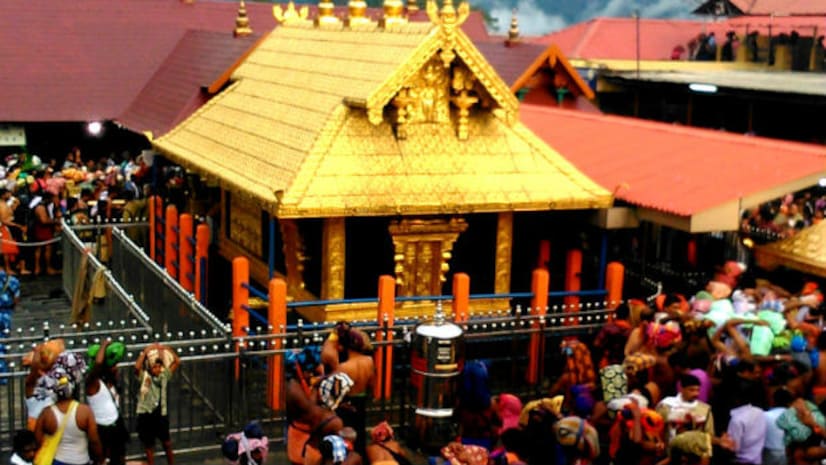
There comes a moment, quiet yet irrevocable, when the ordinary soul lays down its name and rises as the Supreme. It is the moment the sacred mala—the mudra of Ayyappa, not any ordinary chain of beads—is tied about the neck with all prayers and piety on the first day of Mandala Masam, the Malayalam month of Vrishchikam. This mala is the living symbol of the Lord himself. In that instant the identity given at birth falls silent. The one who once answered to a household name is thereafter known only as Swami, as Ayyappa. For the entire mandalakalam the bhakta does not journey toward God; the bhakta becomes God. He is addressed as Ayyappa, regarded as Ayyappa, and required to live as Ayyappa. The lady devotee becomes Malikappuram. This is not symbolic elevation or temporary role. It is the deliberate, sustained practice of the highest declaration the Upanishads ever made: Aham Brahmasmi—“I am Brahman.”
The penance that sustains this transformation begins on the first day of Vrishchikam, when the mala is worn with full devotion and prayer, and continues unbroken for forty-one days, culminating in the offering of the irumudi at Sabarimala. These forty-one days are not ordinary austerity. They are a pure penance of self-realisation in which Aham Brahmasmi is no longer a verse to be recited but a condition to be inhabited. Where else upon this earth is such a philosophy lived with such completeness? Other traditions may invite the devotee to adore, to serve, or, in rare moments of ecstasy, to glimpse union. At Sabarimala the union is the very condition of the pilgrimage. The journey is not undertaken by the mundane soul seeking a distant Lord; it is undertaken by Swamy Ayyappan returning to his own abode. For the full mandalakalam the distinction between worshipper and worshipped is set aside. Swamy Ayyappan regards his devotees as Ayyappa. He himself stands as the devotee. The one who is worshipped and the one who worships are a single reality appearing in two modes. This is the uniqueness of Sabarimala. Nowhere else is the devotee invited, for forty-one days of pure penance that begins with the wearing of the mudra on Vrishchikam 1, to assume the identity of the deity and thereby to live the mahavakya Aham Brahmasmi.
The philosophical dimension of this mahavakya finds its clearest classical expression in the Advaita Vedanta of Adi Shankaracharya. Shankara taught that Brahman alone is real, that the individual self is not other than Brahman, and that the appearance of multiplicity is the work of maya. The great sayings of the Upanishads—Aham Brahmasmi, Tat tvam asi, Ayam Atma Brahma—are, in his vision, not poetic metaphors but direct revelations of this non-dual identity. Sabarimala enacts precisely this teaching in lived form. When the devotee, on the first day of Mandala Masam, consents to wear the mala with prayer and piety and thereafter to be known as Ayyappa, he is performing, for the duration of the mandalakalam, the very recognition Shankara described: the limited adjuncts of name, form, and status are set aside, and the Self stands revealed as none other than the Supreme. The relevance of Advaita here is immediate and practical. What Shankara expounded in commentaries and monastic instruction, the pilgrimage offers to millions as a forty-one-day discipline of identity that begins with the sacred tying of the mudra. The mala upon the chest becomes the seal of that non-dual recognition.
The black attire deepens the same philosophical movement. It absorbs every colour and returns none, just as Brahman, realised as one’s own Self, absorbs every distinction of name, caste, wealth, and status. The richest and the poorest, the highest constitutional authority and the most obscure labourer, stand indistinguishable because the “I” that once claimed difference has been offered. For Swamy Ayyappan there is no hierarchy among those who have become Ayyappa, precisely because Aham Brahmasmi, as illuminated by Shankara’s Advaita, admits no hierarchy. The President and the Prime Minister, if they wear the mudra, are Ayyappa. The Ambani and the landless worker are Ayyappa. All are treated alike because all have entered the same recognition: the limited self is not the ultimate subject. Brahman alone is. This is not social reform added to spirituality; it is the social expression of the Advaitic fact that the Self is one without a second.
Throughout the forty-one days the vratham sustains the living of Aham Brahmasmi. Each dawn the devotee rises not as the person he was, but as Ayyappa. The disciplines of purity, celibacy, truth, and simplicity are the means by which the residual habits of the old “I” are prevented from reclaiming the centre. The irumudi that will be offered at Sabarimala is carried as the last remnant of personal claim, borne by one who has already affirmed “I am Brahman.” In the language of the Upanishads and of Shankara’s non-dual vision, the devotee is engaged in continuous discrimination between the real and the unreal, performed not in a hermitage but in ordinary life now lived under the divine name sealed by the mudra worn on Vrishchikam 1. The penance is pure because its sole aim is this self-realisation: not the acquisition of merit, but the stabilisation of the knowledge that the devotee and the deity were never two.
When the forest path begins at Pamba, the philosophical identification deepens into direct experience. The body tires, the mind narrows to a single purpose, and the world of ordinary roles falls away. The climb is not the effort of a seeker striving to reach Brahman; it is the return of Ayyappa—who is Brahman—to the hill that is his own. At the eighteen steps the final adjuncts grow thin. One does not ascend as a devotee hoping one day to realise Aham Brahmasmi; one ascends as the Swami in whom that realisation is already the manner of walking. The darshan that follows, and the offering of the irumudi after forty-one days, is therefore the recognition of a unity that the mandalakalam has already enacted. The light in the sanctum and the consciousness that has been wearing the mudra are understood to be the same light. The devotee merges with the deity because, in the truth of Aham Brahmasmi as taught by Shankara, merger is the recognition of what always was.
This is the spiritual emotion that Sabarimala awakens: the awe of discovering that the Supreme is not elsewhere, the tenderness of being addressed by all as the very form of the Self one has longed to know, and the quiet certainty that the mahavakya declared in the forest hermitages and elucidated by Shankara can be lived, from the wearing of the mala with prayer and piety on the first of Vrishchikam for forty-one days, by millions. The pilgrimage ends, the mala is removed, and the ordinary name returns. Yet the one who returns has tasted the state in which Aham Brahmasmi is no longer a sentence but a lived condition. He has walked the earth as Swamy Ayyappan. He has been seen as Swamy Ayyappan. And he has known, in the company of countless others who shared the same mudra and the same black cloth, that the devotee and the deity were never truly apart.
In this lies the perfection of Sabarimala’s philosophy and the alchemy that gives the pilgrimage its name. It does not promise the realisation of the Supreme as a distant attainment reserved for the few. It offers Aham Brahmasmi, in the living spirit of Shankara’s Advaita Vedanta, as the very manner of the journey that begins when the mala is worn with all prayers and piety on the first day of Mandala Masam. For the entire mandalakalam the ordinary soul is elevated to the Supreme through pure penance of self-realisation. The mundane self does not make the pilgrimage; Swamy Ayyappan—who is Brahman—does. And in that simple, profound reversal, the highest teaching of the scriptures is no longer heard. It is worn as the mudra, walked for forty-one days, and fulfilled in the offering at Sabarimala.
Swamiye Saranam Ayyappa.