


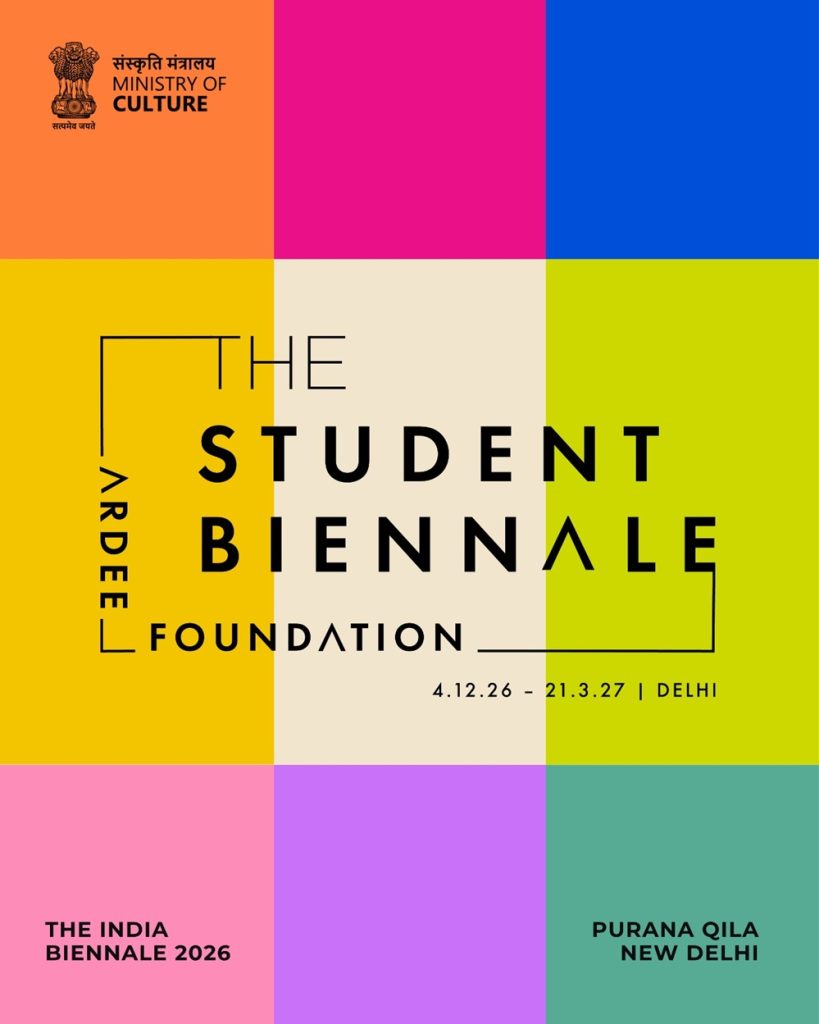
NEW DELHI: The Ardee Foundation has been invited by the Ministry of Culture, Government of India, to present the second edition of the Student Biennale at The India Biennale 2026–27. Taking place across New Delhi from December 4, 2026, to March 21, 2027, the Biennale will bring artistic practice into dialogue with the capital’s heritage sites, opening new ways to experience art within the city’s histories, architecture and landscapes.
Working at the intersection of education and art since 1997, The Ardee Foundation is committed to creating opportunities for students to explore ideas, experiment freely and develop independent artistic voices. The Ardee Foundation’s Student Biennale brings that commitment to a national public platform.
For Shefali Varma, Chairperson of The Ardee Schools and The Ardee Foundation, the origins of supporting students lie in a conversation with artist Jaysri Burman.
“A few years ago, as I was thinking about how to give the Foundation’s vision a formal direction, I went to artist Jaysri Burman for advice. She encouraged me to begin where an artistic life begins—with students. That thought stayed with me. After 25 years in education with The Ardee Schools, this felt both deeply familiar and instantly clear and shaped the path we have taken since” Varma said.
“Every student brings a world with them—their memories, their surroundings, their uncertainties and their hopes. Our responsibility is to make room for that world, to listen carefully and to help them develop the confidence to keep creating.”
Art in Dialogue with the City
The India Biennale 2026–27 will unfold across significant cultural and heritage sites, including Purana Qila, the Red Fort, the National Gallery of Modern Art, Qutub Minar, Lodhi Garden and Lalit Kala Akademi. Bringing modern, contemporary and student work into these settings, the Biennale invites audiences to consider how art can deepen our understanding of the spaces we inherit and the world we inhabit.
Varma also serves on the Organising Committee of The India Biennale, chaired by Vivek Aggarwal, IAS, Secretary, Ministry of Culture, and so she is able to see the preparations of the entire biennale unfold on a day-to-day basis.
“I have been deeply impressed by Mr Vivek Aggarwal and his team. His passion, attention to detail and commitment to leading from the front have been extraordinary to witness. There is a clear sense of purpose behind the initiative, and an immense amount of work and attention to details going into bringing it to life,” she said.
Varma also acknowledged Sharon Apparao, coordinator of the Biennale, for her curatorial vision and sensitivity to the relationship between art and space.
“Sharon understands how a work inhabits a space and how people encounter it. Bringing artists, architects, ideas and historic settings together on a national scale requires imagination, conviction and care. She brings all three.”
The Student Biennale:
Curated by Rahul Kumar, the Student Biennale will occupy approximately 5,000 square feet near Talaqi Darwaza, beside the lake at Purana Qila.
The biennale’s theme, Tat Tvam Asi—“You Are That” draws on an Upanishadic insight into the relationship between the self and the wider world. It invites students to explore interconnectedness: how individual lives are shaped by others, how personal experiences speak to shared concerns, and how art can make those relationships visible.
For Varma, the overwhelming response to the initiative has affirmed the need for platforms that take student practice seriously.
“The response has touched my heart. There is brilliance in the work, but also tenderness, honesty, urgency and a willingness to ask difficult questions. I find that deeply hopeful,” she said. “I want students to know that their ideas deserve attention, that we are listening, and that they have a place in the cultural life of this country.”
The partnership also offers an opportunity to advance conversations around accessible, experiential and inclusive art education.
“As an educator, I keep returning to a question: how do we help each student develop their own way of seeing? We need an art pedagogy that gives them time to observe, freedom to experiment and confidence to trust their questions,” Varma said. Varma said.
Varma hopes to continue engaging with the government to strengthen connections between schools, art colleges, museums, artists’ studios and cultural institutions. Through the Foundation, she seeks to widen access to these spaces and support students as they move from discovering an interest in art to developing and sustaining a creative practice.
The Student Biennale brings these ambitions into a shared public setting, giving students an opportunity to present their work and audiences an opportunity to engage with a new generation.
****