


By Prajapati
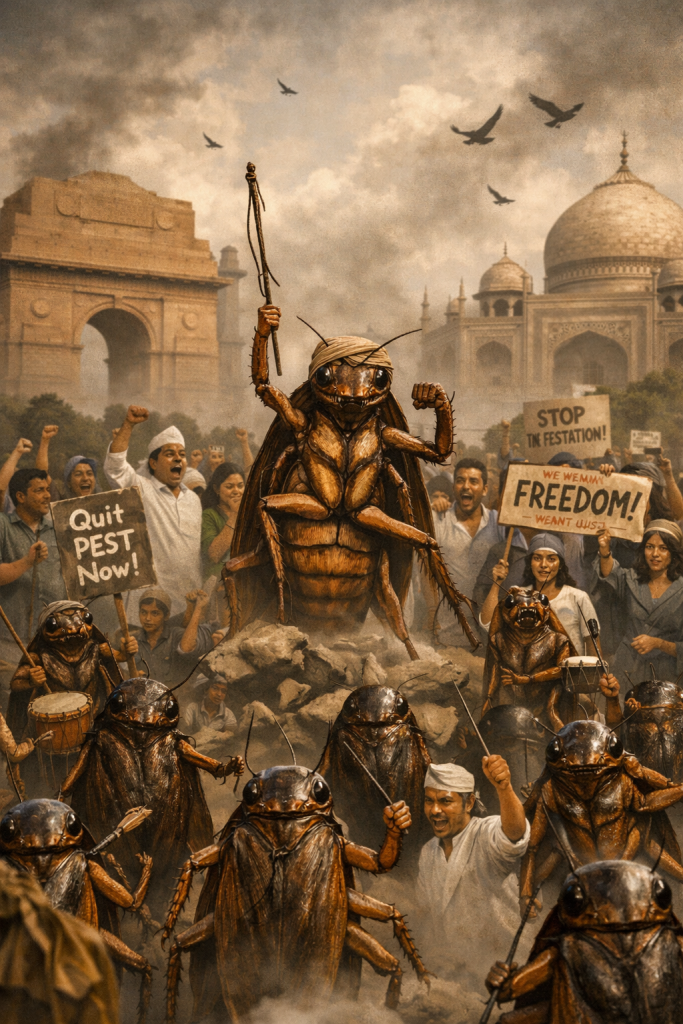
In the chaotic arena of Indian social media, where outrage travels faster than facts, the Cockroach Janata Party (CJP) has emerged as an unlikely sensation. What started as a witty reclamation of a slur directed at jobless youth has snowballed into a massive online movement, drawing millions of followers and outpacing official channels on platforms like Instagram. Led by communication strategist Abhijeet Dipke, CJP cleverly channels the frustration of young Indians over unemployment, leaking examination papers, and an education system that often feels rigged against them. Yet the movement’s explosive growth owes as much to its critics as to its creators.
The irony is hard to miss. A collective built on absurdist humour and cockroach resilience—surviving every setback with renewed vigour—found its perfect foil in online cheerleaders rushing to protect the establishment. During the farmers’ agitation, similar voices had dismissed legitimate protests as anti-national and foreign-inspired, turning dialogue into deadlock. The same pattern repeats with CJP. Instead of engaging with core issues like youth joblessness and economic pressures, certain online cheerleaders immediately branded the movement as a conspiracy, handing its organisers ready-made content on a platter.
CJP’s rapid expansion tells its own story. By repurposing a derogatory label into a symbol of defiance, the group tapped into genuine anxieties: sky-high unemployment rates, repeated paper leaks that destroy careers, and a cost-of-living crisis that hits the young hardest. Their satirical posts mix humour with sharp demands for accountability. The result? A following that quickly surpassed several ruling party handles. This wasn’t just organic growth—it was accelerated by backlash.
When authorities moved to restrict the platform, withhold accounts, and eventually take down the website, the response was predictable. What might have remained a niche meme page transformed into a symbol of suppressed dissent. Organisers framed the actions as evidence that the powerful fear youthful satire. This “censorship effect” gave the movement fresh oxygen, turning every restriction into viral fodder. The heavy-handed approach, though perhaps well-intentioned, reinforced the narrative that the system prefers silence over conversation.
Attempts to discredit CJP by labelling it foreign-influenced or anti-national proved particularly counterproductive. Online cheerleaders took to social media with emotionally charged posts, exaggerating minor criticisms into grand threats against national unity. These over-the-top reactions did not isolate the movement—they legitimised it. Young people watching their economic struggles being dismissed as disloyalty found resonance in CJP’s absurdist style. The more vociferous the attacks, the wider the reach.
This phenomenon highlights a recurring challenge for governance. Online cheerleaders, eager to project strength, often inflate issues beyond proportion. A demand for better job policies becomes “breaking India.” A meme about exam leaks turns into an “anti-national plot.” Such amplification makes governance harder, not easier. Instead of addressing root causes—creating sustainable employment, reforming examination systems, and restoring faith in institutions—these exaggerated responses shift focus to culture wars. The government ends up managing optics created by its own loudest cheerleaders.
The pattern mirrors global trends. Gen Z across democracies increasingly uses meme culture and dark humour as tools of political expression. In India, economic realities have sharpened this edge. Youth equipped with degrees but few opportunities are turning to satire because traditional channels feel unresponsive. By framing these voices as enemies rather than stakeholders, certain online cheerleaders inadvertently strengthen the opposition’s hand. What begins as loyalty ends up complicating policy delivery and alienating a key demographic.
One can almost picture the quiet frustration in administrative circles. While officials work on welfare schemes, skill development, and economic reforms, digital battlefields erupt over every satirical jab. The real difficulty arises not from the cockroaches themselves, but from those who stomp too loudly. Their contribution often stops at volume—daily outrage cycles, trending hashtags, and little else. Constructive nation-building—innovation, community work, policy advocacy—takes a backseat to performative patriotism.
The government would do well to recognise this dynamic. Ultra-patriotic posturing by these online cheerleaders that offers no practical solutions creates unnecessary headaches. These voices, though claiming to protect the establishment, frequently become its biggest liability. By providing handles through unfounded allegations, they enable critics to paint the administration as out of touch. Containing this tendency—through measured responses and focus on substantive issues—could prove more effective than reactive crackdowns.
As CJP continues its satirical march, the lesson is clear: mockery thrives on overreaction. The movement’s absurdist humour gains strength precisely when met with disproportionate fury from online cheerleaders. Young Indians, navigating a competitive, uncertain future, find catharsis in watching cockroaches outsmart the stompers. Global digital rights observers, including the Internet Freedom Foundation, have noted how such restrictions often backfire, amplifying the very voices they seek to quiet.
In the end, the Cockroach Janata Party may owe its longevity less to brilliant strategy and more to convenient enemies. The online cheerleaders who rush in with allegations, much like in the farmers’ protests, have once again demonstrated an uncanny ability to turn manageable discontent into enduring digital folklore. The humble cockroach, it seems, doesn’t just survive—it multiplies when threatened.
Whether this phenomenon fades or becomes a lasting symbol of youth disillusionment depends largely on how the ecosystem responds. If history is any guide, continued exaggeration by these self-appointed online cheerleaders will only ensure the cockroaches march on. In the theatre of Indian politics, sometimes the loudest applause comes from the cheapest seats—and the biggest favours are done by those claiming to help.