


By Suresh Unnithan
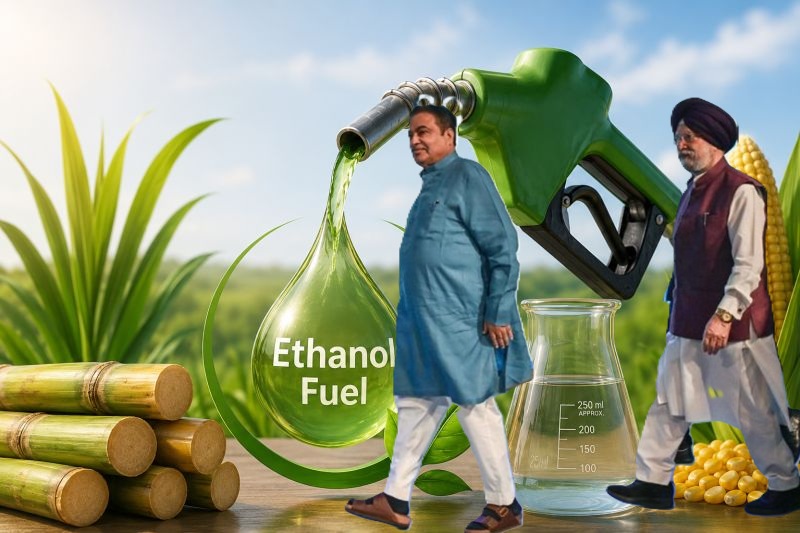
A fierce social media debate has erupted over India’s E20 ethanol-blended petrol, with Union Road Transport and Highways Minister Nitin Gadkari facing relentless targeting, criticism, and personal attacks. In sharp contrast, Hardeep Singh Puri — the Petroleum and Natural Gas Minister directly responsible for fuel policy, procurement, blending, and nationwide distribution — remains largely spared from equivalent scrutiny. This selective outrage, prominently amplified by a Patna-based YouTuber with pro-BJP leanings, raises serious questions about fairness, motives, and possible internal dynamics.
A key flashpoint involves the Patna YouTuber’s claims that his Toyota Innova developed engine troubles after 12,000 km on ethanol-blended fuel. He directed sharp abuse at Gadkari without producing authentic service records or independent tests confirming ethanol as the cause. Toyota’s inspection reportedly found no blend-related damage, instead pointing to possible contamination such as water mixed in the fuel tank. Gadkari has been using a similar vehicle for over two years without any reported issues.
Policy Responsibilities and Global Benchmarks
Ethanol blending is a Cabinet-approved national programme aimed at reducing oil imports, supporting farmers, and cutting emissions. The Petroleum Ministry under Puri holds primary responsibility for implementation — procurement pricing, OMC supply chains, distribution networks, and scaling higher blends. Gadkari’s ministry focuses on vehicle standards and promoting sustainable mobility. The intense social media focus on Gadkari, while Puri is largely spared on execution, stands out as inconsistent.
India has achieved impressive results, reaching E20 nationwide ahead of the 2025-26 target — a leap from under 1.5% blending in 2013-14. Reported benefits include ₹1.8–1.9 lakh crore in foreign exchange savings, substitution of over 300 lakh metric tonnes of crude oil, substantial CO₂ reductions, and significant additional farmer income, supported by nearly fivefold growth in production capacity.
Globally, Brazil provides a shining example of high-blend success with its mandatory E27 (often up to E30) and widespread E100 availability for flex-fuel vehicles that dominate its fleet. Its sugarcane-based programme, established in the 1970s, has delivered energy independence, rural development, and proven long-term vehicle compatibility. India’s rapid scaling places it among dynamic nations pursuing ambitious blends, alongside the US (E10/E15 standard), the EU (mostly E10), and programmes in China and Asia.
Gadkari’s Track Record Amid Sectoral Growth
Nitin Gadkari has driven India’s infrastructure transformation, expanding National Highways by ~60% to over 146,000 km, accelerating project execution, and developing extensive high-speed corridors. His advocacy for ethanol and green fuels reflects a forward-looking commitment to self-reliance. Reports indicate that his son Nikhil Gadkari’s company, CIAN Agro Industries, has experienced strong growth amid the broader ethanol sector boom — with revenues rising sharply (from modest levels around ₹17-18 crore to several hundred crore) and share prices increasing substantially (from lower double digits to several hundred rupees). This mirrors the policy-driven uplift benefiting multiple players in ethanol production. Gadkari has clarified that procurement and policy execution rest with the Petroleum Ministry.
Gadkari’s independent thinking and RSS connections make him less susceptible to factional pressures. The social media campaign’s disproportionate targeting of him, while Puri is spared scrutiny on implementation, suggests possible efforts to sideline a high-performing leader.
Towards Fair Accountability and National Progress
Global ethanol trends, anchored by Brazil’s mature high-blend model, validate the potential of such programmes when backed by robust execution. India’s E20 success is delivering clear national benefits, but addressing practical concerns like mileage in older vehicles requires accountable action from the lead ministry.
Leaders who deliver infrastructure results and champion sustainable policies deserve support, not selective attacks. Nitin Gadkari has consistently demonstrated dedication and outcomes. Hardeep Singh Puri, as the minister responsible for petroleum and fuel policy, must face equivalent, even-handed scrutiny on execution without being spared. India’s progress demands facts and fairness over social media-driven selective outrage.