


The first phase of workplace AI was about access. Professionals learnt to summarise documents, draft communication, generate ideas, ask sharper questions, and make routine work feel faster. For many organisations, that was a meaningful leap. But as AI becomes part of everyday professional life, a sharper divide is beginning to appear. It is no longer between those who use AI and those who do not. It is between those who can experiment with AI tools and those who can apply them to solve real business problems.
That distinction matters because business value rarely comes from isolated usage. A better prompt may save time, but it does not automatically improve a process. A dashboard may display data, but it does not automatically improve decision-making. A chatbot may answer questions, but it does not become a reliable knowledge system on its own. The real challenge today is whether professionals can turn AI into workflows, assistants, dashboards, decision systems, and repeatable processes that make business operations smarter.
This gap between AI awareness and AI application is visible across functions. In marketing, AI can go beyond campaign copy to track market signals, analyse competitors, and support faster content operations. In HR, it can structure policies, answer employee queries, and surface workforce patterns. In finance, it can assist with reporting, anomaly detection, and decision summaries. In operations, it can automate repetitive handoffs and improve workflow visibility. But these outcomes need more than tool familiarity. They require professionals to identify the right use case, understand the process, define the data, set guardrails, and design the workflow around business reality.
That is where the next phase of AI adoption is headed. Organisations are moving from experimentation to implementation. The question is shifting from “Which AI tool should we use?” to “Which business problem are we trying to solve?” This is also why agentic workflows are gaining attention. Unlike simple AI responses, agentic systems can be designed to carry out multi-step tasks, interact with tools, follow instructions, and support execution with greater autonomy. For businesses, this raises a practical question: how can AI move from being a productivity accessory to becoming part of the operating system of work?
No-code and low-code AI tools are making this shift more accessible. They allow managers, functional specialists, consultants, entrepreneurs, and business leaders to build workflows without depending entirely on technical teams. This does not remove the need for technology expertise. It changes the point of entry. Business professionals who understand processes, customer needs, reporting structures, operating gaps, and decision bottlenecks can now play a more active role in shaping how AI is applied within their functions.
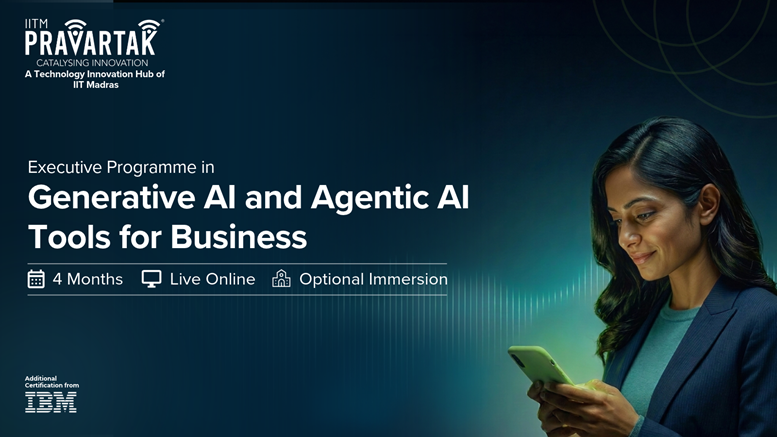
This is why structured, application-led learning is becoming important. IITM Pravartak’s Executive Programme in Generative AI and Agentic AI Tools for Business is positioned around building AI-powered workflows and agents through no-code AI for business professionals. The programme highlights hands-on work with no-code AI tools, practical projects, business use cases, automated dashboards, smart work assistants, custom GPTs, multi-source search assistants, no-code multi-agents, governance standards, and a capstone project that brings assistants, knowledge bases, and automations into one workflow.
The emphasis is significant. The next level of AI readiness is not built through theory alone. Professionals need to practise translating business problems into AI-supported solutions. They need to understand where automation helps and where human judgement must remain central. They need to create workflows that are useful, safe, repeatable, and aligned with organisational needs. AI capability is not just about knowing what the technology can do. It is about knowing where it should be applied, how it should be deployed, and how its impact should be evaluated.
This distinction may shape the future of workforce readiness. Organisations focused only on AI literacy may create employees who are comfortable with tools. Organisations that build AI capability may create professionals who can redesign work. One improves individual productivity. The other can improve how teams, functions, and businesses operate.
For professionals, the question is becoming immediate. Is AI being used only to make current tasks faster, or is it being applied to rethink how work gets done? The answer may determine whether AI remains an everyday convenience or becomes a real business capability. As organisations move deeper into AI-led transformation, the professionals who stand out may be those who can apply AI to real use cases, build practical systems, and help turn technology into measurable business value. For more information about the programme, visit: https://iitmpravartak.emeritus.org/generative-ai-and-agentic-ai-tools-for-business-application
****