


Legal Desk
The Protection of Children from Sexual Offences (POCSO) Act, enacted on June 19, 2012 in our Parliament, has proved an effective deterrent against child sexual abuse. Designed specifically to address offenses like penetrative sexual assault (Sections 3-6), sexual harassment (Section 11), and use of children for pornography (Section 13), the Act shifts the burden of proof onto the accused. The trials of cases under POCSO act are to be completed within one year in dedicated special courts, and the Act prioritizes child-sensitive measures such as in-camera proceedings and medical examinations by female doctors for girl victims.
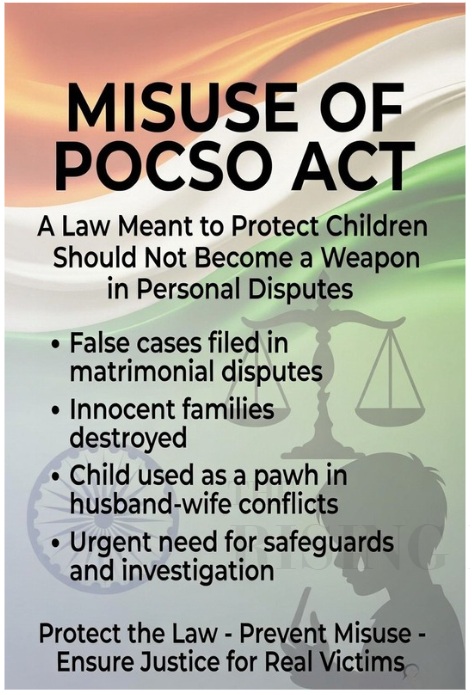
Despite the implementation of this stringent Act, an abnormal surge in POCSO related cases has been recorded in recent years – from 47,221 cases in 2020 to an estimated 70,000+ in 2023 (NCRB data). In 2024, over 69,191 cases were registered. National conviction
rates remain low, hovering around 29–35%, with acquittals ranging from 60–70% of disposed cases. In Fast Track Special Courts, the conviction rate was as low as 19% in 2024, while pendency remains a major concern. POCSO Act Misuse Statistics: While high acquittals do not automatically mean all cases are false, they have raised serious concerns about misuse. NCRB data and court observations show patterns of misuse especially in family disputes, property conflicts, adolescent relationships, and extortion. Regional studies indicate significant false cases — for instance, an analysis of 169 POCSO cases in Bhopal (2024–early 2025) found 85% were false, with only 24 convictions. In Karnataka (2021–2024), around 1.4% of cases were classified as false, with many more ending in acquittal. Courts, including the Supreme Court, have flagged misuse in “Romeo-Juliet” consensual relationships and matrimonial/custody battles.
According to a senior lady advocate practicing in the High Court of Kerala, this discrepancy in figures related to POCSO cases “not only highlights investigative shortcomings but also underscores how the law is misused by adults to extort money, resolve property disputes, or seek revenge, coercing children into false allegations that inflict lasting trauma on all involved.”
To substantiate her claim the senior lady advocate cites a case she recently won for the accused in the High Court of Kerala. “My case was an application for pre-arrest bail filed under section 482 of the Bharatiya Nagarik Suraksha Sanhita, 2023. The Petitioner was accused in Crime No.400 of 2025 of Kattakada Police Station. The offence charged against my client was punishable under section 75(1)(i) of Bharatiya Nyaya Sanhita, 2023 and sections 8, 7, 10, 9(c) 9(f), 9(l) 9(m) and 9(p) of the Protection of Children from Sexual Offences Act, 2012 (for short ‘the POCSO Act’). The charge was that the accused, who was a teacher at Poovachal LP School, had abused a minor child aged 8 years by making her sit on his lap in the class, grabbed her neck, rubbed her cheeks with his beard, and twisted her and thereby committed aggravated sexual assault.”
The senior lady advocate said that she could prove that “knowing the gravity of aftermath of booking someone under POSCO Act “a false and frivolous case was foisted upon my client, on the compulsion of the school management, who wants the petitioner to be terminated from the school to enable the appointment of a person after collecting huge amounts. The court admitted my contention and awarded bail to my client.”
To prove her point, the senior lady advocate said there were more similar false POCSO cases slapped on her client “and the court was convinced that it was a well-planned conspiracy to trap my client.”
A lady social activist from Thiruvananthapuram, who has been working among traumatised children says that misuse of the POCSO Act typically occurs when false allegations are levelled against individuals for ulterior motives. “Common scenarios include property disputes, marital conflicts, political rivalries, or financial extortion. In such cases, children—often coerced or influenced by parents or guardians—are used to file complaints that exploit the Act’s presumption of guilt and non-bailable provisions, which can devastate the accused’s life even before a trial concludes. High acquittal rates in POCSO cases are frequently cited as evidence of weak or fabricated claims, though they also reflect investigative lapses and judicial scrutiny.” She further says that a key concern is the “maliciousparent syndrome,” where one parent accuses the other or their associates during custody battles to gain leverage.”.
Similarly, in neighborhood or family feuds, minors may be prompted to make accusations to pressure the accused into concessions, such as dropping a legal claim or paying off debts. Political opponents have also been targeted, with complaints lodged to tarnish reputations or disrupt careers. These abuses not only undermine the Act’s credibility but also traumatize the children involved, who may face psychological harm from being manipulated into false testimonies.
Here are a few proven false POCSO cases:
Madras High Court Case (2024)
In a landmark ruling, the Madras High Court directed the prosecution of two individuals, Aravind and Pradeep, for falsely accusing a taekwondo coach, N. Dharmarajan, of sexual offenses under the POCSO A The false complaint was filed to settle a personal grudge, with three minor girls coerced into signing a fabricated complaint. During an in-camera hearing, the girls clarified that Dharmarajan was innocent and had been wrongfully targeted. The court ordered action against the accusers under Section 22(1) of the POCSO Act, which provides for punishment for false complaints. This case highlighted the misuse of the Act for personal vendettas and the need for accountability.
Delhi Court Fines Woman for False Allegation (2023)
In November 2023, a Delhi court imposed a Rs 1 lakh fine on a woman who falsely accused a man of sexually assaulting her five-year-old daughter to settle a property dispute. The court recognized the accusation as a deliberate attempt to misuse the POCSO Act, underscoring how such cases are filed for ulterior motives like land or monetary disputes.
Kanpur POCSO Extortion Case (2025)
In Kanpur, a lawyer and his associate were arrested in 2025 for falsely implicating an individual under the POCSO Act and demanding Rs 50 lakh to withdraw the fabricated case. This incident illustrates how the Act is exploited for extortion, with the accused facing severe financial and social consequences before the truth emerges.
Allahabad High Court Quashes False Case (Date Unspecified)
The Allahabad High Court quashed a POCSO case where a woman falsely accused her husband of raping their minor daughter to gain an advantage in a custody dispute. The court found that the victim, who was over 18, had willingly married the accused, and the allegations were baseless. This case highlighted the misuse of the POCSO Act in matrimonial disputes and the importance of thorough investigations.
Bhopal POCSO Case Analysis (2025)
An analysis of 169 POCSO cases tried in Bhopal over one year revealed that 85% were false, driven by motives such as monetary disputes, neighborhood conflicts, or objections to consensual relationships. Only 24 cases resulted in convictions, underscoring the high prevalence of baseless allegations and their devastating impact on the accused.
Additional Recent Cases (2025-2026):
Madras High Court (2025-2026): The court flagged the rising misuse of the POCSO Act and directed trial courts to act against false complainants. It also raised concerns over the “alarming trend” of misusing the 1098 child helpline to file false cases against fathers in family disputes.
Supreme Court of India (November 2025): Expressed serious concern over the growing misuse of POCSO in consensual adolescent relationships and matrimonial/custody disputes, noting it is often used as a retaliatory tool.
Calcutta High Court (2025): Initiated inquiry into a false POCSO case filed under political coercion, where the complainant admitted the allegations were fabricated due to pressure from local leaders.
A lady advocate from Thiruvananthapuram says the lawyers are sometimes victimised or threatened by clients quoting POCSO Act. “One of my clients who has criminal antecedents, when asked for payment, threatened to sue me under the POCSO case.”
Of course, the POCSO Act remains a critical tool for protecting children from predators, but its misuse for personal gain or feuds has devastating consequences for innocent individuals. As a senior Supreme Court Advocate points out “The social stigma, emotional trauma, financial ruin, and erosion of trust in the justice system highlight the urgent need for reforms to address false allegations. By enforcing stricter penalties, ensuring thorough investigations, and supporting the falsely accused, India can restore the Act’s integrity while safeguarding both children and innocent adults from the devastating impact of baseless claims.
Courtesy The Rising Nation