


By Suresh Unnithan
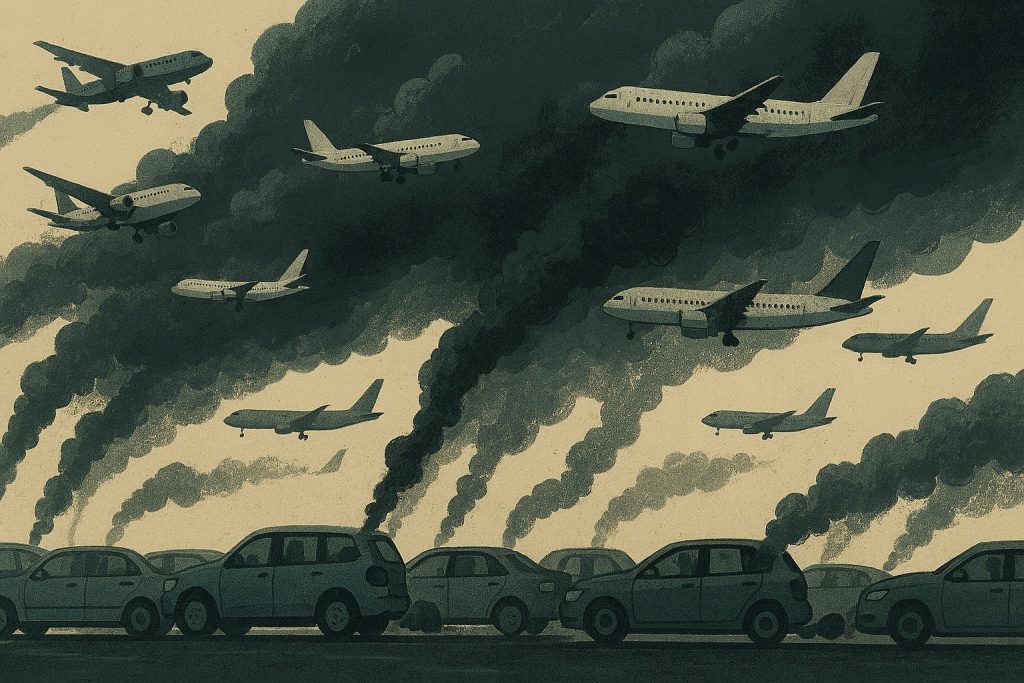
In this busy world time is precious and the passenger planes saves your travel time, for Air Travel is the quickest mode of transport. Ferrying millions of passengers over 100,000 flights crisscross the globe daily. This aerial ballet, while a marvel of modern engineering, comes at a steep environmental cost. Crowded air traffic amplifies emissions, trapping heat in the atmosphere and choking cities with pollutants. Passenger aircraft, operating entirely within Earth’s atmosphere, contribute significantly to air pollution and climate change—not “space pollution,” which pertains to orbital debris from satellites. As India’s aviation sector surges, these impacts are particularly acute, blending global trends with local realities. This article explores the emissions footprint, non-CO2 amplifiers, urban air quality woes, and the vicious cycle of congestion, backed by recent data.
Rapid Rise in Emissions
Aviation’s Greenhouse Gas (GHG) emissions have ballooned alongside booming passenger demand. Globally, the sector accounted for 2.5% of energy-related CO₂ emissions in 2023, totaling nearly 950 million tonnes (Mt) of CO₂—up from 1,000 Mt in 2019 pre-pandemic levels, and on track to surpass them in 2025. This growth outpaced other transport modes like rail and shipping between 2000 and 2019, driven by a 2.2% annual emissions increase.
In India, the story is even more explosive. The country’s aviation GHG emissions surged 2.5 times between 2005 and 2018, reaching 25 MtCO₂e by the latter year. Growth has only accelerated since, fueled by domestic market expansion—India now ranks as the world’s third-largest domestic aviation market. As of 2019, India was the third-largest contributor to global aviation CO₂ emissions among developing countries, accounting for about 1.5% of the world’s total aviation output. By 2023, major carriers like Air India alone emitted 2.8 Mt of CO₂, projected to double to over 5.5 Mt within a decade despite efficiency gains. With passenger traffic rallying 10.1% annually, India’s sector could contribute 15-25% of global aviation CO₂ by 2050 if unchecked.
| Year | Global Aviation CO₂ Emissions (Mt) | India’s Aviation GHG Emissions (MtCO₂e) | Key Driver |
| 2005 | ~600 | ~10 | Post-9/11 recovery |
| 2018 | ~900 | 25 | Low-cost carrier boom |
| 2023 | 950 | ~35 (est.) | Post-COVID surge |
This table highlights the parallel trajectories: global emissions have nearly doubled since 2005, while India’s have tripled, underscoring the sector’s vulnerability to traffic density.
Non-CO₂ Effects Multiply the Climate Toll
CO₂ hits headlines, but aviation’s true climate punch lands higher up. At cruising altitudes of 30,000-40,000 feet, emissions of water vapour, nitrogen oxides (NOₓ), and soot particles trigger reactions far deadlier than CO₂ alone. These non-CO₂ effects—primarily contrails (those lingering vapour trails that spread into heat-trapping cirrus clouds)—can amplify aviation’s warming impact by 2 to 4 times over CO₂ emissions. Recent estimates peg non-CO₂ contributions at two-thirds of the sector’s total warming, with contrails alone responsible for 35% of aviation’s climate forcing.
In 2023, this multiplier meant aviation’s effective impact equated to 4% of global temperature rise since pre-industrial times, despite CO₂ comprising just 2.5%. For India, where high-altitude routes over the Himalayas and Indian Ocean are dense, these effects are pronounced: NOₓ emissions enhance ozone formation, a potent short-lived climate pollutant, while soot seeds clouds that persist for hours. Studies show that optimizing flight paths to avoid ice-supersaturated regions could slash contrail warming by up to 59%, but crowded airspace complicates such manoeuvres.
Airports as Pollution Hotbeds
While skies bear the brunt of cruise emissions, airports are ground zero for local air quality crises. Taxiing, idling, and take-off phases spew ultrafine particles, volatile organic compounds, and black carbon—exacerbating urban smog in India’s megacities. Delhi, the world’s most polluted capital in 2024, sees aviation contribute to PM₂.₅ levels exceeding WHO guidelines by 6 times, with airport operations adding 10-20% to local NOₓ and particulate loads. Mumbai, ranked fifth globally for pollution that year, faces similar woes: Indira Gandhi International Airport in Delhi and Chhatrapati Shivaji Maharaj in Mumbai together emit thousands of tonnes of pollutants annually, worsening respiratory diseases amid seasonal spikes.
A 2024 analysis of 17 Indian non-attainment cities found aviation ground emissions as a key PM₂.₅ driver (8-25% of total), alongside vehicular traffic. Nationwide, 60% of districts breach national PM₂.₅ standards, with aviation hotspots like Delhi-NCR hotspots for 16% of India’s consistent high-pollution zones. These emissions claim lives: Globally, aviation-linked air pollution causes ~74,000 premature deaths yearly, with India bearing a disproportionate share due to its urban density.
Traffic Jams at 35,000 Feet
Crowded skies turn efficiency on its head. Air traffic congestion—delays, holding patterns, and inefficient routing—boosts fuel burn by 5-10% per flight, per 2024 data. As global flights hit record highs in 2023, emissions grew 8% year-on-year to 882 MtCO₂, outstripping 2019 peaks. In India, where airspace bottlenecks around Delhi and Mumbai cause 20-30 minute average delays, this “congestion penalty” adds millions of tonnes of extra CO₂ annually.
High-density corridors amplify non-CO₂ woes too: More flights mean more contrails, with 2024 models showing a 20% emissions hike from suboptimal routing. Safety concerns further hinder climate-optimized paths, as rerouting through busy sectors risks collisions. Yet, tools like AI-driven traffic management could cut congestion emissions by 10%, blending safety with sustainability.
Charting a Course to Clearer Skies
The crowded airways of passenger aviation are a double-edged sword: vital for connectivity, yet a vector for pollution and warming. India’s rapid growth—from 2.5-fold emissions rise to third-place ranking among developing nations—mirrors global trends, where aviation’s 2.5% CO₂ share belies a 4% warming footprint via non-CO₂ multipliers. Ground operations foul city air, while congestion locks in inefficiency.
Solutions exist: Sustainable aviation fuels (SAF) could slash lifecycle emissions 80%, with India mandating 1% blends by 2025. Electric/hybrid short-haul flights, contrail-avoiding routing, and carbon markets like CORSIA offer hope. But demand restraint—via taxes or high-speed rail—may be essential. As skies grow busier, ignoring these skies’ hidden toll risks grounding progress on cleaner air and a stable climate. It’s time to fly smarter, not just higher.
*Inputs from Nanditha Subhadra