


By Suresh Unnithan
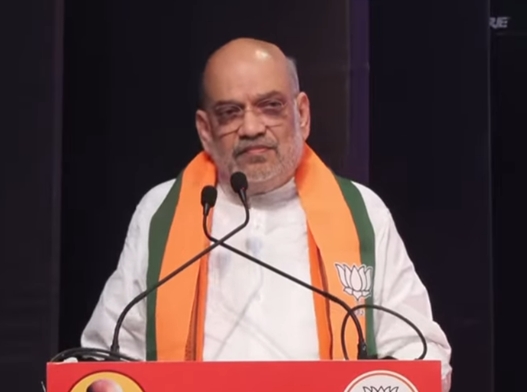
Union Home Minister Amit Shah announced in Mumbai that the Uniform Civil Code would be introduced in all 21 BJP-NDA ruled states before the 2029 Lok Sabha election. It was a confident sentence, the kind that sounds like a government order until one remembers that several of those “states” are run by parties that live not on ideology but on the arithmetic of caste, community and the next booth.
The Bharatiya Janata Party holds 240 seats in the Lok Sabha. The majority mark is 272. The gap is not a rounding error; it is the entire political biography of the present government. Count the NDA without the 20 Trinamool rebels whose merger and recognition remain contested, and the alliance sits at about 298. The often-quoted 318 is an optimistic ledger, not a settled House. Even 298 is a working majority. It is not a licence to treat partners as administrative units.
Of the two large partners whose numbers still matter, the Telugu Desam Party has 16 MPs and the Janata Dal (United) has 12. Neither built its machine by asking voters to admire a common civil code.
That is the unromantic truth of Indian coalition politics. The BJP is the rare national party that still possesses a large bloc of ideologically committed voters. Most of its allies survive on vote banks that are cultivated, counted and, when necessary, soothed. Personal law is not an abstract chapter of the Constitution for them. It is a live wire running through minority neighbourhoods, caste panchayats and the pamphlets that appear three months before polling day.
Shah’s list of “21 NDA-ruled states” papers over a more awkward map. In several of those states the BJP is not the government. It is the junior partner. Andhra Pradesh is the clearest case. N. Chandrababu Naidu is Chief Minister; the TDP and Jana Sena dominate the Assembly; the BJP has a handful of MLAs. Naidu once said that on the UCC his party would stand with the Muslim community. The TDP now says it will “support” the code and then immediately parks the file under stakeholder consultation. In Amaravati, consultation is not a footnote. It is the policy.
Bihar is no simpler. The JD(U) has already drawn a line that Delhi cannot wish away: support the idea nationally, do not implement it in the state. That is not a drafting quibble. It is a veto dressed as federalism. Chirag Paswan’s LJP wants the draft published and every custom weighed. A Home Minister can announce a deadline for Bihar. He cannot draft the Bill past parties that still decide whether the coalition in Patna stands.
Elsewhere the pattern repeats in a lower key. In Meghalaya, Conrad Sangma’s National People’s Party runs the government; the BJP sits in the room, not at the head of the table. In Nagaland, Neiphiu Rio’s regional formation is the face of power, and any civil code that touches customary law will meet Article 371A before it meets a committee. In Sikkim, the SKM government is an NDA ally in Delhi and a local party at home. These are not Uttarakhand. They are not Gujarat. They are states where the BJP can request, not command.
Maharashtra looks more comfortable because the BJP holds the Chief Minister’s office, but even there the Mahayuti is a three-party bargain. Shiv Sena has cheered the UCC. That helps in Mumbai. It does not write the law in Itanagar or Shillong.
So the replies to Shah arrived on schedule, each wrapped in the silk of principle and the steel of self-preservation. The TDP offered support with conditions. The JD(U) offered support with a map. The LJP asked to see the draft. Enthusiasm is easier in states where the BJP is the senior partner and the social map is less complicated. In the states where it is the guest, the uniform is still hanging in the wardrobe.
There is a quiet joke in the phrase “Uniform Civil Code” as it is now being pursued. Uttarakhand has enforced a code since January 2025. Gujarat, Assam and Madhya Pradesh have passed Bills that still await the last bureaucratic rites. Other NDA states are forming committees, which in Indian administration is the official ceremony for buying time. What Shah is promising is not one uniform code but twenty-one state experiments that may or may not resemble one another. One nation, many codes, one deadline. The uniformity is in the slogan; the federalism is in the fine print.
The state-by-state route is not an accident. A single central law would have to travel through a Parliament in which the BJP cannot walk alone. It would also force every ally to vote in public. State legislatures allow the same project to be presented as local reform, local consensus, local timing. Allies can nod in Delhi and stall in Amaravati or Patna. Even a thin sliver inside the BJP itself has little appetite for a fight that converts a manifesto promise into a by-election liability.
Shah’s 2029 horizon is, in that sense, both a deadline and an escape hatch. Three years is long enough for committees to draft, for Presidents to assent, for rules to be notified, and for junior partners to discover fresh “stakeholders.” It is also long enough for the alliance to decide, quietly, that some uniforms look better on the hanger than on the street.
The UCC debate will be sold as a test of national integration. Inside the NDA it is a more familiar test: how far a dominant party can push an ideological project when its majority still depends on parties that count communities more carefully than they count clauses, and when, in more than one state, the BJP is not the landlord but the tenant. Ideology wins speeches. Vote banks win Tuesdays. Between those two calendars, the code may travel far on paper and rather less in the capitals that actually decide whether the alliance holds.