


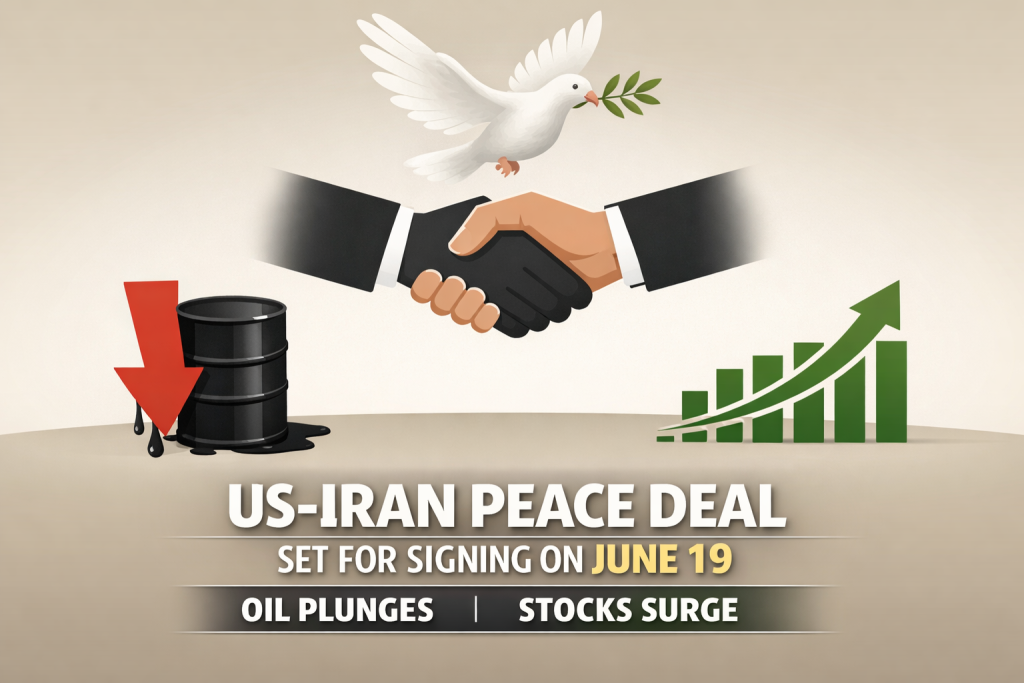
Dubai (PNI News): The anticipated signing of a US-Iran peace agreement on June 19, 2026, in Switzerland is sending shockwaves through global financial markets, with oil prices tumbling sharply and equities rallying as investors bet on the restoration of energy flows through the Strait of Hormuz. The deal promises an “immediate and permanent” end to military operations, offering significant relief to import-dependent economies like India after months of heightened energy costs.
Pakistani Prime Minister Shehbaz Sharif announced the breakthrough, confirming that both sides have agreed to reopen the critical waterway toll-free. US President Donald Trump echoed the optimism, urging global shipping to resume: “Ships of the World, start your engines. Let the oil flow!” The formal memorandum of understanding (MoU) signing is set for Friday, with possible electronic pre-signatures.
Sharp Drop in Oil Prices
Oil benchmarks plunged on Monday following the announcements. Brent crude, the global benchmark, fell more than 4% to around $83 per barrel, touching two-month lows. West Texas Intermediate (WTI) dropped over 5% toward $80 a barrel. These levels represent a dramatic reversal from peaks above $120–$126 during the conflict, when Iranian actions and the US blockade severely restricted flows through the Strait of Hormuz — a chokepoint carrying about 20% of global oil trade.
Analysts predict further softening as tanker traffic resumes, potentially flooding markets with previously bottled-up supply. Energy executives caution that full normalization may take time due to low US strategic reserves and logistical hurdles, but the immediate effect is lower gasoline prices worldwide. For India, which imports over 85% of its crude, this could ease inflation pressures, reduce the import bill, and provide relief to consumers and industries hit hard by recent fuel price spikes.
Equity Markets Rally on Optimism
Global stocks soared in response. Asian markets led the charge: Japan’s Nikkei 225 jumped over 5%, South Korea’s Kospi surged more than 5.5%, while broader MSCI Asia indices gained strongly. US futures also climbed, with Dow Jones futures up nearly 1%, S&P 500 futures rising 1.1%, and Nasdaq futures gaining 1.8%. Bitcoin and other risk assets followed suit.
The relief rally reflects expectations of reduced geopolitical risk premium, lower input costs for businesses, and improved global growth prospects. Sectors sensitive to energy costs — airlines, transportation, manufacturing, and consumer goods — are among the biggest beneficiaries. In contrast, energy stocks faced pressure amid falling crude prices.
Broader Economic Implications
The deal includes provisions for suspending certain sanctions, releasing frozen assets, and initiating talks on Iran’s nuclear program within a 60-day window. These elements could further stabilize markets by improving supply predictability and reducing volatility that has plagued commodities since early 2026.
For emerging markets like India, the positive spillover could be substantial. Lower oil prices typically strengthen the rupee, ease current account deficits, and give the Reserve Bank of India more room for monetary policy support. Kerala, with its reliance on remittances and sensitivity to fuel and import costs, stands to gain from cheaper diesel and petrol, potentially boosting local consumption and curbing inflationary pass-throughs to essentials.
However, analysts warn of lingering risks. Implementation challenges, Israel’s reported reservations on Lebanon-related clauses, and uncertainties around full sanctions relief could cap the upside. Some experts note that while short-term relief is clear, rebuilding trust and verifying compliance will determine longer-term market stability. Gold, often a safe-haven asset, has also seen adjustments amid shifting risk sentiment.
Background of Market Turmoil
The 2026 conflict had driven the largest monthly oil price spikes in recent history, exacerbating global inflation fears and supply chain disruptions. Temporary ceasefires failed to restore confidence until this breakthrough, facilitated by Pakistani mediation and backchannel diplomacy. Markets had priced in prolonged disruption, with floating storage full and alternative routes strained.
As diplomats prepare for the June 19 ceremony, pre-implementation steps are underway. US Vice President JD Vance may attend. Economists view this as a pivotal moment that could avert deeper recessionary pressures from sustained high energy costs.
For Indian businesses and households, the market reaction signals cautious optimism: cheaper energy imports ahead, provided the deal holds. PNI News will continue tracking developments and their direct impact on Kerala and national markets.