


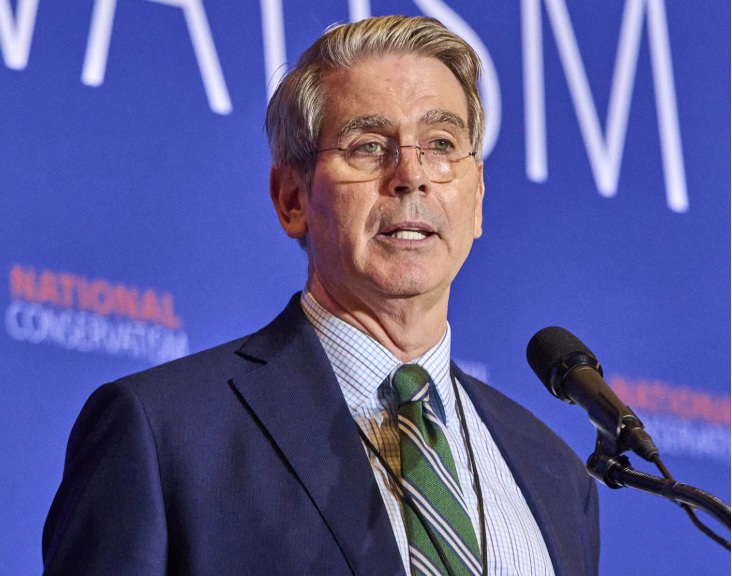
U.S. Treasury Secretary Scott Bessent said Thursday that Washington will impose “the toughest sanctions in history” on Iran as part of a coordinated campaign to isolate Tehran economically and collapse its government, while pressing China to fall in line.
Speaking to CNBC, Bessent framed the new measures as a “one-two punch” alongside the existing U.S. naval blockade of Iran, which was imposed in April and later paused. “It is going to work in Iran and we are going to collapse this regime,” he said. “It is time for our allies and the rest of the world to make a decision.” He added that the United States would tell other countries they are “either with us or against us.”
Bessent announced he will hold a press conference on Monday to outline the details. The remarks came a day after President Donald Trump warned of “Economic Warfare and Isolation on an unprecedented scale” and threatened consequences for any country providing “any type of lifeline to Iran.” Bessent suggested maximum economic pressure could reduce the need for another large-scale military operation, saying markets may have misread the strategy even as oil prices climbed.
He singled out China, Iran’s dominant oil customer. Beijing bought more than 80 percent of Iran’s seaborne crude in 2025, according to data from analytics firm Kpler. Bessent noted that China draws about 50 percent of its energy from the Gulf and would benefit from reopening the Strait of Hormuz. “It would do them a big service to get with the program,” he said. Asked whether the United States could target Chinese entities doing business with Iran, he replied that some conversations were better held privately.
China rejected the approach. A spokesperson for its embassy in Washington said sanctions and pressure “do not help resolve the problem” and called on parties to take responsible actions and settle the issue through political and diplomatic means. Iran’s foreign ministry separately condemned the threatened measures as “economic terrorism.”
The conflict, now approaching six months, has already disrupted shipping through the Strait of Hormuz, a chokepoint that previously carried a large share of globally traded oil. Bessent argued the coming sanctions package, combined with the blockade, would squeeze Iran’s ability to fund its military and proxies. Further pressure on China, a major supplier of rare-earth minerals and other goods to the United States, would carry risks of retaliation.