


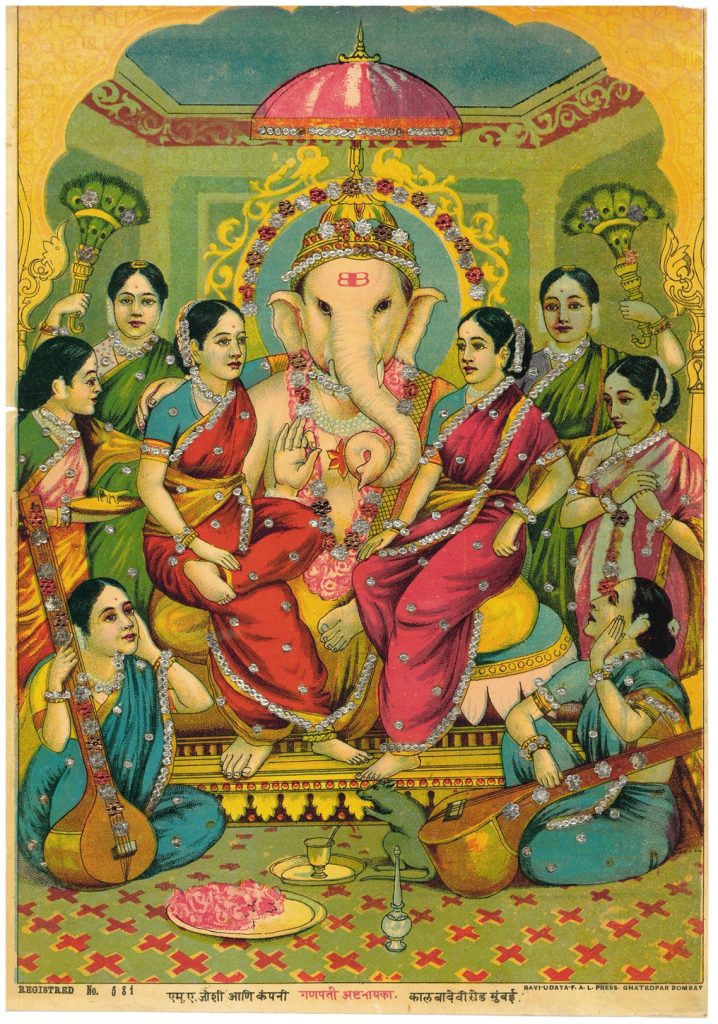
Raja Ravi Varma Heritage Foundation announces ‘What India Learned to See, From Battala to the Ravi Varma Press and Beyond’ a major exhibition examining the pivotal role of printmaking in shaping India’s modern visual culture. Hosted at Gallery G, Bangalore, the exhibition brings together a rare corpus of oleographs, lithographs, and printed ephemera spanning the late nineteenth to mid-twentieth century.
At the centre of the exhibition is the transformative legacy of Raja Ravi Varma and the establishment of the Ravi Varma Press. By translating academic oil painting into widely accessible printed images, the Press redefined the visual language of Indian mythology — standardising iconographies of deities such as Lakshmi, Saraswati, Vishnu, Shiva, Rama and Krishna. These images moved beyond elite patronage into everyday life, shaping a shared visual vocabulary across the subcontinent.
Expanding beyond a single press, the exhibition situates these works within a broader network of regional print traditions, from Calcutta to Western India. Through a comparative display of recurring divine figures, the exhibition reveals how core attributes like the lotus, veena, conch, flute, remain constant even as form, colour, and composition evolve in response to technological advancements, market forces, and regional aesthetics.
By foregrounding repetition, variation, and circulation, the exhibition positions print not merely as a reproductive medium, but as a generative force — one that actively constructed how India came to see its gods, myths, and cultural identity.
“The originals have their place, and the prints have their role. That role is to ensure that everyone can come in and experience the collection as a whole. This exhibition, presented on the birth anniversary of my great-great-grandfather, Raja Ravi Varma, is about opening that access—reminding us that this visual inheritance was never meant to be limited, but shared,” Rukmini Varma, Chairperson, Raja Ravi Varma Heritage Foundation.
“At the Raja Ravi Varma Heritage Foundation, we do not approach prints from a commercial or speculative lens. Prints, by their very nature, were created for dissemination — designed to enter homes, public spaces and everyday life across the country. Their significance lies in access, not exclusivity. Much like music, their value is not derived from rarity or ownership. The artist is gone, the original press is no longer active, and yet the imagery continues to live – quietly, shaping how generations have learned to see, to recognise divinity, and to engage with visual culture. That, to us, is where their true value lies — cultural, educational, and deeply embedded in the public imagination.
What India Learned to See has been conceived precisely in this spirit. It is not an exercise in valuation, but in acknowledgement of how printmaking expanded the visual language of a nation. We are not collectors of prints, nor do we position them as commercial assets. We present them as a shared visual inheritance – something that belongs, in many ways, to everyone,” Gitanjali Maini, Managing Trustee and CEO, Raja Ravi Varma Heritage Foundation
“As an oil painter, one understands the limits of access that original works naturally carry, even as they hold their own value. An exhibition of prints, especially on his birth anniversary, allows people to feel that they too are part of this inheritance, part of his legacy. This is, at its heart, an inclusive gesture,” Jay Varma, Trustee, Raja Ravi Varma Heritage Foundation.
Drawing on extensive research and archival material positioned alongside the Foundation’s extensive collection of oleographs, the exhibition reflects the institution’s continued commitment to scholarship, preservation, and public engagement.
Date: Ongoing until May 31st.
Venue: Gallery G, 38, Maini Sadan, Lavelle Road, Shanthala Nagar, Ashok Nagar, Bengaluru, Karnataka 560001