

The 15-Minute Life: How Mumbai’s Western Suburbs Are Turning Time into Real Estate’s Biggest Luxury

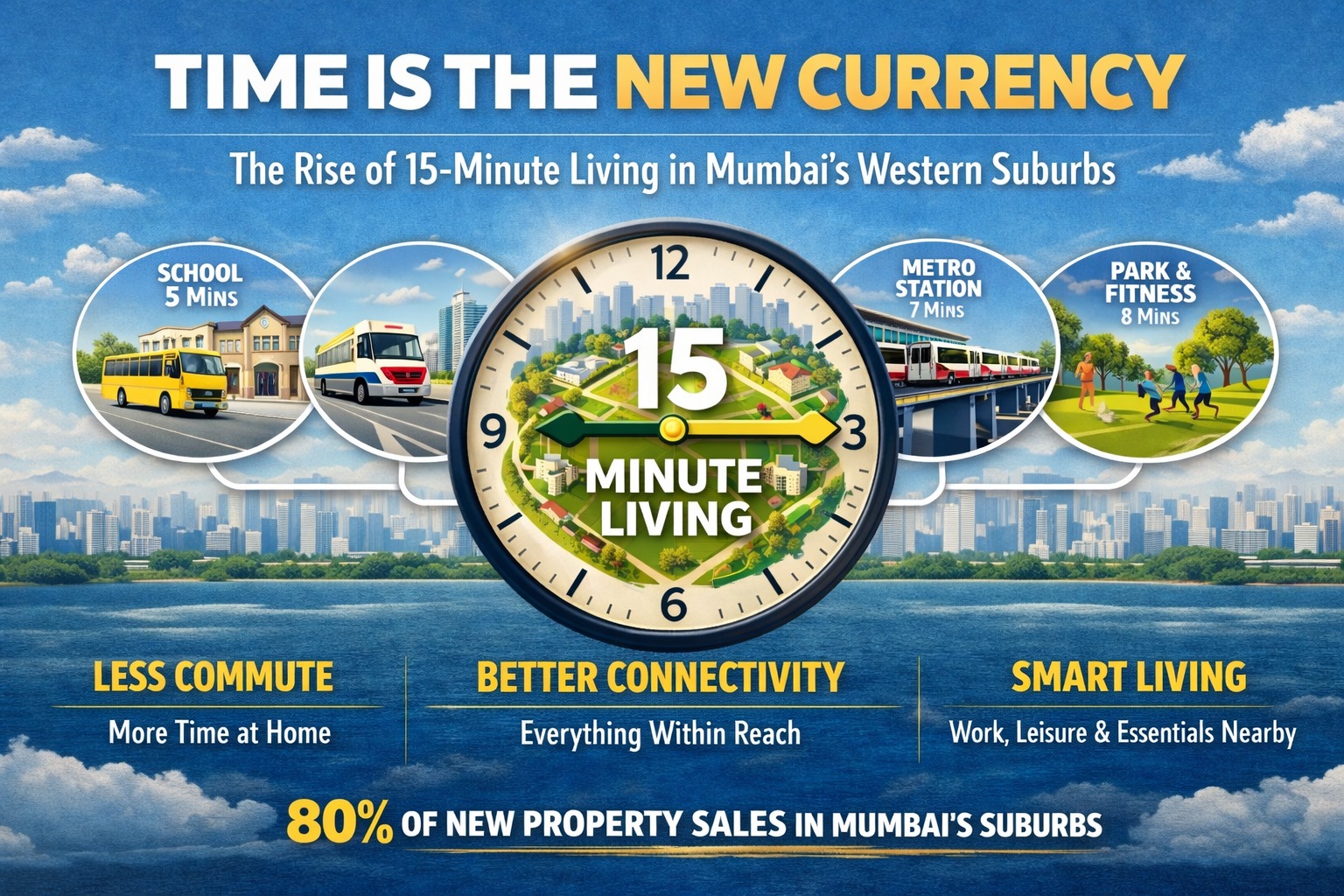
In a city where time often feels like the most expensive commodity, a new way of thinking about home buying is reshaping aspirations across Mumbai’s western suburbs; the idea of the “15-minute life.” It’s not just about where you live, but how much of your life you can reclaim within a short radius of it.
Imagine a morning without a long commute. Your child’s school is a quick drive away, the metro station is nearby, and your daily essentials are within easy reach. Evenings aren’t lost in traffic; they’re spent at the gym, in a park, or simply at home. This is the promise of a micro-life ecosystem; everything you need within 15 minutes.
According to Knight Frank, Mumbai recorded over 97,000 home sales in 2025, even as prices rose by around 7% year-on-year. The city also saw over 1.5 lakh property registrations, the highest in over a decade, underscoring sustained demand. This trend suggests that end-users are increasingly prioritizing value beyond just price.
More importantly, this demand is increasingly concentrated in suburban micro-markets. Industry data suggests that over 80% of registrations are now driven by suburban locations, reflecting a clear shift towards areas that offer a balance of connectivity, social infrastructure, and everyday convenience.
For many homebuyers, this shift represents something deeper than convenience. “Homebuyers today are looking beyond just the four walls of an apartment; they’re evaluating how seamlessly their daily lives fit around it,” says Mr. Dhruman Shah, Promoter, Ariha Group. “Locations that offer a balanced mix of accessibility, social infrastructure, and a familiar neighborhood fabric are naturally gaining attention, particularly well-established residential pockets where everything already feels within reach. The value lies in how much closer everything feels.”
Developers are responding by rethinking how projects are positioned. Connectivity is no longer a checkbox; it has become central to how homes are evaluated. With expanding metro networks and improving infrastructure across the western suburbs, neighborhoods are evolving into more self-sufficient ecosystems where daily needs are within easy reach.
Mr. Nihar Jayesh Thakkar, Founder, The Mandate House Pvt. Ltd., believes this shift is also emotional. “The narrative has clearly moved from ‘where is the property’ to ‘how does life feel around it.’ Buyers are drawn to ecosystems where work, leisure, and essentials coexist effortlessly. When you can structure your day without long commutes, the home becomes far more than a static asset; it becomes an enabler of a better routine.”
Industry voices agree that this is not a passing phase. A spokesperson from Chandak Group notes, “There’s a visible evolution in what defines value for today’s homebuyer. It’s no longer limited to connectivity alone, but extends to how effortlessly daily life can unfold within the neighborhood. Developments are increasingly being envisioned as cohesive ecosystems where essentials, transit, and shared spaces are seamlessly integrated. The emphasis is on reducing friction in everyday routines, allowing residents to experience a more intuitive, time-efficient way of living.”
“This shift is also reflected in on-ground traction across key micro-markets in the western suburbs. For instance, Chandak Group has been witnessing strong end-user interest across its developments in Andheri, Vile Parle, Goregaon, Malad, and Borivali, driven largely by their proximity to evolving metro corridors and established social infrastructure,” the spokesperson further added.
Ultimately, the shift is both simple and profound. In a city defined by its relentless pace, the true measure of luxury is no longer just space or scale, but the ability to reclaim time. Homes that enable shorter commutes, easier routines, and more meaningful daily experiences are fast becoming the most valued. In Mumbai’s evolving suburban landscape, the future of living isn’t just about where you stay; it’s about how much more of life you get to live.
