

Government School Students from Andhra Pradesh and Telangana Build AI-Powered Solutions at Hack to the Future

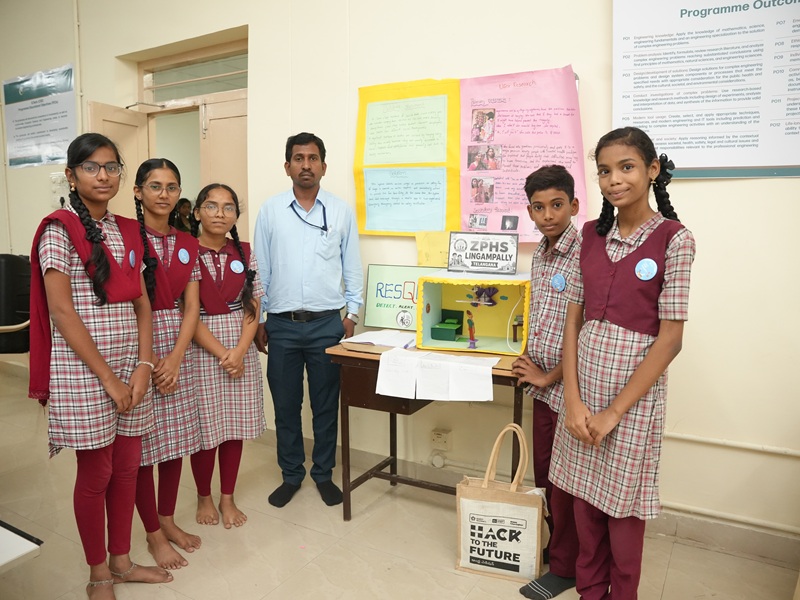
Visakhapatnam : Hack to the Future 2026, Andhra Pradesh Edition concluded today at GITAM Deemed University, Visakhapatnam. The five-day residential bootcamp saw 23 student teams – 111 students from six districts across Andhra Pradesh and Telangana – prototype solutions to challenges drawn from their own communities.
The event brings together learnings from the implementation of the Future Skills curriculum pilot with a focus on AI in 742 government schools across Andhra Pradesh, through which more than 1,500 educators have been trained and over 90,000 students reached. The event was organised by Quest Alliance in partnership with Samagra Shiksha Abhiyan, Leadership for Equity, and GITAM Deemed University.
Over four days, student teams built app-based and product-based AI solutions using various tools including MIT App Inventor, Scratch, Arduino, and robotics platforms. Teams moved through user research, iterative design, and peer feedback before presenting their prototypes. Each solution was rooted in a challenge the students had identified in their school, community or region.
“Hackathons are a forum for us to bring students’ ideas to life. There is so much that the young learners are absorbing from their life experiences. Hackathons become spaces for them to articulate problems they feel deeply about and try to think of tech-based solutions where they become creators and innovators. It instills self-belief in them that they have the agency to bring the change that they imagine,” said Neha Parti, Director, Schools Program, Quest Alliance.
Student solutions spanned a wide range of challenges. Sensor-based water quality monitoring system to address kidney disease linked to contaminated drinking water in their village, elephant alert system using motion sensors and AI-powered monitoring to protect farmers from human-elephant conflict without harming the animals, smart emergency system for buses that automatically unlocks doors during accidents or fires, pedal-powered irrigation pump for farmers in areas with unreliable electricity, interactive chatbot that educates users about phishing, sextortion, and online fraud, and guides them to report incidents through official helplines, awareness apps and community campaigns against child marriage, and a suicide detection device for ceiling fans.
“This fan is designed in such a way that it would sound an alarm and alert people if someone attempted to hang themselves. One of our relatives died by suicide. It affected us emotionally and that’s when my classmates and I started thinking why we couldn’t solve this problem. When we researched, we realised that the problem was much bigger and not ours alone,” said Todelu Naga Divyasri, a ninth standard student from Zilla Parishad High School, Lingampally.
The event is part of Quest Alliance’s effort to develop future skills among young learners, recognizing that young people navigating a rapidly changing world of work require more than technical knowledge. The capacity to think critically, collaborate, identify real problems, and build solutions – these are the skills that could determine whether a young person thrives.
The showcase of prototypes on May 29 was followed by a panel discussion on the theme Reimagining AI Literacy and Future Skills in Public Education, bringing together student innovators, teacher mentors, school leaders, and education officials to examine what AI literacy means for students in government schools, and what systemic change is needed to prepare them for thriving careers. The discussion also addressed the role of critical thinking, data literacy, and computational thinking as foundational competencies, and the transformation required in the teacher workforce to sustain this shift.
Teachers and district leaders were recognised alongside students at the closing ceremony, acknowledging the role of the educator as the central lever of this work.
Hack to the Future has now been conducted across five states. The Andhra Pradesh edition, now in its second year, urged the state education leadership for commitment to scaling the Future Skills curriculum across Andhra Pradesh, to keep pace with the future needs of learners, for their development and to create opportunities for them.
